On February 21, at the "Maquis des Sciences" in Ouagadougou, Equipop presented the initial results of its work on the pilot project for the delegation of family planning (FP) services in two health districts in Burkina Faso. The key role of training frontline workers and community-based health workers to provide quality counseling and the barriers to task delegation were at the heart of the debate.
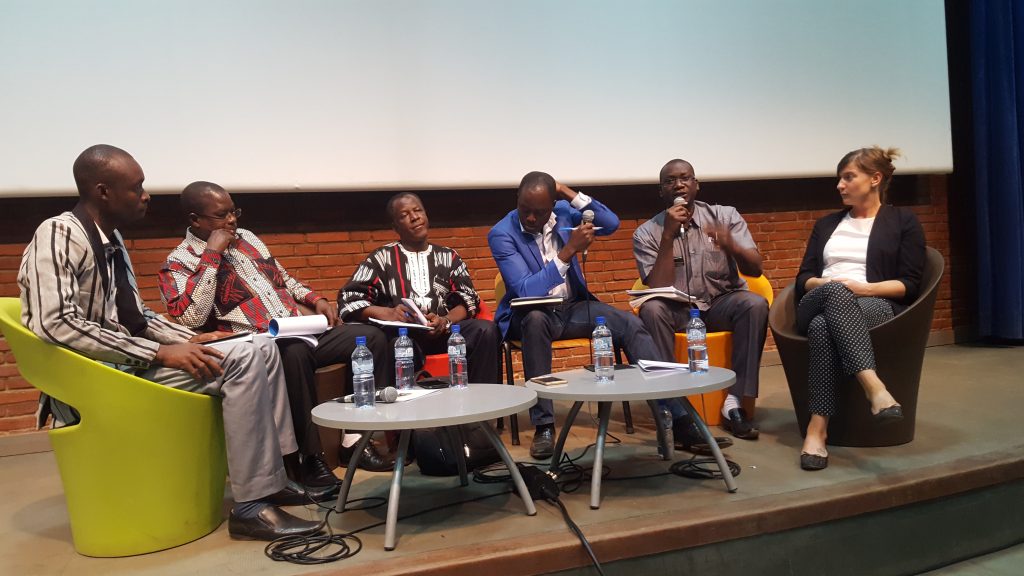
Every month, the French Institute in Ouagadougou hosts "Le maquis des sciences," a renowned scientific event organized by the IRD. During a panel discussion open to the general public, Equipop brought together several specialists to discuss the topic:"Is task delegation in Burkina Faso the solution for providing family planning services?"
- Dr. M. Bougma, Head of the PF Division Office at the Department of Health and Family Affairs,
- Mr. A. SAWADOGO, Monitoring and Evaluation Coordinator at Marie Stopes International,
- Mr. I. SORE, ABBEF Task Delegation Coordinator,
- Ms. E. BLIN, Head of Capitalization at Equipop,
- Mr. G. GUIELLA, researcher at the Higher Institute of Population Sciences, joined this panel.
Together, the speakers presented the mid-term results of this experiment in two health districts in Burkina Faso.
Agents trained to provide better counseling, more tailored to needs and concerns
After 10 months of study, Equipop observed that the capacities of frontline workers (APL*) and community-based health workers (ASBC) were strengthened through initial training and continuing education via supervision and workshops analyzing professional practices using the Equipop capitalization system. This enables them to offer medium- and long-acting methods to clients and, above all, to stimulate demand for FP products. Thanks to the provision of FP services directly in the homes of CHWs, geographical barriers are also being removed. According to Elissa Blin, capitalization manager at Equipop, "this result can be explained by the fact that APLs and ASBCs are close to the communities and have the ability to find solutions to overcome barriers, in particular by dispelling doubts about rumors heard here and there about FP." For example, many husbands believe that family planning methods encourage women to be unfaithful. ASBCs and APLs, particularly men, are able to find the words to convince husbands that the link between family planning and infidelity is not possible, explaining, for example, that infidelity has always existed.
As a result, APLs and ASBCs are able to provide accurate counseling tailored to all types of informational needs of clients. For example, many women are afraid of the side effects of the methods. When agents notice that a woman is concerned about this, they will be careful not to use words that could further frighten the client—they will not talk about disadvantages, but rather about changes.
Operational and contextual barriers remain to be overcome
This experiment in offering family planning services also faces numerous barriers. From an operational standpoint, the main problem is the mobility of public officials between different districts, which means that some health centers find themselves without staff qualified to offer long-acting methods.
From a contextual perspective, it is primarily resistance from husbands and traditional and religious leaders that constitutes a barrier to the provision of FP services. Many women still come in secret, and it is important to note the perseverance of agents in providing services when they may be exposed to reprisals within their communities.
In light of these results, the public has shown considerable interest in the operational aspects of implementation. The fundamentals of the experiment are not being called into question, and experimentation is being encouraged. The results are there to prove it.
* APLs are made up of certified nurses (IB), assistant midwives (AA), and traveling health workers (AIS).