Training courses committed to greater equality
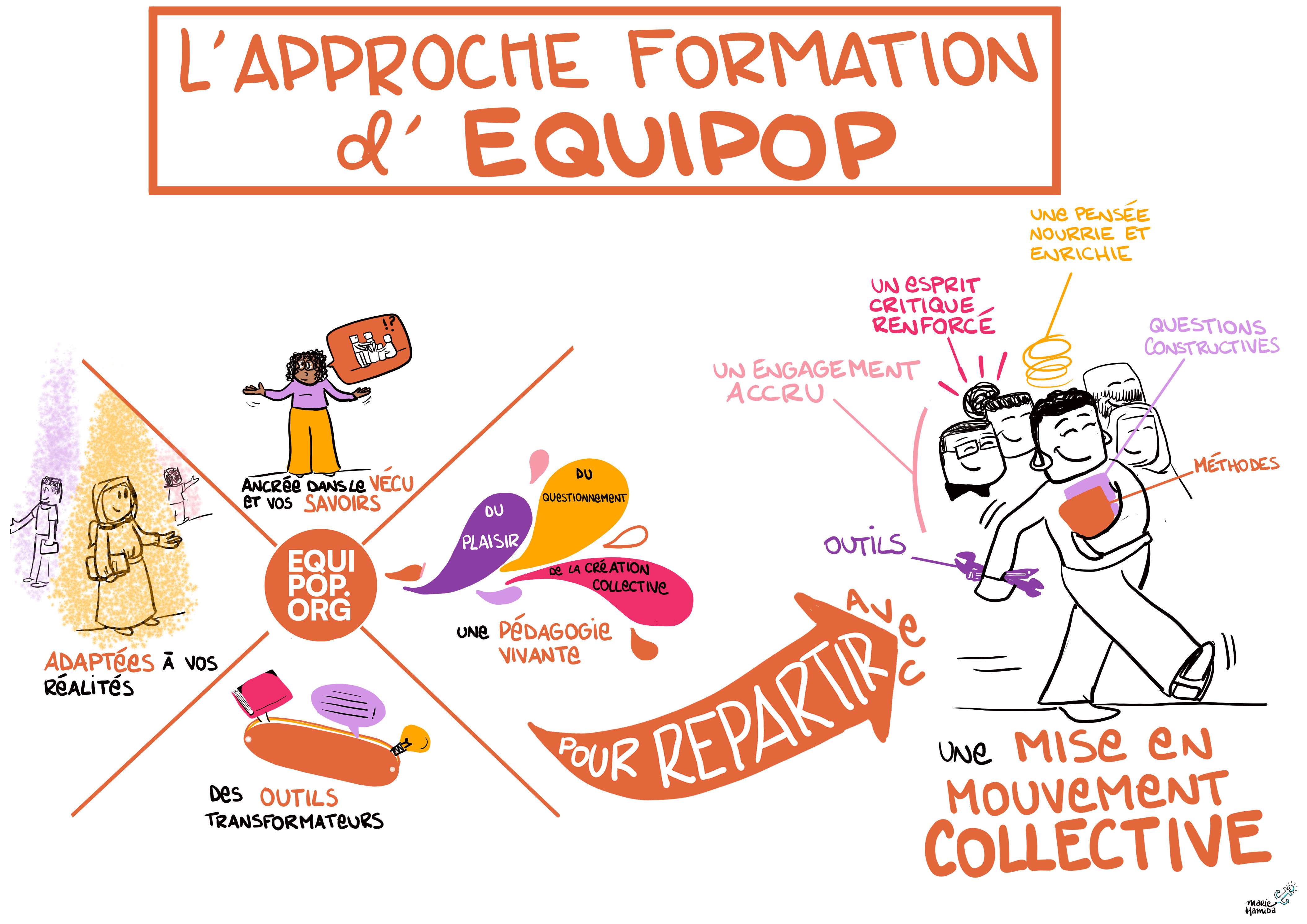
At Equipop, we consider training to be an essential lever for strengthening skills and encouraging positive collective dynamics. Inspired by the principles of popular education, our training courses support professionals and organizations in their reflection and action towards greater equality.
Our approach is based on three fundamental principles:
- Participatory teaching : We encourage the exchange of knowledge and the co-construction of knowledge by actively involving participants in the learning process.
- Valuing experiences and backgrounds : Our training courses take into account the real-life experiences and expertise of participants for a more practical approach that is tailored to current issues.
- A framework for reflection and action : Our training courses invite participants to question their practices and explore avenues for development, both individually and collectively, without imposing any prescriptions.
Our trainers, who come from a variety of backgrounds, continuously reflect on their practices in order to continually adapt to the context and needs.
Our training catalog
Would you like to learn more about our training offerings?
Our training organization is Qualiopi certified – Training activities.
Download our catalog!
Educational approaches that resonate with our feminist principles of action
Equipop's educational approaches are based on a few fundamental feminist principles: they are political, contextualized, and designed to contribute to collective dynamics of transformation, while taking care of individuals.
Our teaching approaches:
Providing tools without prescribing solutions: our training courses are based on the practices and questions of the participants. It is not a question of delivering solutions, but of creating the conditions for collective progress by supporting empowerment—that is, awareness of one's power to act.
Creating the conditions for collective analysis : our training courses facilitate the co-construction of meaning and the sharing of experiences. They promote the production of knowledge rooted in real-world experience.
Working with, not for : participants are recognized as full stakeholders. This stance reflects our desire to question power relations and avoid any form of domination in the educational relationship, as in our partnerships.
Mobilize participatory methods : tools derived from popular education (surveying, photo language, chosen non-mixity, etc.) encourage people to speak up, take a step back and think differently, broaden their perspectives, and strengthen their autonomy of analysis and action. They enable the concrete deployment of an intersectional approach by creating spaces for listening to plural identities.
Anchoring ourselves in the practices of trained individuals : by combining field experience with experiential and more theoretical knowledge, we construct situated analyses. This promotes the institutionalization of feminist values in contexts that are sometimes not conducive to their expression.
Working collectively : we connect committed actors who, together, can make their voices heard. This reflects our desire to support movements for equality and build alliances in our various areas of intervention.
Cultivating continuous self-reflection : we constantly question our practices to ensure that our feminist values are reflected in our teaching approaches and in all our actions.
Training tailored to your needs
Our training programs are aimed at civil society actors, development professionals, public and private institutions, as well as students and journalists.
We offer modules on a variety of topics, such as:
Inclusive communication: understanding the issues and acquiring tools for effective advocacy.
Preventing and combating gender-based violence: identifying and responding to situations of violence.
Integrating gender considerations into projects: adopting cross-cutting approaches tailored to professional contexts.
Leadership and empowerment: developing individual and collective skills for shared power.
Fair partnerships : supporting collective thinking and building of partnerships
Contact us
Would you like to organize a customized training course tailored to your specific needs?
Let's work together to build an offer tailored to your needs!
They have placed their trust in us
Sophie Derudder
, Deputy Director of the AFD Group Campus
"The workshop clarified concepts and gave meaning to words. It helped participants understand that feminist struggles are both localized and global (...) It strengthened team cohesion and showed how feminist approaches can be translated into concrete strategies. Regardless of their initial level of awareness, everyone leaves with the tools they need to question, understand, and take action."
Tidiane Sadio
Community Manager, Sédhiou, Senegal
“These sessions enabled me to acquire valuable skills for evaluating the progress made in projects and better co-construct future ones. The facilitation methodology helped me understand the different aspects covered, particularly the concept of collective intelligence, with techniques and practical scenarios. I also enjoyed sharing experiences based on our own lives, and I plan to adapt these tools when facilitating future sessions in my community. Thank you also to the whole team for taking such good care of the group!”
Mediation Officer, Research and Development Institute (IRD), France
"I feel that we have succeeded in coming up with solutions to be tested in the short, medium, and long term within our organization. I also understand that small actions can be taken right now, without waiting for global change. (...) I'm leaving with positive energy and the desire for everyone to take this training. (...) The facilitator listens empathetically, puts herself in everyone's shoes, and never judges."
Project Manager, Yvelines Cooperation, France
“The training was an enriching experience for both the team and our partners. The trainers are dynamic and attentive, and their backgrounds and experiences are very motivating! The facilitation techniques were well chosen (wheel of privilege, photo language, videos that lead to discussion, and World Café) and helped to lay a solid foundation by including gender in our international solidarity projects. I found it extremely relevant to discuss vocabulary such as ableism and intersectionality and to cite all their sources! Overall, my experience was entirely positive."