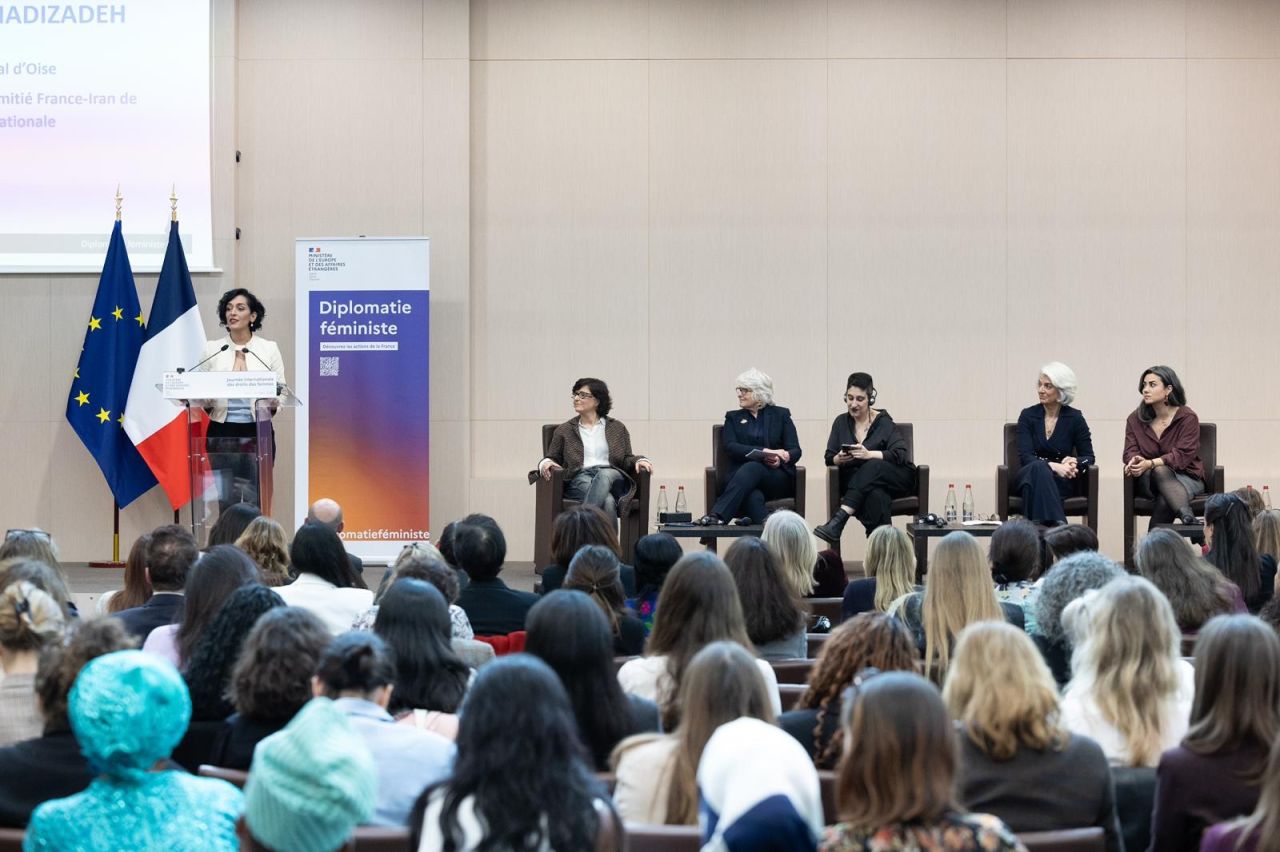
Equipop has been involved in the development and monitoring of French feminist diplomacy for several years. In particular, in October 2025, we published a position paper presenting analyses and recommendations on this topic. On March 6, 2026, Equipop attended the event organized by the Ministry for Europe and Foreign Affairs to mark International Women’s Day.
With just two days to go before March 8, this meeting aimed to highlight France’s commitments to feminist diplomacy, in an international context marked by escalating conflicts, the rise of reactionary movements, and coordinated attacks on women’s rights and gender equality.
This article reviews some of the lessons Equipop has drawn from this meeting. As setbacks multiply and the backlash intensifies, feminist diplomacy appears more necessary than ever. It constitutes a diplomacy of resistance that must be translated into concrete action within international partnerships, embassies, consulates, and multilateral forums. Yet, a gap persists between stated political ambitions and budgetary realities.
A Renewed Commitment to Feminist Diplomacy
Since 2019, feminist diplomacy has officially been a guiding principle of France’s foreign policy. It was formalized with the adoption of the International Strategy for Feminist Diplomacy (2025–2030), which outlines its priorities and implementation tools. This commitment was also reaffirmed at the 4th Ministerial Conference on Feminist Diplomacy in Paris in October 2025, which resulted in a political declaration endorsed by 31 states, before France passed the torch to Spain for the 5th Conference in Madrid in June 2026.
On March 6, this commitment was underscored by remarks from prominent figures. In his opening address, Jean-Noël Barrot, Minister for Europe and Foreign Affairs, emphasized that, in an international context marked by multiple conflicts and tensions—particularly in the Middle East—women’s participation in peace and negotiation processes remains essential to reaching lasting agreements. Giving women their place at the negotiating table is not just a matter of equality: it is also a prerequisite for building more robust and inclusive peace processes. Éléonore Caroit, Minister Delegate for the Francophonie, International Partnerships, and French Citizens Abroad, also noted that feminist diplomacy serves as a bulwark against the reactionary tide threatening women’s rights in many parts of the world.
Several priorities were highlighted:
– Supporting access to justice for survivors of sexual and gender-based violence;
– Combating cyberviolence and online harassment;
– Strengthening women’s participation in peace processes as part of the Women, Peace, and Security agenda;
– Support for human rights defenders in repressive environments.
One of the highlights of the day was the presentation of the Simone Veil Award to the Marta Center in Latvia, in recognition of its work supporting survivors of violence and ensuring their access to justice. Several panel discussions also shed light on current challenges.
A discussion focused onaccess to justice—the priority theme of the UN Commission on the Status of Women this year, in which Equipop and the Francophone Feminist Alliance participated—( Attorney Anne-Sophie Laguens; Dr. Patricia Gonzalez Rodriguez; Ms. Meganne Boho; Dr. Silvia Semenzin) highlighted the importance of legal support services and legal clinics for survivors of violence, particularly in crisis contexts. Another roundtable focused on the situation of women in Afghanistan, where the speakers (Ms. Françoise Puig-Inza; Ms. Fereshta Abbasi; Dr. Muzhda Halem Rahime; Ms. Mursal Sayas) denounced the erosion of women’s rights under the Taliban regime and emphasized the need to maintain international support for human rights defenders.
A panel discussion onIran alsopaid tribute to women standing up against the regime’s repression, in the wake of the “Woman, Life, Freedom” movement, which gained momentum following the death of Mahsa Amini. The panelists—Ms. Sepideh Farsi, Ms. Ayda Hadizadeh, Ms. Sorour Kasmaï, Ms. Asal Abasian, and Ms. Aida Tavakol—highlighted a fundamental truth: when women’s voices are silenced, democracy and human rights are undermined. At their core, these initiatives address urgent needs: protection, justice, digital security, and political participation.
Several new initiatives were also announced for 2026: the launch by Jean-Noël Barrot of the national action plan “Women, Peace, and Security” (2026–2030), with the full text of the document yet to be published; the development of a network of French-speaking women mediators in peace processes, and the continuation of projects aimed at combating digital violence. The minister also announced the creation of a “Peace Factory ” within the G7 framework, designed to support innovative initiatives in mediation and conflict prevention by further integrating gender perspectives into peace processes.
As part of the Support Fund for Feminist Organizations (FSOF), two international projects totaling 10 million euros were recently launched to support survivors’ access to justice and civil society advocacy for sexual and reproductive rights. A new pilot project, “Digital Dignity,” will also support 50 African feminist organizations working on digital violence. As part of the Laboratory for Women’s Rights Online, five projects aimed at supporting innovative solutions to combat digital violence and strengthen the safety of women and activists online will also be launched.
Initiatives severely hampered by an alarming budgetary situation
In France, the budget for official development assistance—on which many international solidarity organizations depend—has been cut by nearly 60% over the past two years. Yet these funds finance a large portion of the programs run by feminist organizations that partner with the French government. According to a survey by the Mouvement associatif published in October 2025, one-third of nonprofit organizations have less than three months of cash reserves, 50% have lost public grants, and 90,000 nonprofit jobs are at risk. These cuts come amid an already challenging budgetary context for associations, as over the past 20 years, the share of public subsidies in their budgets has fallen by 41%, without other funding sources to compensate for this. The women’s rights and gender equality sector is particularly affected. A study by the Women’s Foundation reports that in 2025, 71% of French feminist organizations report a financial situation worse than in 2024, with an average 15% drop in grants in 2025. Organizations are forced to close their drop-in centers, inadvertently depriving women of essential health services.
Internationally, the situation is equally concerning: less than 1% of humanitarian funding is allocated to combating gender-based violence. According to a UN Women report, this share has remained extremely low over the years, despite the steadily increasing needs in crisis and conflict settings. Women’s rights organizations, which are essential for protecting and supporting survivors, are thus seeing their resources gradually dwindle, which undermines their ability to intervene effectively and provide sustainable support on the ground.
The key challenge for the coming months is therefore clear: while many initiatives are being promoted, the funding needed to implement them remains insufficient.
The Support Fund for Feminist Organizations (FSOF), praised for its irreplaceable role in supporting civil society organizations, is an important tool. Similarly, initiatives promoting access to justice, legal clinics, and programs in partnership with the Ministry of Foreign Affairs demonstrate a concrete commitment. The recent parliamentary report by the National Assembly: Sustainably Strengthening Feminist Diplomacy in the Context of a Global Backlash thus calls for “providing the means for a strong, ambitious, and long-term feminist diplomacy.”
Building the capacity for a strong, ambitious, and long-term feminist diplomacy
The event on March 6 highlighted a striking contrast: on the one hand, political and institutional contexts where women’s rights and gender equality are being undermined by conservative or theocratic forces—such as in Iran or Afghanistan—which are curtailing women’s access to justice, political participation, and fundamental freedoms; on the other, women courageously mobilizing to defend human rights, equality, justice, and peace.
The Women, Peace, and Security agenda emphasizes, in particular, that women’s participation in peace processes enhances the sustainability of agreements and strengthens justice. But feminist diplomacy is not limited to this agenda: it aims more broadly to integrate gender equality into all international policies. For these principles to become a reality, they must translate into concrete responsibilities, strong political support, and secure funding. In a context of protracted wars, escalating tensions, and the rise of masculinist and virilist rhetoric, feminist diplomacy cannot be merely a label: it must be a conscious political choice.