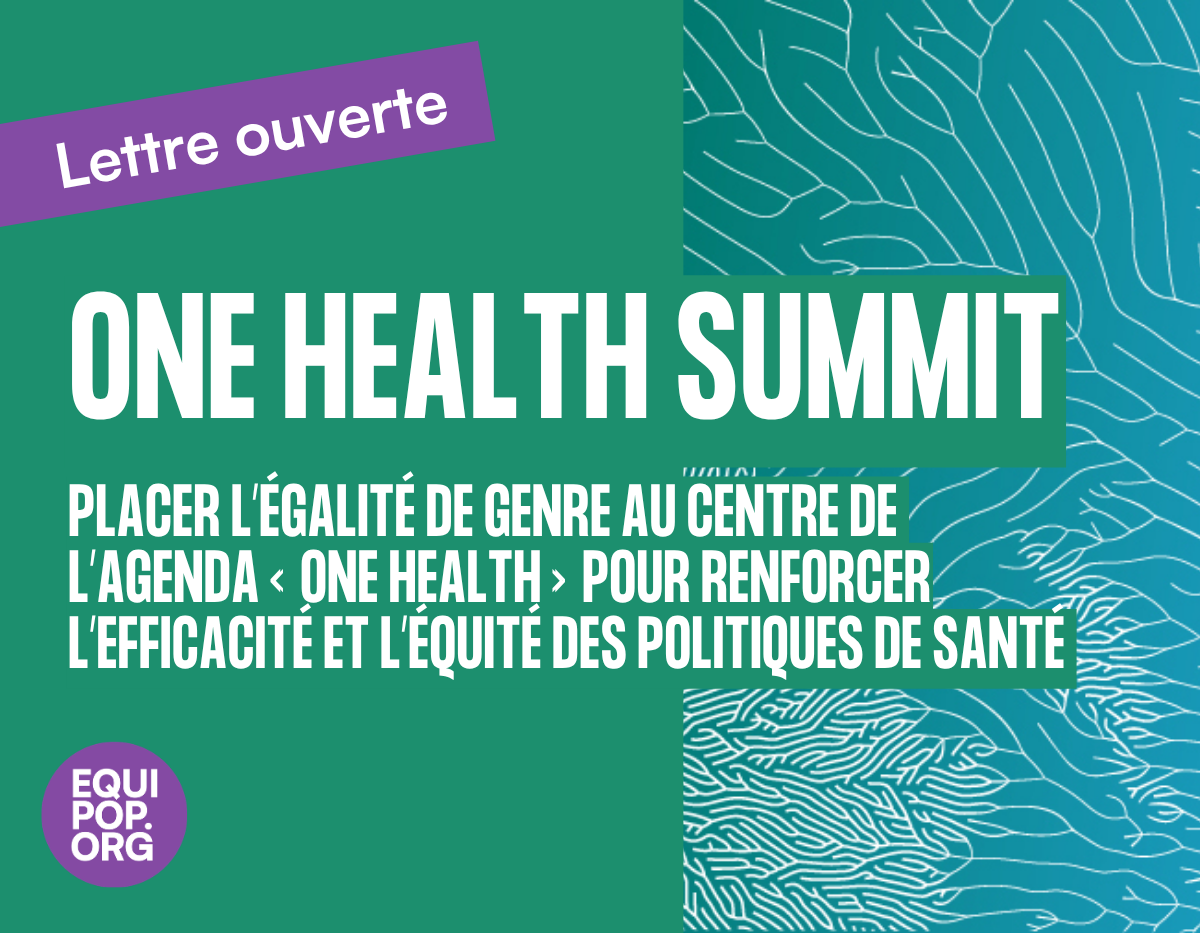
Open Letter to Public Authorities, Academic Institutions, and Stakeholders Involved in the “One Health” Approach, Ahead of the One Health Summit in Lyon (April 5–7, 2026)
In recent years, the “One Health” approach has emerged as an essential framework for addressing global health challenges. By recognizing the interdependence between human, animal, and environmental health, it has helped move beyond long-standing siloed approaches and strengthen interdisciplinary collaboration.
These advances are significant. However, they remain incomplete.
Recent crises—pandemics, climate change, ecosystem degradation, and food insecurity—have starkly reminded us that health is not solely a biological issue. Health is profoundly shaped by the social, economic, and environmental conditions in which people live.
These conditions are marked by structural inequalities, particularly gender inequalities, which influence vulnerability to risks, access to resources, and the capacity to respond.
This reality has been clearly recognized by the international community. The resolution on universal health coverage adopted by the United Nations General Assembly in 2023, for example, emphasizes the importance of social determinants and calls for “mainstream[ing] a gender perspective on systems-wide basis when designing, implementing and monitoring of health policies, taking into account the human rights and specific needs of all women and girls […], and ensuring women’s effective participation and leadership in health policies and health systems delivery.”
However, these aspects are still too often overlooked in the “One Health” approach which continues to prioritize technical solutions focused on disease management. This is now a major limitation.
The lack of gender sensitivity is consistently evident in the most basic aspects of responses to health crises. There is a striking disparity between the overrepresentation of women on the front lines of crises and their underrepresentation in decision-making forums and public discourse – as seen during the COVID-19 crisis. The 2023 United Nations General Assembly resolution on pandemic prevention, preparedness and response highlights the 25 per cent pay gap between women and men, as well as the double burden faced by female healthcare workers who perform the majority of caregiving and domestic work without pay.
A study by Women in Global Health found that COVID-19 protective equipment, including masks, had been designed based on a default “standard” male body type, making them ill-fitting for a large proportion of female healthcare workers.
Treatment dosages are calculated based overwhelmingly on male subjects' physiology while women’s health is generally viewed as an exception to the "rule."
Furthermore, health issues are shaped by life trajectories marked by varying levels of exposure, particularly in terms of the environment, nutrition, and sexual and reproductive health. Social and environmental inequalities take root in the body and mind with lasting effects.
In practical terms, inequalities in exposure, recognition, and power therefore endanger women’s health and significantly undermine the effectiveness of public health responses for society as a whole.
Extending the “One Health” approach to these social realities is not a peripheral addition: it is an essential prerequisite for ensuring its continued relevance. To take this approach to the next level, we therefore call for:
– Placement of gender equality at the center of the design and implementation of “One Health” policies, rather than on the periphery;
– Development of truly interdisciplinary approaches by fully integrating the social sciences and knowledge derived from local communities and brought by frontline actors;
– Involvement of affected populations from the very outset of the design of health policies and programs to better address their realities, and more broadly, to systematize the so-called “health democracy” approach;
– Recognition and concretely support of the role healthcare providers by strengthening their position within decision-making structures and fora;
– Strengthening of the expertise of “One Health” actors regarding the social determinants of health and the dynamics of inequality.
The aim is to strengthen an existing framework to maximize its impact, in support of more effective, equitable and sustainable health policies.
These approaches must be promoted by all those invited to Lyon, including heads of state and government from around the world, along with representatives of relevant international and regional organizations, parliaments, the scientific community, the private sector, civil society, local authorities, development banks, and youth.
They are also fully in line with the commitments made by the Summit’s host, France, regarding feminist diplomacy, global health and sexual and reproductive health and rights. Finally, they naturally align with all the objectives set for this Lyon Summit: “foster international and interdisciplinary dialogue,” “reshaping global institutional frameworks,” “engaging all public and private stakeholders ready to commit to implementing concrete actions,” and “developing solutions to strengthen health and surveillance systems.”
The organizations and individuals who have signed this open letter stand ready to contribute to this effort in consultation with all stakeholders.