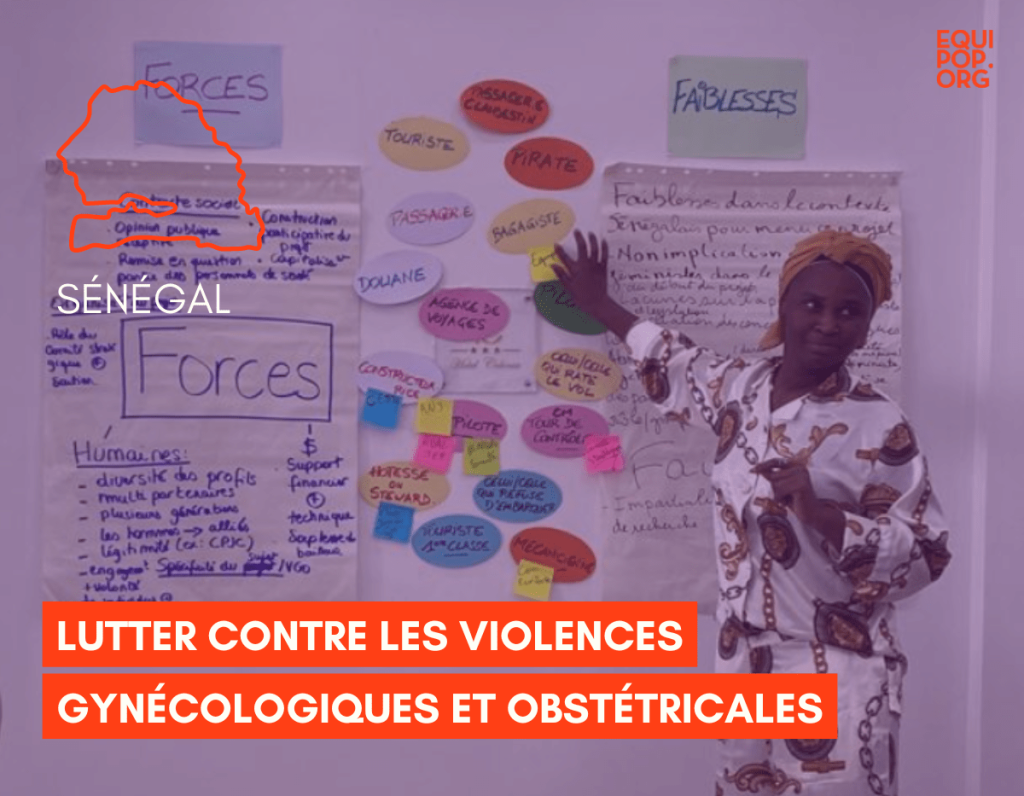
Gender-based violence (GBV) refers to specific forms of gender-based and sexual violence that exist everywhere but have only recently been recognized. Focus on the program "Our bodies, our health: a project to combat GBV in Senegal" implemented by a consortium of several Senegalese associations in partnership with Equipop.
VGOs are specific forms of gender-based and sexual violence that exist everywhere but have only recently been recognized, following demands from women (for example, the Plus jamais ça ! collective in Senegal and the #PayeTonUtérus movement in France).
They cover a variety of manifestations: malicious care (insults, threats, abrupt gestures) or non-consensual care, moralizing or even discriminatory attitudes towards women, especially young girls, sexist surgical procedures such as the "husband stitch" (a medical procedure involving unnecessary sutures following an episiotomy to reduce the size of the vaginal opening and increase male pleasure), sexual assault or rape by healthcare personnel, etc. These manifestations are a result of the power and control that social systems, institutions, and individuals exert over women's bodies.
The program "Our bodies, our health: a project to combat VGO in Senegal," implemented by a consortium of several Senegalese associations in partnership with Equipop, will address this issue by encouraging women to speak out (in single-sex discussion groups) and raising awareness of the realities they experience. A national quantitative and qualitative study conducted by a Senegalese research laboratory specializing in gender will quantify the extent of the phenomenon and report on how structural and symbolic violence shapes experiences of GBV.
A writing committee has also been created to update the book Our Bodies, Our Health: The Sexuality of Women in Sub-Saharan Africa. This new edition draws on the experiences of women in all their diversity and will be a source of knowledge on the body, the functioning of the genital organs, sexual and reproductive rights, and gender-based violence (including GBV), from an emancipatory and feminist perspective. Healthcare personnel will be closely involved and supported through training and encouragement to provide respectful care.
Also on VGOs: The Feminism and Health meeting with Laura Berlingo, feminist gynecologist Gender-based violence: a guide to understanding and taking action
• Partners: ENDA Santé, ROAJELFF, ANJ-SR/PF, GESTES, Collectif Plus jamais ça !
• Allies: members of the strategic committee – 12 women sociologists, gynecologists-obstetricians, midwives, doctors, teacher-researchers, feminist activists, gender experts, psychologists.
• Project co-financed by AFD (French Development Agency) – NGO Sector Innovation Facility (FISONG) against GBV launched in 2020.