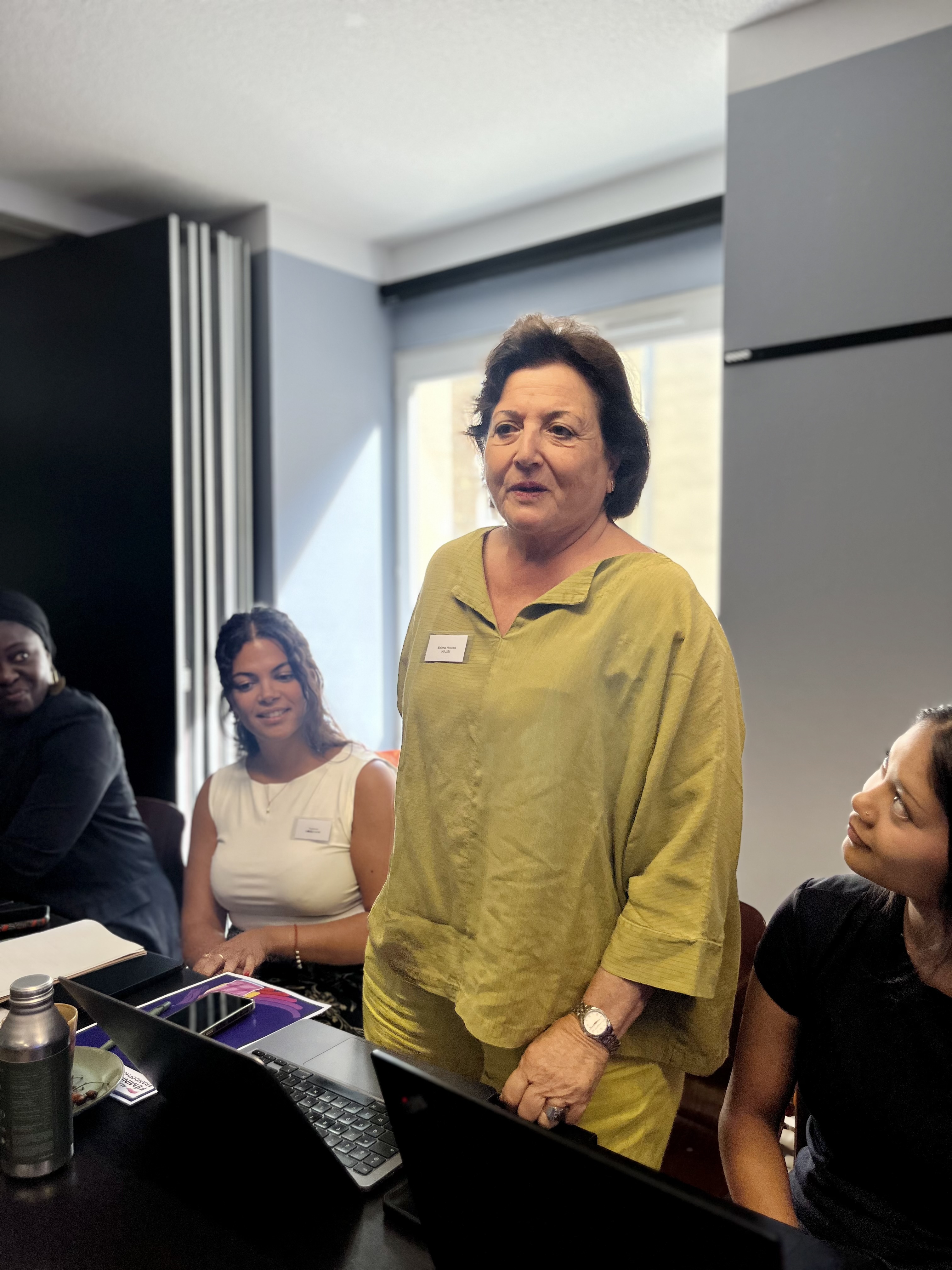
An Interview with Dr. Selma Hajri
A physician specializing in reproductive endocrinology, Selma Hajri has been an advocate for sexual and reproductive rights for more than twenty-five years. Her career—spanning clinical practice, research, and activism—has taken her from helping introduce medical abortion in Tunisia to coordinating a regional network for access to safe abortion in the Mediterranean. A feminist since her college years, she reflects on the milestones that have shaped her activism, the progress that has been made, and the resistance that persists.
Becoming an activist.
I was already a feminist in my own mind long before I became an activist. My feminism was shaped by my upbringing, my reading, and my years of study. When I was a medical student, I was already interested in rights activism in general and women’s rights in particular. But medical school was extremely demanding and left me little time to get actively involved.
"I was already a feminist in my own mind"
The real turning point came when I started working in family planning. That’s when I gained a much closer understanding of the realities faced by women seeking access to reproductive health services.
In Tunisia, abortion has been legal since 1973. On paper, one might therefore think the issue has been settled. But in practice, I discovered a very different reality: the stigma, judgment, and moralizing attitudes that young, unmarried women in particular face.
I’ve experienced this myself. When I had an abortion, a fellow gynecologist—who was considered a very liberal woman—shifted the blame for my situation onto me. I was told, “You’re an adult; you’re responsible for your actions.”
That statement deeply shocked me. To me, it revealed a form of judgment that can still accompany access to abortion, even when it is legal.
That experience helped turn me into an activist.
From Research to the Introduction of Medical Abortion
I started out in research. Gradually, my work shifted toward sexual and reproductive health, and then toward medical abortion, just as this method was beginning to gain traction in Europe.
When I tried to introduce it in Tunisia, some organizations refused to support the project on the grounds that Tunisia was a Muslim country. To me, that argument didn’t hold water. I didn’t see why being in a Muslim country should prevent access to a safe and medically recognized method of abortion.
A few years later, I was able to resume the project thanks to support from an American organization; we launched research studies aimed at introducing medical abortion in Tunisia. At the time, this effort relied largely on my personal initiative and on a professional network I had built up over the years.
The first study was a major success and was published in *The Lancet*. This recognition opened up new possibilities. We therefore continued our research until we obtained authorization to officially introduce medical abortion in the country.
In 2001, the method was introduced in Tunisia, first in a few pilot centers, then gradually in all family planning centers. In 2008, it became the primary method used in these facilities.
This experience showed me that tangible changes in practices were possible when we managed to bring together research, activism, and institutions.
Advocating for the Recognition of Sexual and Reproductive Rights
In 2012, along with several colleagues and activists, I founded the Groupe Tawhida Ben Cheikh association. We chose the name of Tunisia’s first female doctor, who was also a key figure in the establishment of family planning in Tunisia.
Our goal was clear: to provide training and raise awareness about sexual and reproductive rights and health.
But I quickly realized that the struggle wasn’t limited to institutions. We also had to convince part of the Tunisian feminist movement of the importance of these issues.
At that time, sexual and reproductive rights were sometimes viewed as a prerogative of the Tunisian state rather than as a genuine feminist issue. It took time for access to abortion to regain a more prominent place among feminist demands.
It took nearly a decade for this issue to regain its full significance, particularly because, despite the legality of abortion, women continued to face numerous obstacles in actually accessing it.
Going Beyond Tunisia's Borders
Over time, I came to realize that a struggle limited to Tunisia wasn't enough. In many countries in the region, the opportunities to openly advocate for abortion rights are much more limited.
Together with friends and researchers committed to the right to abortion, I therefore began working to create a regional network bringing together activists from several countries in the Middle East and North Africa: Morocco, Algeria, Egypt, Lebanon, Iraq, Turkey, and Tunisia, among others.
At first, the network operated primarily online, especially during the COVID-19 pandemic. But we quickly ran into financial and administrative difficulties. Moving funds between different countries was complicated, and that made it difficult to build a truly regional organization.
In 2023, a new network was launched: MARA-MED, which stands for Movement for Access and Rights to Abortion. The network was established in Europe to facilitate its financial operations, but we have also expanded our scope.
It was no longer just about defending the right to abortion. We wanted to place the issue of women’s bodily autonomy at the heart of our advocacy.
This more international perspective seems essential to me. The challenges we face in the Arab world are echoed elsewhere: conscientious objection in Italy, the erosion of rights in certain European countries, criminalization in Malta, and the rise of conservatism in several regions.
Control over women's bodies knows no borders.
A battle against conservatism and misinformation
After several decades of activism, I refuse to portray this history as a continuous progression. Progress goes hand in hand with setbacks.
The surveys we conducted among young people in Tunisia revealed, in particular, a level of conservatism that surprised me, even among young women.
Even more concerning: although abortion has been legal in the country for more than fifty years, a significant proportion of the young people surveyed were either unaware of this or opposed to it.
When it comes to social media, one might have thought that it would make it easier to access information. But it also allows for the widespread circulation of misinformation and disinformation.
Yet I do see something that gives me hope. Some younger generations are more open and outspoken when it comes to discussing the body and sexuality. Young women, in particular, sometimes seem to me to be braver than previous generations when it comes to challenging the norms imposed on them.
A new generation to carry on the fight
Today, I would say that I’ve “reached the end of my journey, so to speak.” I left the Tunisian nonprofit I had founded when I felt that a new generation was strong enough to take over.
However, I continue to be actively involved in the regional network.
What gives me confidence are precisely these young activists, who are coming of age with more resources, skills, and tools than previous generations. Change will take time, but the key is that organizations exist to enable this new generation to get involved.
When I look back on my journey—from medicine to research, and then from activism in Tunisia to building a regional network—I ultimately see it all as part of the same struggle: the struggle for women’s autonomy over their own bodies.
This struggle cannot be confined to a single region or religion. While the contexts differ, the mechanisms of control, stigmatization, and restriction of access to rights are found everywhere.
That is precisely why this struggle, too, must be global.
"The fight for women's rights is a global struggle"