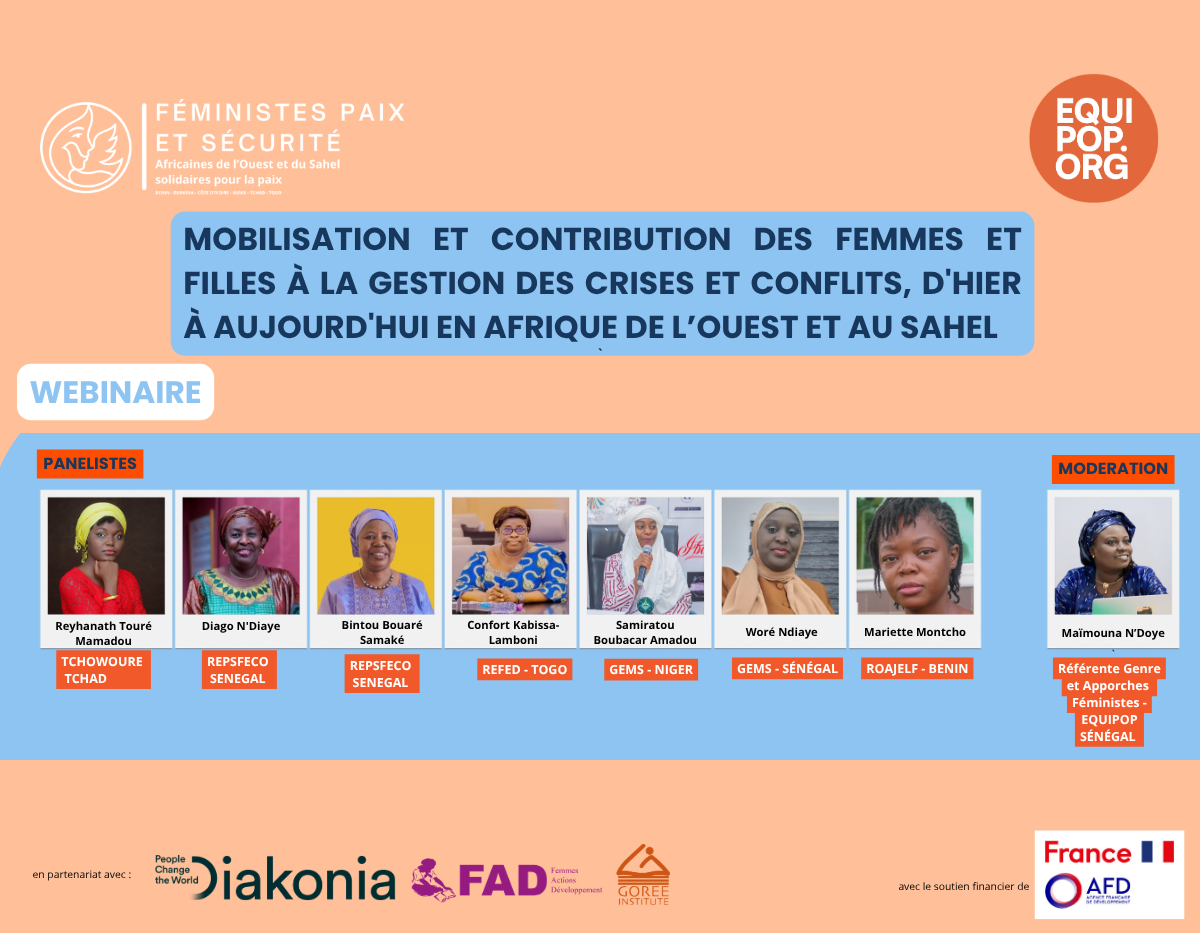
To mark the International Day for the Elimination of Sexual Violence in Conflict, Equipop organized a webinar on June 19, 2026, titled “The Mobilization and Contribution of Women and Girls to Crisis and Conflict Management, from the Past to the Present, in West Africa and the Sahel,” as part of the project “Toward Feminist Agendas for Peace and Security—Women of West Africa and the Sahel United for Peace.”
Two weeks after this event, what can we take away from it? Beyond the rich discussions, this webinar highlighted several key lessons for advancing the Women, Peace, and Security agenda in West Africa and the Sahel. Here’s a look back at the main messages, the challenges raised, and the courses of action identified collectively.
By bringing together pioneers of the feminist movements, activists from the middle generations, and young activists from West Africa and the Sahel, this gathering fostered intergenerational dialogue around a common goal: to highlight inspiring experiences, analyze current challenges, and identify levers for sustainable change in support of a lasting, inclusive peace grounded in the rights of women and girls in the region.
Ms. Maïmouna N’DOYE, Gender and Feminist Approaches Coordinator at Equipop, skillfully facilitated the discussion, fostering a rich dialogue among the panelists: Ms. Bintou SAMAKE, Chair of the Board of Directors of WILDAF AO and member of the National Human Rights Commission (Mali), Ms. Diago N’DIAYE, President of REPSFECO (Senegal), Ms. Confort KABISSA-LAMBONI, Coordinator of REFED and member of the Togolese Senate (Togo), Ms. Woré N’DIAYE, expert in Conflict Transformation and Development (Senegal), Dr. Samiratou BOUBACAR AMADOU, co-founder and Executive Director of the NGO GEMS (Niger), Ms. Mariette MONTCHO, Executive Director of ROAJELF (Benin), and Ms. Réyhanath TOURE AMADOU, Executive Director of Tchowoure Women Empowerment (Togo).
Women Have Always Been at the Heart of Peacebuilding
The discussions highlighted a reality that has long been overlooked— : women are not merely the primary victims of conflicts and crises. They play an indispensable role in preventing violence, maintaining dialogue within communities, supporting survivors, and rebuilding family and social structures.
This perspective resonated strongly during the interactive discussions. For the participants, peace is first and foremost synonymous with social cohesion, justice, solidarity, freedom, dialogue, and shared well-being—going far beyond the mere absence of conflict.
Legacies of struggles that continue to drive change
Through the panelists’ testimonies, webinar participants gained an understanding of the major mobilizations that have shaped feminist movements in the region.
In Mali, the struggles waged by women’s organizations to secure their inclusion in peace processes illustrate the power of collective advocacy and perseverance. Despite widespread resistance, women have succeeded in making their voices heard in spaces where they were neither heard, nor expected, nor welcome. One example of this is their participation in the Ouagadougou Preliminary Agreements, even though they had not been invited.
In Senegal, the experience of the Yewwu Yewwi network has shown how women’s ability to rise above slanderous or defamatory remarks and continue to advocate for causes they believe in has helped influence public policy and achieve significant legislative progress. Meanwhile, capacity-building for women—including in rural areas—in Togo is an example of women-led efforts to influence the social and political environment.
A common theme emerged from these testimonies: each generation makes an essential contribution to peacebuilding and the defense of women’s rights. Younger generations are not starting the struggle; they are continuing and renewing a long-standing commitment carried forward by their elders, while bringing their own strategies and perspectives to the effort.
As one of the speakers pointed out, “Our generation did not invent women’s activism; we build on the struggles and achievements of those who came before us to continue the fight against today’s challenges.”
Significant progress, but achievements still under threat
The discussions also highlighted the obstacles to the full and meaningful participation of women and girls in peace and security processes.
In Niger, conflict and insecurity continue to expose women and girls to multiple forms of violence: forced displacement, early marriage, sexual violence, and difficulties in accessing their rights and protection mechanisms.
The participants highlighted the persistent gap between international commitments, national laws, and their actual implementation on the ground. The limited dissemination of these laws—which are rarely available in local languages—continues to hinder their adoption by those most affected.
Women remain significantly underrepresented in formal peace processes. Patriarchal norms, gender stereotypes, and processes that continue to focus on armed and institutional actors limit recognition of their contributions—which are nonetheless essential to mediation, conflict prevention, and social cohesion.
The lack of community buy-in for the Women, Peace, and Security agenda, as well as the underfunding of feminist organizations, were also noted.
Looking beyond national contexts, the participants warned of the rise of conservative movements and the gradual erosion of hard-won gains. Preserving women’s rights now appears just as essential as continuing to advance them.
Intergenerational Collaboration as a Strategy for Transformation
One of the key takeaways from the webinar is the importance of strengthening alliances across generations to advance feminist, peace, and security agendas in a sustainable manner and to gradually build peaceful, inclusive, and just societies.
The participants highlighted how the roles of different generations complement one another: the pioneers pass on institutional memory, the achievements, and the lessons learned from past struggles; the middle generations promote mentoring and networking and strengthen organizations; young feminists are revitalizing forms of engagement through digital tools and new spaces for advocacy, and they amplify the voices of groups that remain underrepresented in decision-making processes.
Far from pitting generations against one another, these approaches reinforce one another and constitute a vital force in addressing contemporary challenges.
Beyond the specific details, a strong message emerged: today’s challenges regarding peace, security, and women’s rights call for collective responses. Knowledge transfer, mentoring, trust, and mutual recognition emerged as essential drivers for ensuring the continuity of these struggles, preserving hard-won gains, and developing innovative responses to the current challenges of conflict prevention and peacebuilding.
The feedback gathered during the interactive discussions also reveals a broad consensus: women and young people become true agents of change when they participate in all stages of the decision-making process, when their voices are heard, when their opinions are taken into account, and when they have real influence.
Rethinking Peace Based on Real-Life Experiences
The interactive discussions confirmed this vision. Participants emphasized that lasting peace depends above all on inclusion, social justice, the participation of all, dialogue, and addressing the needs of the most vulnerable. Many emphasized that women and young people must not only be protected but also fully involved in decision-making, mediation, implementation, and monitoring of peace processes. This conviction was also expressed in a comment from the audience: “Every woman and young person, whether in urban or rural areas, has something to contribute, and their contributions should be valued.”
Panelists and participants are calling for greater recognition, documentation, and promotion of the knowledge developed by women in crisis situations so that it can better inform public policies and conflict prevention mechanisms. This expertise, which is still not sufficiently recognized, is an essential tool for building lasting peace.
Areas for Action in the Coming Months
The panelists are calling for the development of a joint regional advocacy strategy, the strengthening of intergenerational mentoring mechanisms, and better documentation of local initiatives led by women in order to facilitate their scaling up and inform public policy.
The discussions also highlight the need to strengthen synergies between the Women, Peace, and Security (WPS) and Youth, Peace, and Security (YPS) agendas, through a more coordinated and complementary approach. To this end, the creation of a permanent regional framework for dialogue among feminist organizations spanning different generations was proposed. This platform would enable the sharing of experiences, strengthen solidarity among countries, support the implementation of National Action Plans, and develop common strategies to address the challenges facing the region. This vision resonated with the participants, as evidenced by this comment: “ I’m participating from Chad, and I hope my country can be part of this alliance if it ever comes to fruition.” This comment illustrates the interest this initiative has generated beyond the countries directly involved and the expectations for more inclusive regional cooperation.
Finally, the participants emphasized the importance of strengthened regional cooperation so that the challenges faced in one country can be addressed through collective responses at the West African and Sahel regional levels. Combating conflict-related sexual violence, recognizing local peace initiatives led by women, and ensuring the sustainability of spaces for intergenerational dialogue are among the priorities identified for the coming years.
Building Solutions Today for Tomorrow’s Crises
Beyond the sharing of experiences, the webinar highlighted a strong conviction: peace is not built solely in the heat of a crisis. It is prepared, organized, and consolidated long before tensions become apparent, by strengthening alliances, mechanisms of solidarity, and the coordination of actions during periods of relative stability. This proactive approach makes it possible to respond more effectively when crises arise.
More than just a call to remember the past, this webinar conveyed a message for the future: passing on our heritage, strengthening bonds between generations, and taking collective action today are essential to building lasting peace in West Africa and the Sahel.