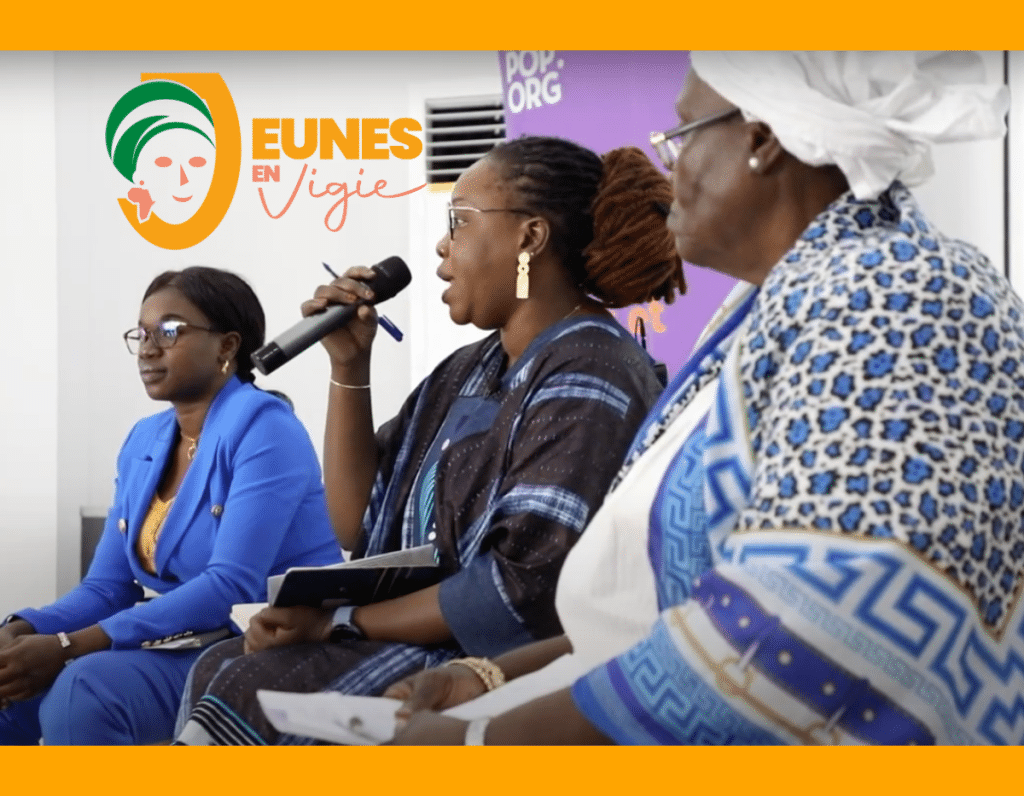
From December 5 to 7, 2023, the city of Dakar hosted the closing workshop of the Jeunes en Vigie project. On the sidelines of this workshop, a round table was organized on December 7 on the theme: "Health democracy and the meaningful and inclusive participation of young people for effective accountability in health."The event brought together several project stakeholders, as well as actors all committed to promoting the health and rights of young people, from Ouagadougou, Réo, Koupéla, Koudougou, and Tenkodogo (Burkina Faso) and Dakar, M'Bour, and Mattam (Senegal).
Democracy in health, as the speakers pointed out, concerns the way in which public health policies are discussed, designed, implemented, and evaluated by all stakeholders, including elected officials, health professionals, health service users, and citizens, particularly young people. It aims to improve access to health services, combat inequalities, and guarantee respect for fundamental rights. The round table was punctuated by two panel discussions.
The first panel discussed the fundamental principles of democracy in health care and the importance of incorporating a feminist and inclusive approach. The speakers (Annick Laurence Koussoubé from SOS JD, Project Manager for Jeunes en vigie, Ndeye Bineta MBOW, Director of the Sokhone departmental mutual insurance company, and Ms. Salamatou TRAORE, President of the DIMOL organization, involved in FONDEMSAN to improve SRH for young girls and girls with disabilities and in vulnerable situations in Niger) presented various experiments conducted in the sub-region.
This has highlighted the need to place young people at the heart of projects and decision-making processes, and to integrate feminist values into the actions implemented, particularly through kindness, sisterhood, empathy, power sharing, etc.
As a result, this panel provided an opportunity to highlight the link with mutual health insurance companies and the importance of involving stakeholders in the decisions made by these companies in order to ensure that everyone's specific needs are taken into account.
Laurence Annick Koussoubé, project manager at SOS/JD, explains: “Young people bring a fresh perspective. They contribute new insights that help improve health policy development. This means that young people's needs are better taken into account."
In the second panel, discussions focused on reinventing power in the field of health, highlighting the challenges of individual and collective empowerment, as well as the recognition of diverse forms of knowledge.
The speakers, (Azaratou Bancé, feminist activist involved in the Jeunes en Vigie project (Burkina Faso), Jane Medor, project manager for Jeunes en Vigie, Organisation Jeunesse et Développement (Senegal) and Abdou Khaly Mbodj, Coordinator of the Rawal Ak Diam Platform (Senegal)) emphasized the importance of valuing the experiential knowledge of young people, women, and communities in decision-making and the formulation of health policies.
Azaratou Bancé emphasizes to the project's listeners, "You have already learned a lot, continue to learn about your rights, learn more about feminism. It is constantly evolving. It is important that you continue to learn.". She goes on to add that "when it comes to empowerment, regardless of our level of education or where we come from, we can all contribute to building a healthy feminist democracy.".
Yaye Ndiaye from the Matam Health District in Senegal explains: "At first it was difficult." Lorène Kawané from the Koudougou Health District in Burkina Faso adds, "Dialogue does not happen overnight; it takes patience and, above all, commitment." She explains that empowerment has enabled female listeners to engage in healthy dialogue with the female health providers involved in the project and to initiate discussions that have made it possible to "erase all prejudices and start again on a sound footing."
Their contributions highlighted the challenges and opportunities associated with promoting democracy in health and the need to involve young people in this process and amplify their voices, as Alima Goumbala, member of the National Council for the Fight against AIDS in Senegal, pointed out.
In conclusion, this roundtable provided an opportunity to share inspiring experiences and collectively reflect on ways to strengthen youth participation in health governance. It also highlighted the importance of promoting a feminist and inclusive approach to ensure more equitable health policies that respect the rights of all.