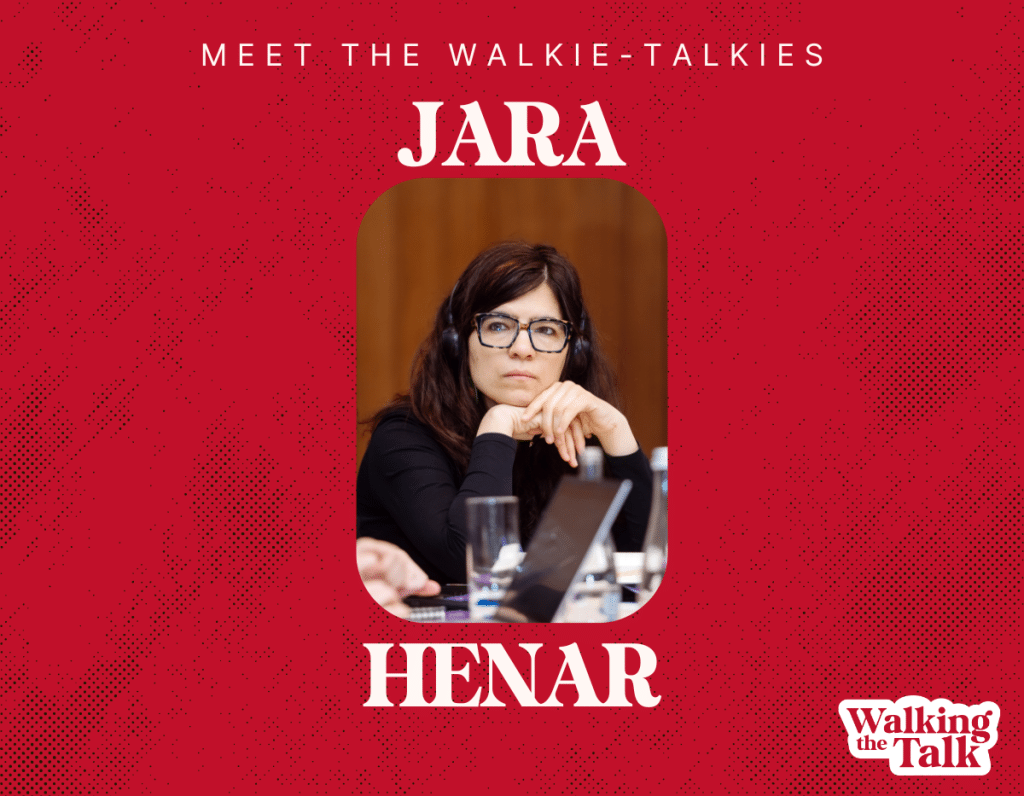
– Walkie-Talkie #2: Jara Henar

Meet Jara Henar, Barcelona-based advocate for women’s and migrant rights! Walking the Talk consortium is proudly working with six exceptional feminists from all over the world – aka our team of ‘Walkie-Talkies’. These experts bring unique perspectives and invaluable experience to our mission of promoting Feminist Foreign policies, practices, and funding in Germany, France, the United Kingdom, the Netherlands, and the European Union.

  • How would you introduce yourself?
  I am Jara, from Barcelona. I have always been working and studying around topics that I am passionate about, such as women's rights and the rights of migrants and refugees.    It took me a while to understand that some changes won't happen in my lifetime, but I now believe that there is still a lot of agency and power when deciding what you stand for and what you are ready to keep fighting for, even if changes are not immediate.  
  • Could you share with us a fun fact or something surprising about you?
  I love riddles and jokes. I can spend hours reading bad jokes or memes and enjoying it immensely. I try to play with words in different languages, but am not always successful…(nevertheless, I keep trying!)  
  • What personal experiences shaped your feminist beliefs? In what way?
  I had the privilege of growing up with a feminist mother. I had feminist children's books with feminist roles to inspire me, which came together with a particular sensibility towards justice and the fight against inequalities.    Now I am more cautious towards the concept than I used to be when I was younger. I believe that if it is not inclusive, if it is not antiracist, if it is not intersectional, then it is not feminism. I know it is not the same for everyone, so as a white person from the minority world, I am not always comfortable identifying myself as a feminist.  
  • How would you explain the concept of feminist foreign policy to someone who has never heard of it?
  It is a strategy to reverse historically unequal relations between the minority world and the majority world. In order to challenge patriarchy, colonialism and institutional racism, and to center those relations around recognition, reparations, care and rights of individuals and peoples.   
  • Do you remember your first encounter with the FFP approach? What did you think then? 
  It was through the analysis of the Spanish and EU foreign migration strategy, looking at how blind these policies are to gender equality, women's rights, and women's agency.    This leads the way to start considering how a FFP could challenge this, and change a colonial, patriarchal, and racist perspective guiding countries’ external action in the minority world.   Must read: Discover 5 more Walkie-Talkies’ portraits!  
  • What does FFP mean in your community?
  It means the opportunity for the minority world to repair and amend and move beyond colonial paradigms, putting responsibility and care at the center.  
  • In your opinion, what role can young people play in making a feminist foreign policy successful?
  Young people are crucial in this process. Not long ago, I was at a conference organized by a group of so-called feminist organizations, composed mostly of middle-aged white women. They were wondering how the feminist movement could include the LGBTQIA+ community, but to me it seemed more like a superficial thought than real strategic thinking.   It’s not the same everywhere of course, but I brought this up because the youth movements and organizations I (myself being a white middle-aged woman) am working with are not organizing seminars about it: they are already doing it, understanding that social cohesion can only be achieved by addressing discrimination towards joint work and cross-pollination between movements driven by different agendas.   Besides, they are much more capable of being flexible, connecting local and global aspects of their realities, engaging, mobilizing, and shaking things up. So, young people are crucial in paving the way towards the foundations of a feminist foreign policy approach, looking at both their internal and external aspects and the coherence needed between them.  
  • If you had a magic wand: what would you change in your country or region? 
  The lack of acknowledgment of the role played in past and present colonialism and epistemicide. And discrimination, particularly institutional and legal racism.   
  • A favorite feminist song?
  I have always been a huge fan of the 80s, and "Girls Just Want to Have Fun" is one of my favorite songs. It's a song that defies patriarchy with easily understandable language. I love the references to sorority and celebration, and also how the name has been transformed into something very powerful: "Ggirls just want to have funfundamental human rights!   Must read: What is the Walking the Talk program?

Further information

April 2, 2026

Open Letter to Public Authorities, Academic Institutions, and Stakeholders Committed to the “One Health” Approach, Ahead of the One Health Summit in Lyon

March 31, 2026

Equipop has been involved in the development and monitoring of French feminist diplomacy for several years. In particular, in October 2025, we published a report on

March 31, 2026

Since September 2023, Equipop and RESACOOP have been working together to build a long-term training partnership aimed at professionals in the fields of international solidarity, youth, and

Looking for something?