
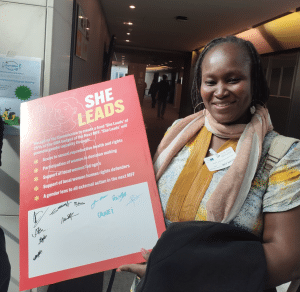
On April 9, at the European Parliament, Equipop took part in launching a strong political appeal for the creation of a European fund to support feminist organizations. This initiative comes amid a global crisis in development aid andan offensive by anti-rights movements. At the heart of this meeting, organized by MEPs Chloé Ridel and Marit Maij, in partnership with ODI Europe and the Walking the Talk consortium, Equipop mobilized French-speaking feminist actors to make their voices heard by European decision-makers.
“Equality is not just a matter of justice: it is a security policy. Shouting our support for oppressed women around the world, in Iran or Afghanistan, is not enough. We must now move from words to action. We must finance their emancipation by supporting the organizations working on the ground.” – Chloé Ridel, Member of the European Parliament
Development aid funding is in crisis. The sudden halt in USAID funding has had devastating effects, bringing many gender equality support programs to an end. These budget cuts disproportionately affect women and girls, particularly in conflict zones and contexts of democratic regression. In Europe, countries historically committed to development aid, such as the Netherlands, Sweden, Belgium, Germany, France, and the United Kingdom, are also experiencing budget cuts. At the same time, the European Union's priorities are shifting toward trade and security issues, to the detriment of human rights and development. For example, during the mid-term review of the multiannual financial framework (MFF) in 2024, the EU redeployed €2 billion from its international cooperation instrument to finance migration management and investments that benefit its own interests. At the same time, anti-rights movements, largely funded by powers such as the United States, Russia, and the EU itself, are stepping up their attacks. Their establishment in spheres of power and their capacity for influence are growing at an alarming rate, undermining decades of progress in women's rights. Between 2019 and 2023, nearly €1 billion is reported to have been allocated to these reactionary actors, while feminist organizations remain structurally underfunded.
In the face of this "international reactionary" offensive, support for feminist organizations is more than ever a priority. The current figures are alarming. In 2023, less than 1% of official development assistance dedicated to gender actually reaches feminist organizations, highlighting the urgent need to rethink funding arrangements. Calls for projects are often inaccessible, procedures too complex, and funding too rigid. These obstacles prevent feminist organizations, often the last to intervene in areas devastated by war or political instability, from acting with the responsiveness and flexibility they need. The example of the Feminists in Action project, the first intermediary fund set up as part of the Feminist Organizations Support Fund (FSOF) led by France, illustrates the concrete impact of support funds for feminist organizations. In four years, it has funded 265 projects carried out by 239 organizations in 30 countries around the world. As Juliette Bakyono, President of the Pananetugri Initiative for Women's Well-being (IPBF), points out, this type of funding has given them "the means to structure themselves, network, and strengthen their action against violence or in favor of professional integration." In contexts marked by conflict or state withdrawal, these organizations become frontline actors in ensuring access to fundamental rights.
In light of this situation, a European fund to support feminist organizations, networks, and funds would be a strong response to current threats. Inspired by national mechanisms such as the FSOF launched by France in 2019, this fund could provide direct and sustainable support for feminist initiatives on the ground. The aim would be to give them the means to act independently, without the administrative constraints and excessive conditions that currently hinder their ability to respond to the needs of the communities they serve. The call by Equipop and its partners for such a fund emphasizes the urgency of supporting feminist movements that play a vital role in preserving human rights, particularly in fragile contexts where states are absent or failing. By providing accessible, flexible, and multi-year funding, this European fund would offer feminist organizations the resources they need to continue their vital work defending women's rights, promoting economic empowerment, and combating gender-based violence.
For years, the European Union has placed gender equality at the heart of its foreign policy priorities, notably through initiatives such as the Gender Action Plan (GAP III) and the Women, Peace and Security Action Plan. However, recent policy shifts highlight an urgent need to strengthen this commitment by creating a fund specifically dedicated to feminist organizations. It is in this contextthat Equipop contributed to the European Commission's public consultation on the next EU budget, advocating for increased, accessible, and sustainable funding for feminist organizations, as well as the creation of a dedicated European fund. In the ongoing negotiations on the next European budget, France, which already has significant experience with the FSOF, is called upon to play a key role. In line with its feminist diplomacy strategy for the period 2025-2030, France must defend the idea of this European fund in order to ensure sustainable and accessible support for feminist organizations around the world. The Francophone Feminist Alliance (AFF), created in early 2025, is joining this effort. Faced with the rise of the far right and anti-rights rhetoric in Europe, the AFF's mission is to defend acquired rights, renew narratives around women's and LGBTIQIA+ rights, and secure funding for feminist organizations. It is committed to making concrete recommendations and supporting the scaling up of feminist funding mechanisms that have already proven their worth.
The message is clear: supporting feminist organizations means supporting democracy and fundamental rights. These organizations, often on the front lines in crisis situations, play a vital role in ensuring access to sexual and reproductive health, combating gender-based and sexual violence, and supporting women's economic empowerment. However, they need direct, sustainable, and accessible funding to carry out their mission. As Bénédicta Aloakinnou, a lawyer and committed feminist activist from Benin, pointed out, "these organizations don't need saviors, they need trust and direct, accessible, and sustainable resources." It is time for Europe to invest in these actors of women's empowerment. In the negotiations on the next EU budget, France must position itself as a driving force for the creation of a European fund that would enable these organizations to continue fighting for women's rights and gender equality around the world.
In short, the creation of a European fund for feminist organizations is not just a question of financing, but a political imperative to preserve and strengthen the achievements in human rights and gender equality. Faced with a global offensive by anti-rights forces, Europe cannot afford to remain passive. Urgent action is needed.