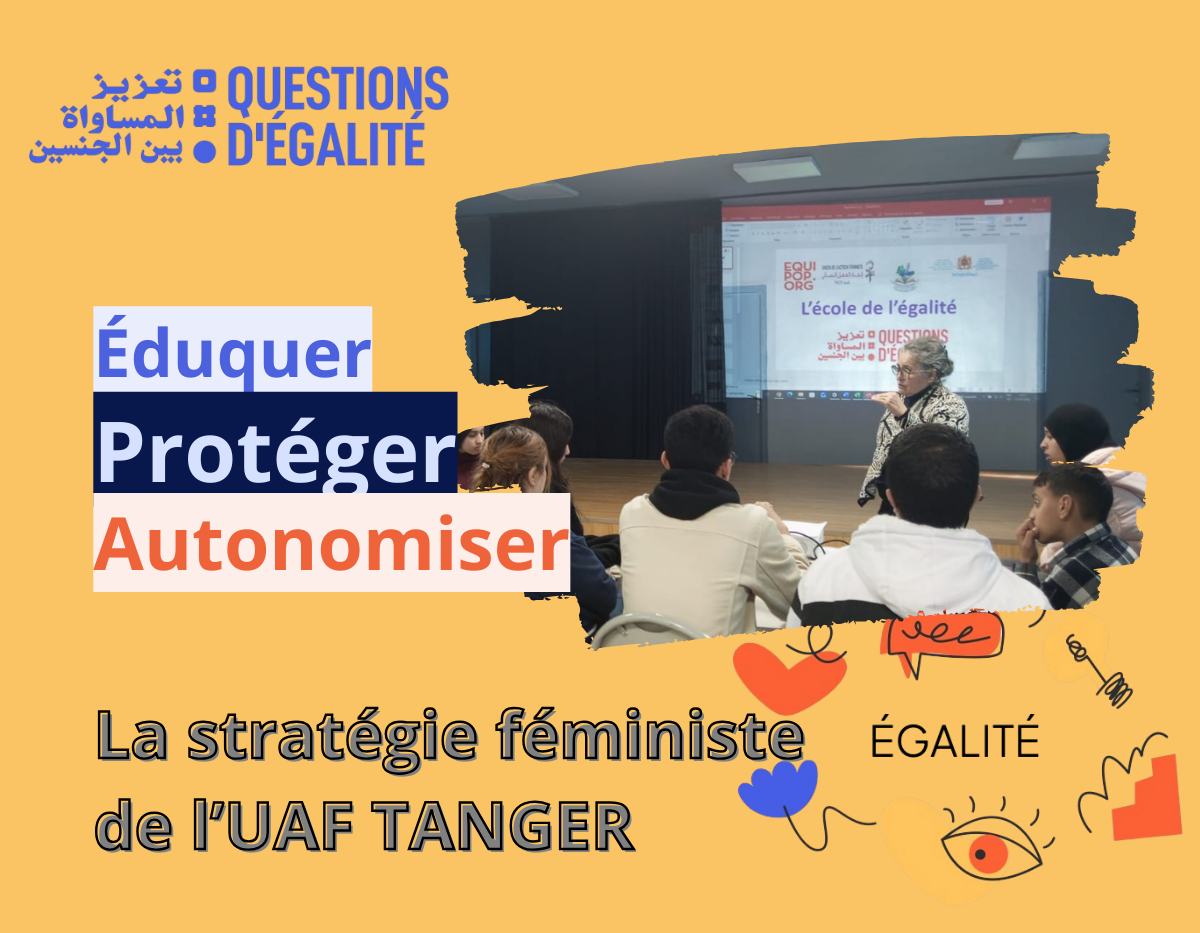
The Union de l’Action Féministe (Union for Feminist Action) – Tangier branch – has been working for nearly thirty years to defend women's rights, combat gender-based violence, and promote the economic empowerment of young people and women in Morocco. Through the Questions d'Égalité project, led by IRD and Equipop, it strengthens the leadership of young girls, develops spaces for education on equality, and consolidates feminist solidarity in the face of social and cultural resistance. In this interview, UAF Tangier shares its vision, priorities, and levers for action to build effective equality.
Why did you decide to participate in the Questions of Equality project, and what does this partnership mean for your organization?
Because gender inequalities are becoming increasingly glaring in society, the Union de l'Action Féministe (UAF) has been fighting for women's rights on a daily basis since its creation. Because we refuse to give in to resignation and believe in women's ability to take action, the Tangier branch of the UAF has chosen collective action to transform social, economic, and cultural realities. Participation in the Questions d'égalité project is part of our strategy to promote a culture of equality and combat gender discrimination.
What specific activities are you carrying out as part of the project in your country?
The "Questions d'Egalité" project aims to promote the empowerment of young girls and a culture of gender equality by strengthening their personal development and raising awareness of the fight against gender inequality and violence through several actions:
- Strengthening female leadership among young girls through mentoring: an initiative to encourage and support young girls in their personal and professional development. By setting up mentoring programs, the UAF aims to provide positive role models, boost participants' self-confidence, develop their leadership skills, and enable young girls to acquire new skills. Mentees will benefit from the support of experienced women leaders who will share their expertise and experiences.
- Promoting gender equality in education and vocational training institutions: This action will take the form of launching equality schools within the university, UAF partner high schools/colleges, and vocational training centers. These spaces will be designed to raise awareness and encourage dialogue, where young people can discuss gender issues, learn to recognize and prevent violent behavior, and promote a culture of equality and respect. Workshops, awareness campaigns, and educational activities will be organized to actively engage young people and teachers in this process.
- Strengthening the association's communication and the visibility of its actions: improving its communication strategies and increasing the visibility of its actions. This includes using social media, organizing public events, and publishing reports and testimonials. By strengthening communication, the UAF aims to raise awareness of gender equality issues among a wider audience and mobilize more support for its projects.
Why is flexible feminist funding important for young feminist movements?
Such funding enables feminist associations to develop actions that reinforce the implementation of their strategy for promoting equality and women's rights, respond to specific and appropriate needs, and strengthen their structures.
Impact and changeHow does the project contribute to strengthening the feminist movement in Morocco, particularly in a context that is sometimes hostile to women's rights?
The Moroccan context is characterized by structural and cultural resistance despite legislative advances, notably the reform of the Moudawana and constitutional provisions on equality. In this context, the project contributes to strengthening the feminist movement in Morocco, especially in this context that is sometimes hostile to women's rights, and can manifest itself in several strategic and concrete ways.
- Provide funding, capacity building, and technical support to Moroccan feminist associations and alliance networks.
- Generating reliable data through action research to challenge data and strengthen national advocacy
- Encourage intergenerational and thematic convergence by creating spaces for dialogue (the mentoring program) to connect feminist activists with younger generations, enabling the sharing of experiences with young activists to strengthen their innovative engagement and perspectives for the promotion of rights and equality.
- Combating stereotypes through the media and digital tools to promote an inclusive feminist discourse rooted in Moroccan realities
- Awareness-raising and education on rights through community outreach activities to inform women and girls about their rights and encourage them to exercise their citizenship.
- And, of course, establishing or strengthening Annajda centers, which provide direct assistance to women victims of violence by offering legal, psychological, and social support, thereby strengthening the movement and its credibility on the ground.
- Fighting economic inequality
- Encourage women's political and civic participation by providing the feminist movement with the resources and tools necessary to address conservative and institutional challenges and to establish gender equality as a foundation for all social and political action.
What forms of solidarity or collaboration do you hope to see emerge with feminist organizations in Morocco, Lebanon, and Tunisia through this project?
We should consider a transnational project involving feminist organizations in Morocco, Lebanon, and Tunisia with a view to exchanging best practices based on each country's experiences in combating GBV, promoting economic empowerment, and including future generations in feminism. For example, a knowledge-sharing platform could be developed and remote workshops could be set up to strengthen leadership and advocacy skills. Consideration could also be given to producing a white paper on cyberbullying and women's political participation in these countries. Podcasts could be produced in the different dialects of these countries to mobilize young people to defend effective equality. A regional network of feminist associations in these countries could become a regional catalyst to give greater visibility to feminism in these countries.
If you had to sum up in one sentence the change you hope to see come about thanks to Questions d'Égalité, what would it be?
"Together for effective equality, together for a society that lives freely and flourishes."
What are the next major battles or priorities for your organization as a feminist organization (UAF-Tangier)?
Our next major battles can be broken down as follows:
- Continue the fight against GBV, in particular through the implementation of a unified protocol for prevention, protection, and support for victims, especially in cases of physical, psychological, and online violence.
- Continue to strengthen the work of legal clinics to combat GBV,
- Establish Schools of Equality in primary and secondary schools in Tangier.
- Develop the mentoring program for young feminists in rural and peri-urban areas.
- Advocacy for a bill against cyber sexism,
- Establish ESS Clinics in the Faculty of Law and the ENCG (National School of Management of Casablanca).
- Set up training workshops for migrant women and Moroccan women to promote their access to employment and economic empowerment.