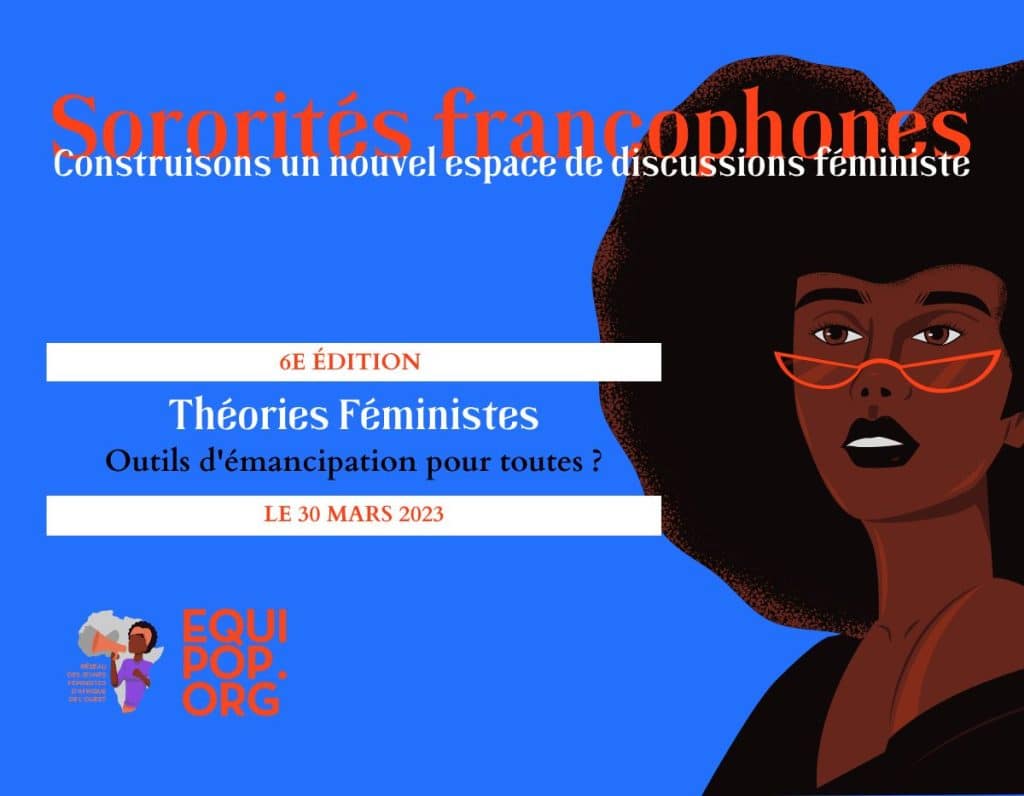
On March 30, 2023, Equipop organized the sixth edition of the Sororités francophones cycle. The aim of this meeting? To discuss the accessibility of feminist theories and their power to empower women.
How can feminist ideas be disseminated when spaces dedicated to theory and sharing are scarce? This is a major concern for feminists, particularly those in West Africa.
Feminists working in the field and those who produce theory are not treated equally. The former enjoy greater legitimacy, while the latter are often considered elitist, even "out of touch." However, other voices urge us to use and reclaim theories as tools for collective emancipation.
To reflect alongside us, Equipop and the Network of Young Feminists of West Africa invited three speakers who have placed feminist theories at the heart of their actions.
- Fania Noël is a feminist, activist, sociologist, and doctoral student. Her analyses and work focus on conflictual relationships in academic and activist circles.
- Talah Hassan is a Lebanese feminist activist. She works for “The Knowledge Workshop," a local feminist organization that works to produce feminist knowledge in Lebanon.
- Edwige Dro is a writer, translator, and activist in Ivory Coast. She founded the feminist library 1949 in Yopougon.
Theories and fieldwork: a reciprocal contribution
“Feminist organizations working in the field without feminist theories risk becoming project managers who merely respond to a need. This response must be accompanied by a theory that helps us understand how this problem is structural.” Fania Noël
Contrary to popular belief, practical action and theoretical reflection are far from being disconnected. The speakers explain that it is vital for these two aspects to feed into each other. Fania Noël highlights the importance for feminist organizations to link their actions to feminist theories, in order to avoid the depoliticization of struggles and the phenomenon NGO-ization. Theories enable feminists and their organizations to conceive of a certain political project for society and collective liberation, and then to put their actions at the service of this political objective. This is also the key to not limiting oneself to implementing actions in response to structural problems such as violence.
For Edwige Dro, it is essential that there be constant dialogue between theory and action: feminists do not develop these theories in a bubble, but rather their work stems from experiences and observations made in the field. Fania reminds us that theories developed without a direct link to activist action run the risk of being unrealistic and disconnected. Activism is a learning process that enables us to change society and ourselves.
The accessibility of feminist theories
“Knowledge should not be an inaccessible resource, nor an exclusive individual asset.” Talah Hassan
Once we recognize the importance of linking our feminist practice to theories in order to politicize our approach, a second observation becomes clear: these theories are inaccessible to a large number of women.
One of the barriers to accessibility is time. Patriarchy and capitalism do not allow women to find the time to produce or read these theories. Fania Noël explains that it is essential for women to be able to "carve out free time" from the sexist and patriarchal organization of our societies. By organizing collectively, by campaigning for a better distribution of domestic work, for more social rights, and finally for a limitation of working hours.
Theories are also often criticized for being elitist and inaccessible to activists outside the academic sphere. Fania Noël urges organizations to invest time and energy in supporting activists in their learning process, encouraging them not to be intimidated by academic writing and not to settle for simplified or summarized versions.
Finally, in the West African context in particular, feminist activists report great difficulty in accessing feminist works and writings. Important works, such as those by Awa Thiam or Constance Yaï, are either out of print, prohibitively expensive, or virtually impossible to find in countries other than those of their authors.
Feed your thoughts and imagination
"Women who create in a feminist context must have a space to reflect on what they want to create." Edwige Dro
Talah Hassan reminds us that books and theoretical works are tools for survival and liberation for women and marginalized people. At the same time, knowledge and learning have always been used by those in power to control and oppress. How, then, can we break this deadlock and enable everyone to reclaim these tools?
Talah Hassan gives us the example of the "Knowledge Workshop," an oral history workshop. It consists of autobiographical interviews with queer and trans people in Lebanon. Through exercises, participants deepen their knowledge of the various social dynamics (relationships between women and men) that affect society. The aim is to provide time and space to encourage exchanges between people and, above all, to make feminist theories more accessible to everyone.
Edwige Dro, as part of the 1949 feminist library, also offers some ideas. She explains that she works with oral tradition, through exchanges, conversations, and also through podcasts. She reflects on the place to be given to the languages and vocabulary used, particularly by moving away from the systematic use of French. Finally, she proposes providing tools and spaces for reflection to enable women, including those who are kept away from academic knowledge, to produce and write.