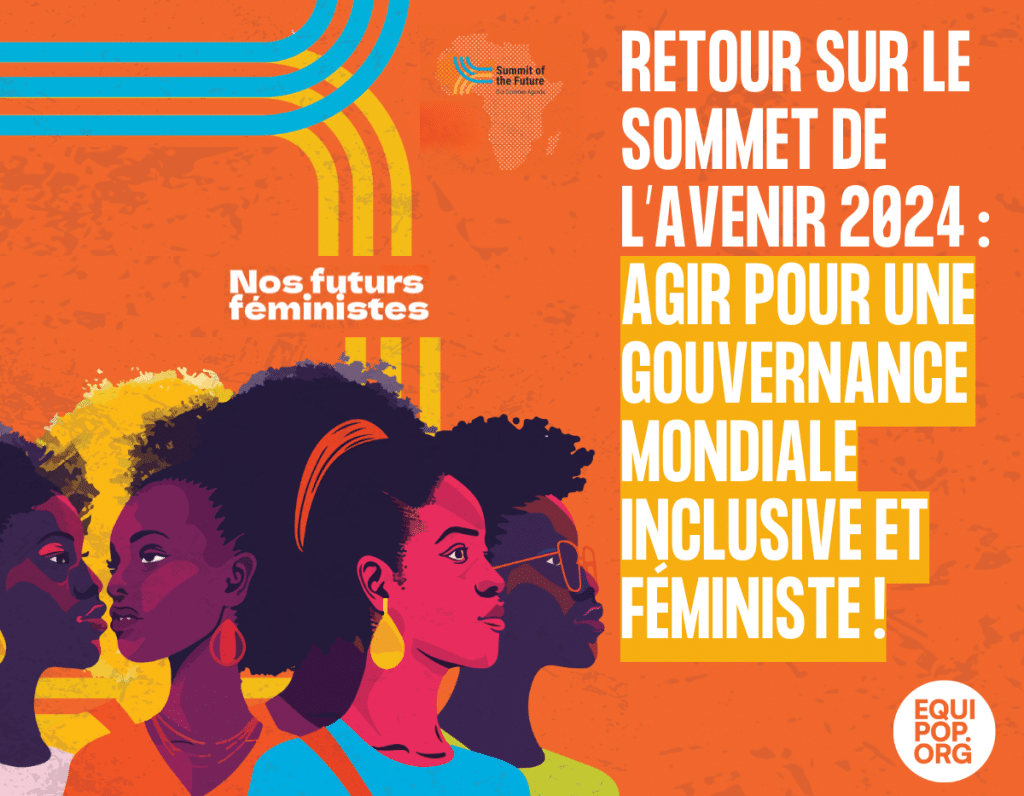
The Summit of the Future 2024, held in New York on September 22 and 23, brought together world leaders to adopt the Pact for the Future. Too ambitious for some and not progressive enough for others, this 30-page document "reaffirms the commitment of member states to the 2030 Agenda and the construction of a more prosperous and inclusive world,", addressing topics as diverse as climate change, gender equality, peacekeeping missions, artificial intelligence, and international finance. In a context of crisis of confidence in UN multilateralism, and where much progress remains to be made in terms of inclusivity and representativeness of those most affected, Equipop supported the participation of its feminist and youth partners from French-speaking West Africa with the aim of bringing about lasting change in governance systems by integrating feminist perspectives and ensuring the meaningful participation of women and young people in international decision-making.
The Pact for the Future: promising progress, but persistent challenges
The Future Summit resulted in a pact offering courses of action to promote more inclusive global governance. This pact commits states to take concrete action on gender equality, combating gender-based and sexual violence, and sexual and reproductive health and rights (SRHR). These commitments are promising, particularly for the continuation of the 2030 Agenda and post-summit initiatives. However, despite these advances, several areas of concern remain. The negotiations on the pact revealed the limits of states' commitments, particularly in the face of pressure from conservative governments that opposed the pact at the last minute (e.g., Russia, Syria, Nicaragua, Belarus, Iran, and North Korea). Certain definitions, such as those of discrimination and vulnerability, were weakened in order to exclude LGBTQI+ populations. In addition, a change in vocabulary has been observed, with a shift from "social policies" to "family policies," thus obscuring crucial issues related to youth, education, and health. Finally, the pact remains non-binding, raising questions about the real willingness of states to implement these recommendations. While questions have been raised about restructuring the Security Council (e.g., greater inclusivity; veto power) and reforming international financial institutions, it is unclear whether the pact has been able to remedy the crisis of confidence in UN multilateralism and the failures of the system.
Making feminist voices visible at the heart of international discussions
For Equipop, one of the key objectives was to ensure that the voices of young people and feminists, particularly those from French-speaking West Africa, were heard and taken into account. In the run-up to the Summit, the organization mobilized around 30 young people and feminist partners through online discussion forums to develop a joint position paper. These efforts made it possible to formulate clear and precise recommendations, supported by those who live with and fight against the effects of gender inequality and gender-based violence on a daily basis. During the Days of Action preceding the Future Summit, Equipop organized a side event entitled "Our Feminist Futures". This event provided an opportunity for young activists to share their visions and aspirations for gender equality, sexual and reproductive health and rights (SRHR), and bodily autonomy, including in contexts of security crises. These key recommendations were also highlighted during the side event organized by UN Women and the Generation Equality Forum (GEF) Action Coalition on SRHR and bodily autonomy. During this conference, a feminist activist spoke and shared her experiential knowledge, contributing to the development of concrete solutions within this global framework for reflection.
Ongoing support for feminist activists
Although the process leading up to the Future Summit appears to have been driven by a genuine effort and a greater willingness to involve young people and people with disabilities in the negotiation process, the challenge for CSOs and their partners lies in the structural obstacle of civil society's marginalization in multilateral negotiations that primarily target member states. Added to this is a certain dissonance between the rhetoric on youth involvement, the reality of limited participation, and the lack of support mechanisms available (e.g., obtaining visas, financial support), which can lead to frustration (see Youth Dialogue). In this complex context, where the presence of civil society remains an added value in terms of monitoring, counterbalancing anti-rights movements, and connecting national and international advocacy, Equipop's role is to offer tailored guidance and support to activists, who often have underrepresented voices in global debates. Equipop, as an organization defending women's rights and social justice, has adapted its practices to better support its partners in this type of space. Whether through technical, financial, or strategic support, the organization aims to continuously improve the conditions for participation of young people and feminists from French-speaking West Africa in international discussions. Advocacy for both Meaningful and Inclusive Youth Participation (MYIP) and Linguistic Justice is a key strategic focus for Equipop. The inclusion of these voices in international governance spaces is essential to ensuring fairer and more equitable decisions. In this way, the organization intends to contribute to a sustainable transformation of global governance systems by ensuring that the demands of women and young people are truly taken into account in public policy, thus paving the way for more inclusive, intersectional, and feminist governance focused on equality and social justice.
A stronger commitment to the future
Equipop reiterates its commitment to supporting feminist movements and activists, both nationally and internationally. Flexible, long-term funding for feminist organizations and follow-up on the commitments made at the Summit are crucial to ensuring sustainable progress. The ICPD+30 and Beijing+30 processes in 2025, as well as the Conference on Financing for Development, are opportunities to strengthen advocacy for women's and young people's rights. In addition, Equipop calls for the mobilization of resources from donors to translate these commitments into binding normative frameworks. As Foteini Papagioti stated at the side event organized by Equipop, it is essential to continue investing in these collective dynamics to ensure that women's and young people's rights are at the heart of international agendas. With this in mind, the Francophone feminist alliance, announced at the Francophonie Summit, is a further step towards the adoption of feminist approaches in public policy. It is more crucial than ever to strengthen these alliances and ensure that commitments are followed up on, in order to build a future where equality and social justice are no longer mere aspirations, but concrete realities.