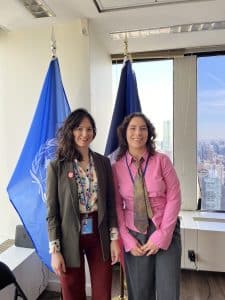
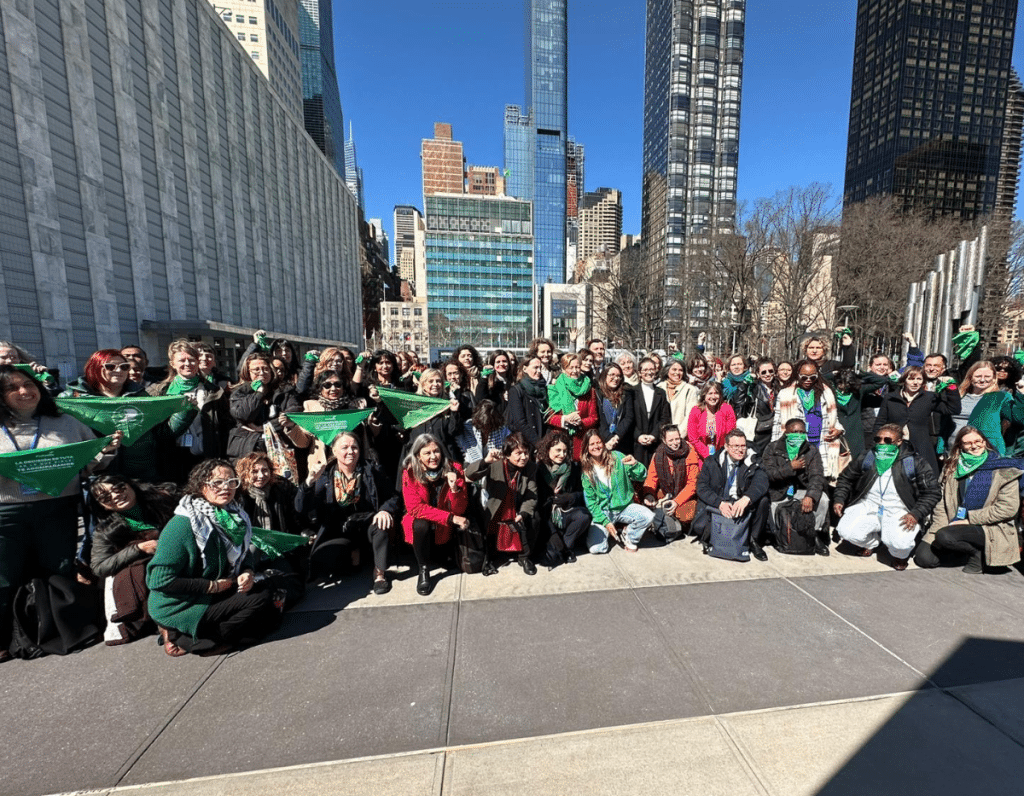
Equipop participated in the 68th session of the UN Commission on the Status of Women, held from March 11 to 22, on the theme "Accelerating the achievement of gender equality and the empowerment of all women and girls by addressing poverty and strengthening institutions and financing from a gender perspective." The text adopted at the end of these two weeks is the result of negotiations in which the most conservative states attacked women's rights and gender equality.
The international community is currently facing wars waged by men that primarily affect women, "wars against women's rights": it was with these serious words that Antonio Guterres opened the 68th session of the Commission on the Status of Women (CSW). The UN Secretary-General renewed his call for an immediate ceasefire in Gaza, as well as for the release of hostages and access to humanitarian aid. He also denounced sexual violence against women and girls in times of conflict, citing the report of the UN Special Rapporteur on violence against women and girls, which documents sexual violence committed by Hamas as well as testimonies of violence against Palestinian women in the occupied territories. Other cases, such as those in Sudan and the Democratic Republic of Congo, which are also scenes of sexual violence, were highlighted and denounced in various speeches during this CSW. CSW68 concluded with the adoption of "agreed conclusions" in which UN member states renewed a number of commitments to gender equality. Negotiations were made difficult by the presence of anti-rights actors and the context of a UN funding crisis, which greatly limited the space for discussion and pushed states to rush certain compromises, thereby weakening the scope and content of the text. Nevertheless, some victories for gender equality and the protection of sexual and reproductive health and rights (SRHR) were achieved. The CSW is a space where women's rights are regularly exploited to replay power struggles between states, against a backdrop of conflict, diplomatic competition, or geopolitical disagreements. In addition to providing technical support during the negotiations, it was important for Equipop and its feminist allies to participate in order to occupy the multilateral arena in the face of anti-rights movements.
Achieving gender equality through feminist solidarity
This year, the CSW had special significance for the French delegation that attended: it was an opportunity to celebrate the recent constitutionalization of abortion, the result of strong mobilization by French feminist associations. This had a strong resonance in Europe and internationally. In Poland, following the recent elections that removed the far right from power, feminists see an opportunity to make the same demand. Despite attacks on SRHR in Latin America, activists in the region said that this victory gave them hope, proving that feminist activism works. This constitutionalization was made possible thanks to close collaboration with French parliamentarians, who were represented by a particularly large delegation this year. Led by the vice-president of the National Assembly's Delegation for Women's Rights, Guillaume Gouffier-Valente, this cross-party delegation reiterated the important place that gender equality must occupy in French politics. Equipop collaborated with them in advance to strategically prepare for the CSW. While in New York, Equipop also facilitated a meeting with several partners from French-speaking West Africa to raise awareness among parliamentarians about SRHR issues in the region. This collaboration will continue in France to finalize the "feminist diplomacy" strategy and ensure its implementation.
Funding feminist movements in the face of backlash
The theme of this CSW focused on the source of the fight for gender equality: funding for feminist movements. One word came up repeatedly in all the activists' discussions: trust. They called on states and private donors to increase their funding, but also to make it more flexible in order to facilitate access for smaller organizations. The feminist network AWID reiterated this point during a side event: funding for anti-rights movements continues to grow, while funding for feminist associations remains very low. The Black Feminist Fund found that more than 60% of Black feminist groups have never received structural funding. At the same time, since 2019, the presence of far-right organizations on the African continent has increased significantly. AWID explained that anti-rights groups are also investing heavily in the continent's media. Equipop also spoke at an event organized by the feminist fund AWDF, dedicated to funding feminist movements in French-speaking Africa. Lucie Daniel, Equipop's advocacy and research manager, presented the findings of the report co-authored in 2023 with the Jean-Jaurès Foundation: "Women's Rights: Fighting the Backlash.". Together with the ISDAO network, Equipop reiterated the importance of building links between feminist and LGBT networks. This mission to New York was also an opportunity for Equipop to discuss the "Walking the Talk" project, led by four European organizations (Equipop in France, Hivos in the Netherlands, Center for Feminist Foreign Policy in Germany, and Restless Development in the United Kingdom), which aims to strengthen the framework and accountability of feminist foreign policies in Europe, particularly with regard to funding for feminist associations in countries in the Global South.
Occupy the field and strengthen international conventions on issues related to SRHR and financing
Anti-rights movements were also present and very vocal at the CSW, both in side events and during negotiations. This year, they went so far as to organize a counter-conference "on women and the family," further distorting the semantics and body of rights related to women's rights. families. The most conservative states tried to reduce the scope of the agreed conclusions by attacking the language around gender in the text, going so far as to question language that had been agreed upon for years, such as the terms "sexual and gender-based violence." The issues of protecting LGBTQIA+ rights, which are fundamental human rights, are not addressed in the final text. Comprehensive sexuality education, although mentioned as important, is subject in its content to "cultural contexts" and "parental supervision." The most progressive voices nevertheless allowed for some mention of the need to protect SRHR. The text recognizes the need to integrate a gender perspective into the commitments made by states to finance development. In particular, it calls for ensuring "universal access" to SRHR by increasing investment in health services, including digital services, and recognizing women's human right to have control and decide freely and responsibly on all matters related to their sexuality, including sexual and reproductive health. The final text also calls on governments and private donors to increase their support for civil society organizations in the form of sustainable, flexible, and multi-year funding. These are important elements of language for the future advocacy work of Equipop and its partners. Finally, the Commission on the Status of Women adopted a resolution on HIV/AIDS in parallel with the negotiations on the agreed conclusions, which reiterates the importance of linking the fight against HIV/AIDS with the fight against gender inequality, and urges States to take joint action on both fronts, in accordance with the commitments made by the international community.
Mobilizing progressive states to achieve significant progress in gender equality
In response to conservative voices attacking the rights of women and LGBTQIA+ individuals, Equipop has drafted an open letter calling on progressive states to form an alliance and mobilize during the negotiations to reach agreed conclusions that protect these rights to the maximum extent possible. The association also supported France in the run-up to the CSW and throughout the negotiations, by sharing analyses and amendments to the agreed conclusions consolidated with the Countdown 2030 Europe, and during strategic exchanges with France's permanent representation to the United Nations. It is essential to continue this dialogue, which is part of the feminist foreign policy that France intends to promote, and in the run-up to upcoming international events such as the CSD and the Future Summit. France's statements during this CSW were marked by the promotion of this feminist foreign policy, which aims to protect SRHR on the international stage. To be heard, France must be consistent, ensuring the effectiveness of SRHR within its own borders: it must guarantee effective access to all sexual and reproductive health care, including abortion, which is now enshrined in the constitution, and secure funding for feminist organizations, an issue that was central to the theme of the CSW.
[vc_column width= »1/2″]In the coming weeks, Equipop will remain mobilized and will continue to call on the government to act, as significant budget cuts have been announced by Minister Bruno Le Maire, threatening to affect funding for public policies on gender equality and feminist movements in France and internationally. We call on the government and French parliamentarians to do everything in their power to safeguard them.
[vc_column width= »1/2″]