Global spaces that bring feminists together are necessary to build connections between activists and strengthen their collective capacity to promote gender equality, in a climate of trust and based on shared values. It was therefore important for Equipop to attend Women Deliver, one of the world's largest gatherings for women's rights and gender equality and a vibrant rallying point for feminist movements from every continent.
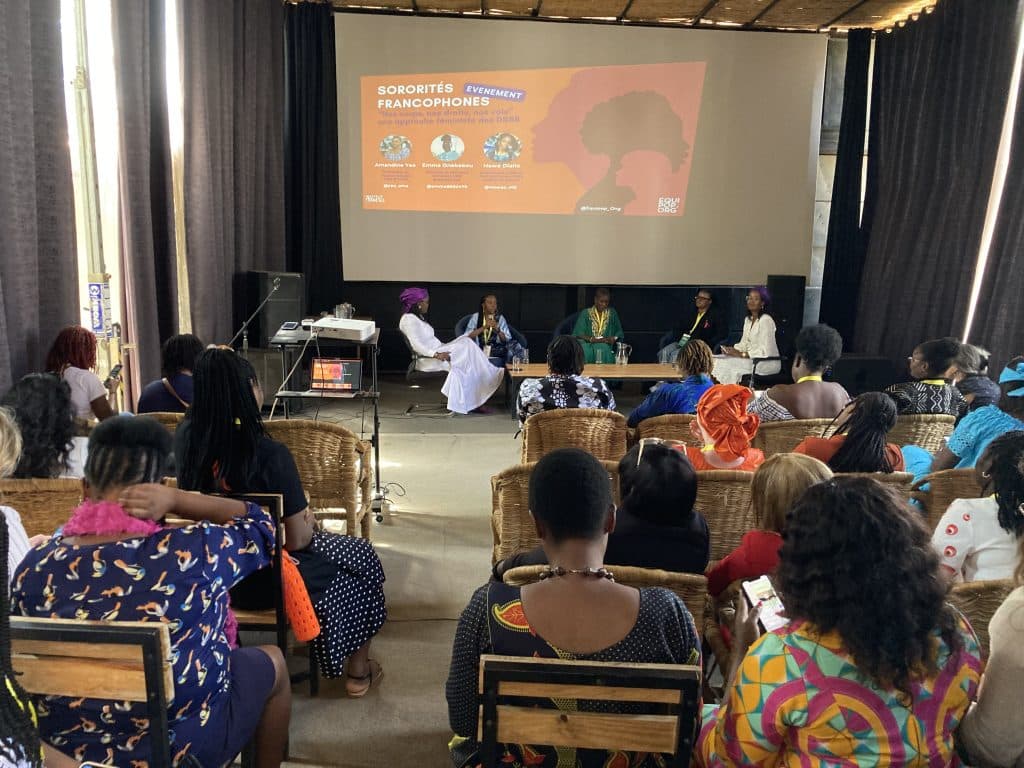
This year, Women Deliver took place in Kigali, Rwanda. Equipop participated alongside a large delegation of feminists from West Africa to amplify the voices of French-speaking activists, create new spaces for dialogue, and (re)mobilize strategic alliances to confront the backlash against women's rights and gender equality. What are our conclusions?
At the heart of the 6th edition: the challenge of combating anti-rights movements In the program for the sixth edition, one issue emerged in all discussions: the fight against opposition and anti-rights movements. For a very long time now, feminists have been repeating that we must organize ourselves in the face of a highly structured, vocal, and well-funded opposition (see our report Women's Rights: Combating the Backlash with the Jean-Jaures Foundation). Anti-rights activists are infiltrating all spaces and are now present all over the world. Feminists, who are often exposed, harassed, and attacked, need safe spaces to strategize together. This explains the anger and shock caused by the presence of Katalin Novak, the Hungarian president and an emblematic figure of anti-rights movements, at the opening ceremony. After this episode, pro-choice actors need to reflect on the situation, and Equipop will actively participate in this process. It should be noted that in this context, France's France's assertive position, as expressed by Delphine O, was necessary and right. This reinforces France's diplomatic position on SRHR issues. It also reinforces what Equipop says: we must engage in all multilateral and multi-stakeholder spheres and not give any ground to anti-rights activists.
“Finance us as if you really want to really us to win!" An essential bulwark against backlash, feminist movements are also transforming societies and breaking down conservative barriers that once seemed insurmountable, with Latin America's "green wave" at Women Deliver serving as a compelling illustration. But the balance of power remains highly asymmetrical: anti-rights movements are heavily funded, while feminist actors often still have to rely on themselves. This is of course a question of the amount of money allocated to them, but also of the way in which they are supported. It cannot be repeated often enough: only flexible, long-term funding will make a difference. Donors must fund feminist movements "as if they really wanted them to win." Promising initiatives are emerging. Alongside feminist funds that have existed for many years in the Global South and whose work is invaluable, states are embarking on new paths that are to be welcomed. This is the case in France with the Fonds de Soutien aux Organisations Féministes (FSOF), a financial mechanism that must be made permanent. France must make this one of the priorities of its future "feminist diplomacy" strategy.
Feminist foreign policy: rethinking and strengthening alliances with activists In Kigali, with the support of Equipop, a delegation of feminists from West Africa met with a number of multilateral and bilateral decision-makers, including the French Ministry for Europe and Foreign Affairs, to discuss its future strategy on feminist foreign policy. Among the main messages from the delegation members were: a call for linguistic justice and for international discussion and decision-making forums to no longer be dominated by English; the urgent need for equitable access to financial resources; the need to strengthen the fight against gender-based and sexual violence; and improved protection for women human rights defenders. The meeting concluded with a commitment from the MEAE to liaise with activists in the context of future working groups and to organize a second session on the definition of "feminist approaches." It is precisely this type of partnership that those who promote feminist foreign policies would do well to nurture, in the belief that being guided by feminist thinkers and activists remains the best way to build a credible, powerful, and truly transformative framework for action.