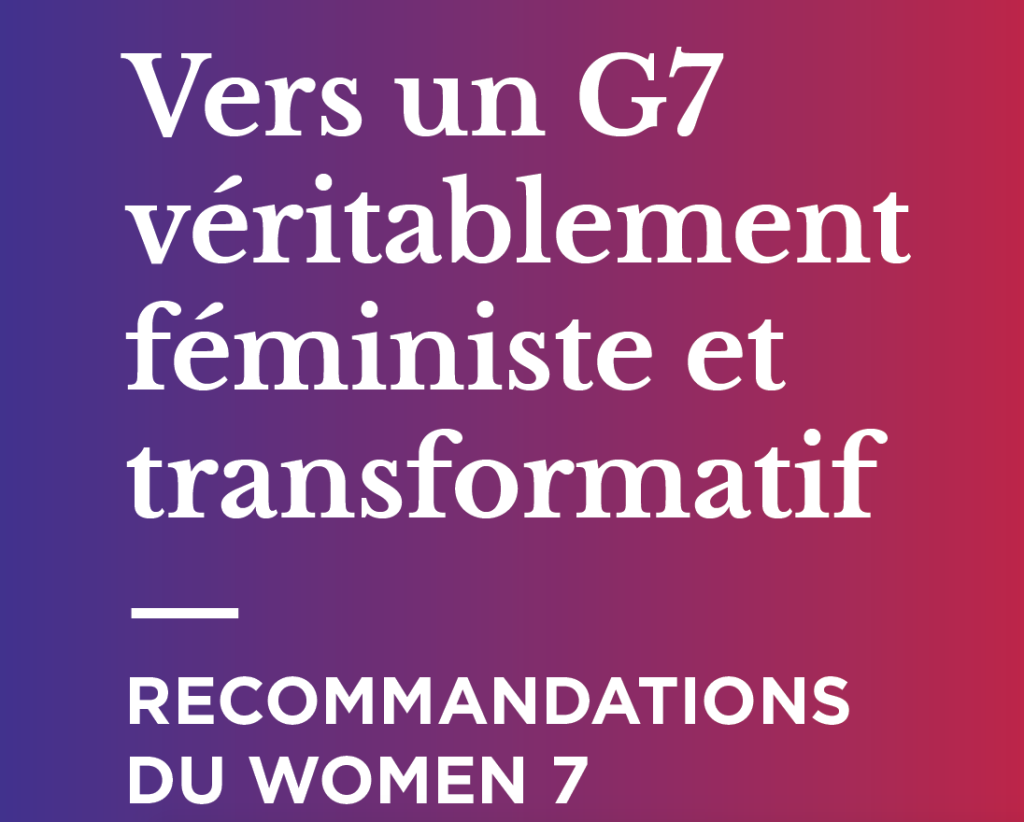
More than 400 feminist activists from around the world gathered in Paris on May 9 and 10, 2019, to present their recommendations to the G7 ministers for equality.
Women 7 calls on G7 leaders to adopt national policies and foreign policy that are truly feminist and transformative of traditional patriarchal power relations.
To this end, the G7 countries must activate two levers as a priority, without which any political promise for gender equality will be in vain:
Increased financial resources dedicated to associations, non-governmental organizations, researchers, and feminist movements that, at all levels (local, national, and international), have the legitimacy and field expertise to carry out initiatives that have a concrete and lasting impact on the rights of women and girls and a transformative effect on power relations and social norms. women and girls and a transformative effect on power relations and social norms.
This funding must be accompanied by specific measures to support the work of feminist associations and NGOs, in order to secure their actions on the ground. Particular attention must also be paid to the needs of associations and organizations led by and working for the most marginalized populations, as well as to women human rights defenders, both in terms of funding and protection.
The full and effective participation of women and girls in decision-making processes within the G7 and beyond, through inclusive consultation, recognizing the diversity of women, their voices, and their capacity for action.
To this end, the W7 recommends:
— Effective and equal representation of women among decision-makers and in public governance, at the local, national, and international levels.
— Taking into account the voices of women and girls in all their diversity throughout the design, development, implementation, monitoring, and evaluation of policies. We call on G7 leaders to recognize that all women and girls have equal rights, but that, depending on their circumstances, access to these rights is unequal and difficult, particularly if they face structural barriers and multiple forms of discrimination. Specific attention must be paid, among others, to racialized women and girls, Indigenous women and girls, migrant women and girls, LGBTI+ people, young women and girls, women and girls with disabilities, and women and girls in precarious situations, conflict or humanitarian disasters.
Download the full set of Women 7 Recommendations in PDF format (267 KB).