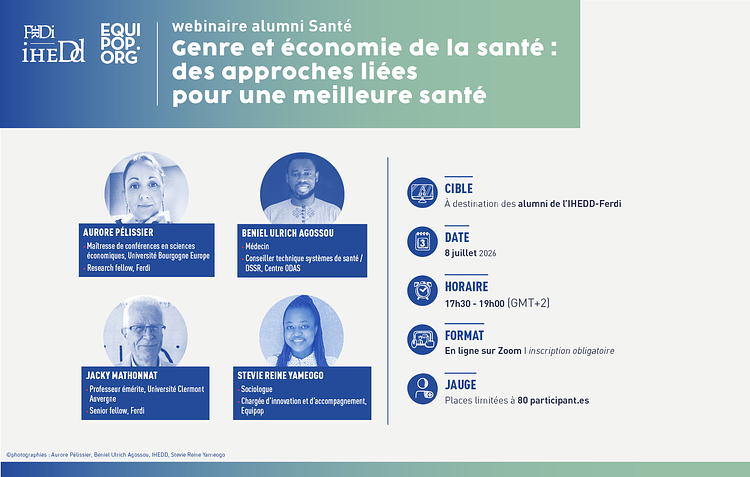
During the groundbreaking webinar “Gender and Health Economics—Interconnected Approaches for Better Health,” Equipop and FERDI brought together researchers and development practitioners to address a central issue: understanding gender relations, their role in the formation of health inequalities, and their influence on the effectiveness, equity, and impact of public health policies. At the intersection of research and action, the discussions highlighted the need to integrate gender analysis across the board into health policies and systems—not as an additional dimension, but as an essential lever for addressing the social and economic determinants of health inequalities!
Partnerships to Break Down Barriers in Healthcare
This webinar marks the first collaboration between the Institute for Advanced Studies in Sustainable Development (IHEDD-Ferdi) and Equipop.
This discussion between Aurore Pellissier, Beniel Ulrich Agossou, Jacky Mathonnat, and Stevie Reine Yaméogo provided an opportunity to compare economic approaches and analyses of health issues with the realities on the ground, thereby strengthening the triad of knowledge linking research, fieldwork, and advocacy. As moderator Dominique Pobel (health policy and systems specialist at Equipop) emphasized, health interventions that fail to take gender issues into account: “often result in some needs, practices, and barriers experienced by populations being overlooked—or even in certain conditions being ignored—and, in all cases, in the social determinants of access to care being underestimated.”
Overall indicators affected by a “glass ceiling”
Despite an overall improvement in health over the past twenty years, progress has slowed at an alarming rate over the past 7 to 8 years, with a trend toward a “plateau.” Women and girls, however, continue to have an advantage in terms of mortality and life expectancy.
Some indicators show stark disparities that cannot be explained solely by countries’ income levels.
This is the case with maternal mortality, which remains the leading cause of death among adolescent girls worldwide. Although it has fallen to approximately 200 deaths per 100,000 live births in 2023, we remain very far from the Sustainable Development Goal (SDG) of fewer than 70 deaths by 2030. Similarly, access to skilled birth attendance—which has increased significantly in many countries—varies drastically (34% in the DRC compared to 99% in Burundi or Botswana).
Jacky Mathonnat points out that a recent study of 2 million women in 61 low- and middle-income countries reveals that two-thirds of them report facing at least one major barrier to accessing health care (lack of money, distance, lack of decision-making autonomy). Poor, young, rural, and less-educated women—as well as those without any form of health insurance—are the hardest hit.
“Gender should not be treated simply as just another social or individual variable, but as a cross-cutting dynamic that profoundly shapes health needs, the demand for care, care pathways, effective access to care, and, in some cases, the quality of care. This is increasingly reflected in the discourse and empirical economic analyses of health issues and health system reforms. All of this, moreover, raises the question of how to effectively expand universal health coverage.” Jacky Mathonnat.
Refusal of Medical Care: Insights from the “Capabilities” Framework
To illustrate these mechanisms in concrete terms, Aurore Pélissier shared the results of a quantitative study conducted among 760 students at the University of Lomé in Togo. The figures are telling: 72% of the students surveyed chose not to seek medical care the last time they needed it.
While 38% resorted to self-medication (known as “partial non-use”), 34% completely forwent seeking medical care, primarily due to financial barriers. The analysis reveals a striking gender-specific pattern: while women in this student population generally seem less likely than men to forgo general medical care, they are, in contrast, much more likely (more than 75%) to forgo gynecological care or intimate health consultations. Drawing on Amartya Sen’s capabilities approach, Aurore Pélissier invites us to rethink the concept of access.
It is not enough to simply declare a right or establish a service, as Aurore Pélissier points out : “We must ask ourselves about actual freedoms and not just the rights of individuals. Are individuals actually able to choose to access certain types of care when the need arises?” Without this, traditional cost-benefit analyses will continue to systematically underestimate women’s specific needs.
Transforming Services Through Feminist Health Democracy
The projects led by Equipop confirm that the barriers are not only material but also largely social and institutional. Stevie Reine Yaméogo shared the lessons learned from the “SANSAS” project in Senegal and the “Jeunes en Vigie” project in Burkina Faso and Senegal. In these projects, adolescent girls face strong social stigma, moralizing attitudes from healthcare providers, and a lack of confidentiality.
To break down these barriers, Equipop implements feminist health democracy methodologies, particularly through participatory social audits conducted by the young women themselves. As Stevie Reine Yaméogo explains:“Beyond the financial aspect, a teenage girl often refrains from seeking care out of fear of moralizing judgment from healthcare staff or a breach of confidentiality. The social audit empowers these girls: by evaluating the quality of care themselves, they cease to be merely passive users and become agents of change, able to negotiate adjustments to services.” These community-based and participatory assessments serve as a catalyst for transforming health systems. In particular, they make it possible to:
- to bring to light realities overlooked by traditional approaches (e.g., menstrual health management or the extent of gynecological and obstetric violence);
- tailor health services to specific needs in practical ways (hours, confidentiality, reception);
- transform the power dynamics between caregivers and care recipients, promoting the empowerment (or agency) of girls;
- strengthen their agency and capacity to take action by creating the conditions that allow them to articulate their needs, voice their concerns, and participate in decisions that affect their health.
These participatory and community-based approaches have been widely validated by positive external evaluations and have been the subject of scientific publications (see the “Further Reading” section).
For his part, Beniel Ulrich Agossou noted that gender mainstreaming still faces strong political and technical resistance. He highlighted the lack of analysis in current methodologies: “Current statistical tools often merely sort data by sex (male/female) without capturing the complex power dynamics. Furthermore, many policymakers, although convinced of the need for gender mainstreaming, lack practical tools to translate political will into gender-responsive budget lines.”
Gender and Health Economics: An Indispensable Partnership
The conclusion of this webinar offers a clear roadmap for the future of health policy:
- The gender perspective and health economics should no longer be viewed in isolation, and we are seeing very positive developments in this regard.
- The gender-based approach examines how social norms, inequalities, and power dynamics influence exposure to risks and effective access to care.
- Health economics provides frameworks for understanding the determinants of health, the demand for health care, resource allocation, financial incentives, costs, and the effectiveness and efficiency of interventions.
By linking these factors, we demonstrate that a more just and equitable health care system is also a more effective and efficient one. By eliminating barriers to access for women and young people, we optimize the use of public resources and avoid significant long-term health and social costs.
Get trained to take action
Gender mainstreaming in development programs cannot be done on the fly. It requires analytical frameworks, appropriate educational tools, and a genuine effort to challenge professional biases. With Qualiopi certification for its training programs, Equipop supports actors in the field of international solidarity, research teams, and health institutions through theoretical and practical modules based on popular education.
Browse the Equipop training catalog on this page or contact us to learn more: formation@equipop.org
Further information
- Pélissier, A., Alowou, A. P., & Atake, E. H. (2024). Use of gynecological care by young women in Togo: a focus on students and an analysis of the determinants at the University of Lomé. Public Health, 233, 190–192.
- Equipop (2024). “Toward Feminist Health Democracy: Meaningful and Inclusive Youth Participation for Effective Health Accountability,” a practical guide for action
- Equipop (2025), “The Jeune en Vigie Program,” Knowledge Management Training Package for Global Health Programs and Johns Hopkins, Link.
- Memmi Machado, S., et al. (2025). “Democracy in Health: Adopting a Feminist Approach to Combat Social Oppression,” *Revue Santé Publique*, No. 1, pp. 37–41
- Guttmacher Institute. Adding It Up: A simulator to measure the benefits of investments in contraception and reproductive health
- Webinar page on the IHEDD website
Who are the speakers?
- Dominique Pobel (Moderator): Health Policy and Systems Specialist at Equipop, with more than twenty years of experience working on issues related to gender and sexual and reproductive health
- Aurore Pélissier: Associate Professor (HDR) in Economics at the University of Burgundy Europe and Fellow at FERDI
- Beniel Ulrich Agossou: Physician and Technical Advisor for Health Systems/DSSR at the ODAS Center
- Jacky Mathonnat: Professor Emeritus of Economics at Clermont Auvergne University, researcher at CERDI, Senior Fellow, and director of the Health Program (research and training) at FERDI
- Stevie Reine Yaméogo: Sociologist, Burkinabé feminist, and project manager at Equipop; specialist in community dynamics and health democracy
Spotlight on FERDI
The Foundation for Studies and Research on International Development (Ferdi) is an independent research institution that aims to influence international development policies. Through its Institute for Advanced Studies in Sustainable Development (IHEDD), it offers high-level training programs for senior officials in the public administrations of countries in the Global South, drawing on cutting-edge academic expertise to guide public policy decisions. This webinar is part of the IHEDD-Ferdi training program “Strengthening Health Systems,” supported by the Government of the Principality of Monaco and the French Development Agency (AFD).
Spotlight on Equipop
Equipop is a feminist international solidarity organization that works toward a world where the rights of all people—particularly sexual and reproductive rights—are respected, and where everyone can participate fully in just and sustainable societies. Through its Resource Center and training organization, Equipop creates spaces for reflection and dialogue among researchers, activists, and international solidarity practitioners, and offers training programs informed by more than 30 years of field experience, combining academic and experiential knowledge.