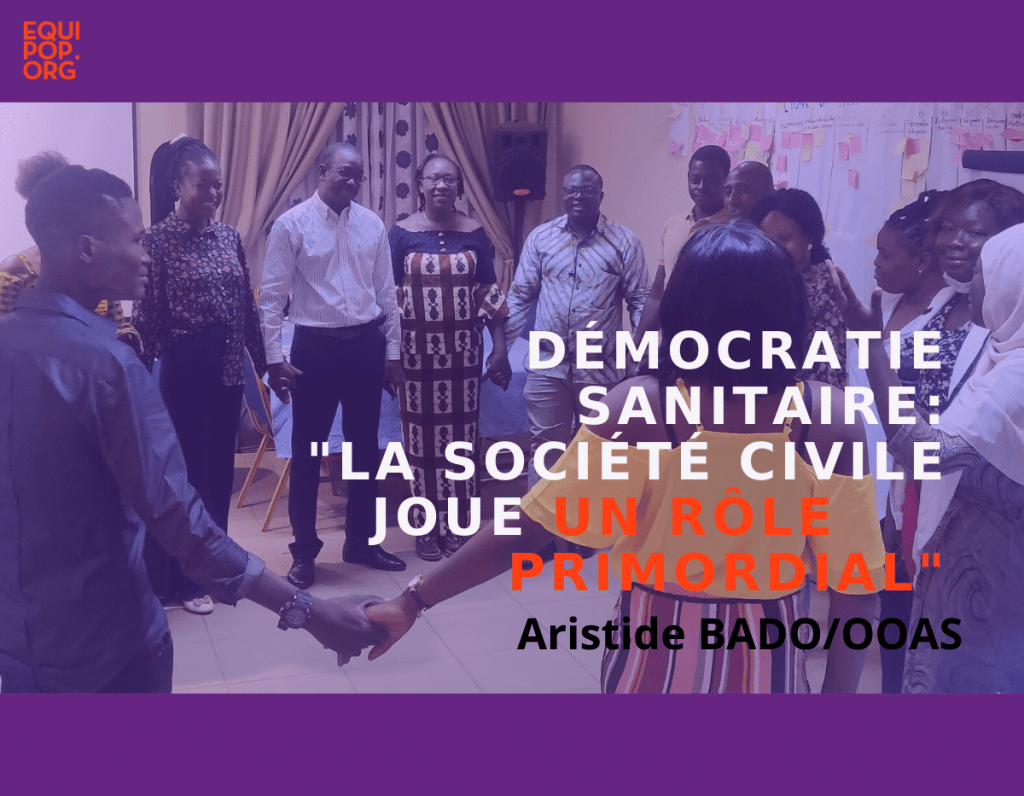
How would you define health democracy? In my opinion, health democracy means involving all structures and components of society in the management, decision-making, and use of health services. This means involving everyone, including the community, young people, religious leaders, civil society actors, and everyone else who can help with the use of health services.
And how do you view the role of civil society in shaping public policy? Civil society plays a key role; we know that it can help boost indicators. It can help citizens monitor the situation; it can also help politicians to fulfill their commitments. Civil society has also played an important role in recent decades in raising awareness of the HIV/AIDS pandemic, and this has had very positive results. We can see that in our countries, the rate is really low. This is partly due to the work carried out by civil society. And if we also look at other parts of the world, especially Latin America, civil society has played a very important role in demographic transition, and these results can be generalized. This can be generalized in our context, and we believe that it is an important role to play and that civil society must find its rightful place.
You participated in the workshop to capitalize on the Burkinbiwili project. How do you feel after discovering what young people are doing? For me, it's a very pleasant feeling. I am very pleased to know that these young people, who have been empowered by the various actors involved in the project, have managed to go out into the field, conduct social audits, persuade health providers to change their position, and also encourage other young people, their peers, to see and understand what sexual and reproductive health rights are and how to exercise them. We are truly proud of this.
Bado Aristide, PhD in Demography, works for the West African Health Organization (WAHO) where he holds the position of Demography Research Officer for the Demography, Sexual and Reproductive Health Project, abbreviated as DEMSAN.