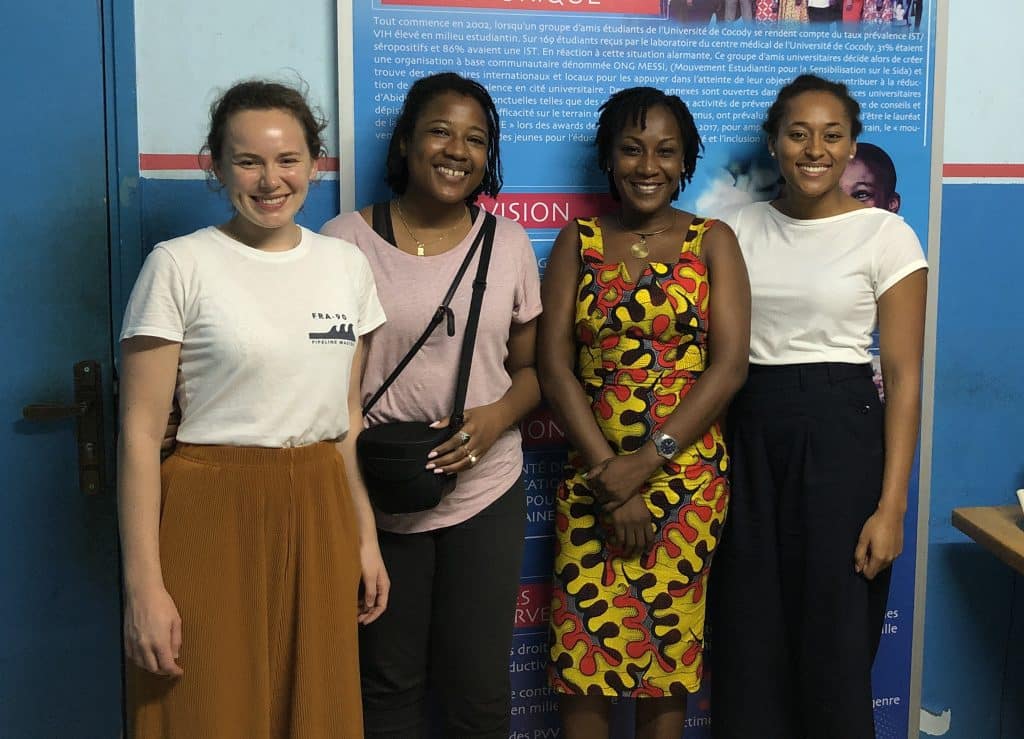
In January, five students from Sciences Po traveled to Senegal and Côte d'Ivoire to meet with young feminists. This field study will enable them to document their research project, carried out for Equipop, on collective actions led by young activists in West Africa in order to identify how best to support these initiatives.
In September, Carolin, Chloé, Hannah, Inaïssa, and Sofietou, first-year master's students, responded to a call for applications launched by Sciences Po's Gender Research and Teaching Program (PRESAGE) and Equipop. All five were selected to write a report on the actions taken by young feminist activists in West Africa.
From Paris, first phase of research
This project, funded by Women Forward International, aims to capture the diversity of young feminists' modes of organization, communication, and action in West Africa. "Our goal is to understand the dynamics, actions, and impact of young feminists within countries and how an organization like Equipop can support them," explains Chloé Bertrand. " We began by mapping feminist actions in two countries, Côte d'Ivoire and Senegal. This enabled us to identify activists via social media and existing lists, such as that of young feminists who gathered in Ouagadougou in 2018 at the initiative of Equipop. For Côte d'Ivoire, we gathered the contact details of around 40 young feminists."

The students conducted an initial series of remote interviews from Paris. " The aim of this stage was to gain a better understanding of the profiles of the people we would be interviewing, and then to define a series of relevant questions to ask them in person during our fieldwork, " explains Inaïssa Sylla. "For example, we wondered whether they shared the same definition of the term 'feminism' and what the gender dynamics were in their countries."
Between Senegal and Ivory Coast, encounters with feminists from diverse backgrounds
In January, the five students spent 10 days in the field, dividing their work between two countries. "For Senegal, we contacted around 30 activists in advance," explains Hannah Milbers. "Once there, we interviewed around 20 people. We were interested in understanding the keys to their success, their challenges, and the obstacles they face."
They thus encounter many different types of activists, mainly women: feminists committed to fighting female genital mutilation, journalists, entrepreneurs, health professionals, etc. Their protocol leads them to ask everyone similar questions: "Do you consider yourself a feminist or an activist?"; "What actions do you take, and what are their effects and limitations?" "What would you need to expand your actions?"
There is not one feminism, but many feminisms to support.
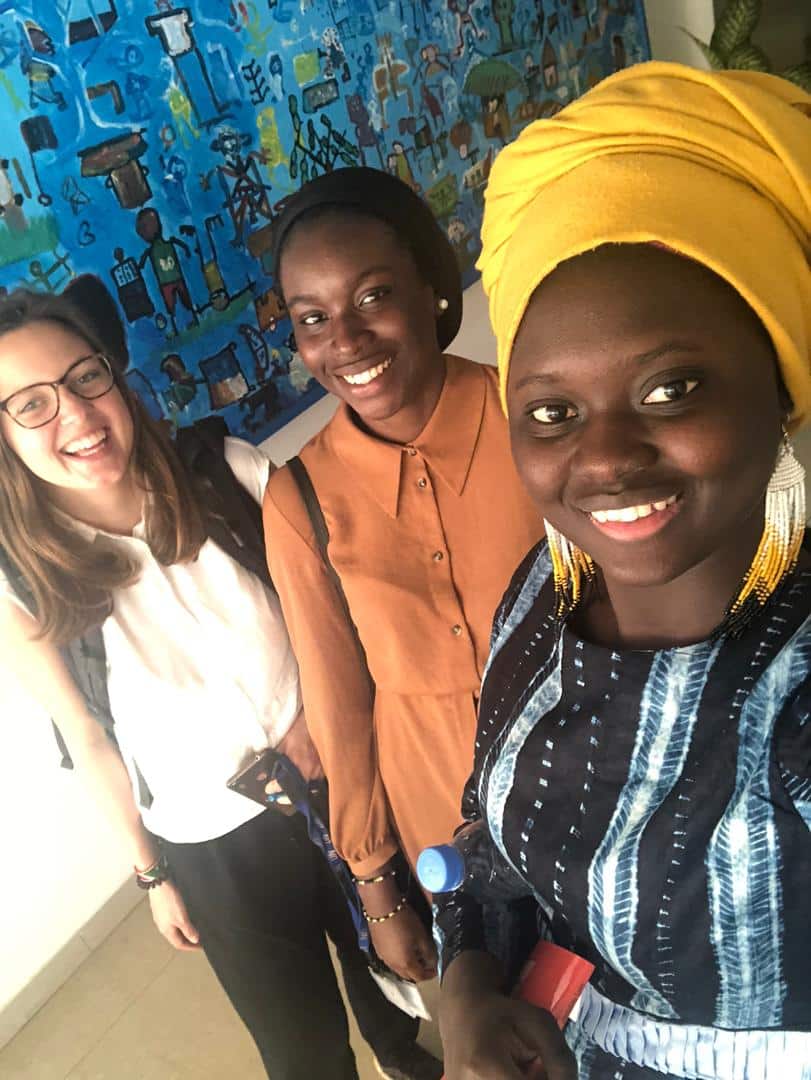
"I was particularly struck by the energy that emanated from these interviews," says Inaïssa Sylla. " I was also surprised by the diversity of the actions. Even though we understood that not all of them are necessarily coordinated with each other, and that many even overlap."
"I was struck by the fact that not all of them consider themselves feminists," notes Chloé Bertrand. " Or that they consider themselves feminists for different reasons. Some even think that it's a very Western concept that isn't necessarily suited to their realities."
All emphasize the importance of visiting the country. "It was essential for our study to meet people in their everyday context, in their working environment," insists Inaïssa Sylla. We are well aware that the people we met are not representative of all the realities of the country. For example, we limited ourselves to Abidjan. And we realize that the realities are different in the interior of the country."
This assessment of the different forms of activism and feminism will take the form of a report that the five students will submit in June. It will fuel reflection on the best ways to support young activists in West Africa. "In West Africa, voices are emerging with new energy to participate in building a more just society, "notes Aurélie Gal-Régniez, executive director of Equipop. Active on the streets and on social media, denouncing in the press the devastation caused by lack of access to safe abortion, intervening in families' private lives to prevent child marriages, training teenage girls in leadership or facilitating their access to sex education, opening dialogue with adults, men, and traditional leaders, these young people are pushing boundaries, often taking risks. Equipop is convinced that now more than ever, we must support their struggles and help ensure that their voices are heard in all the spaces where tomorrow's policies are being shaped!