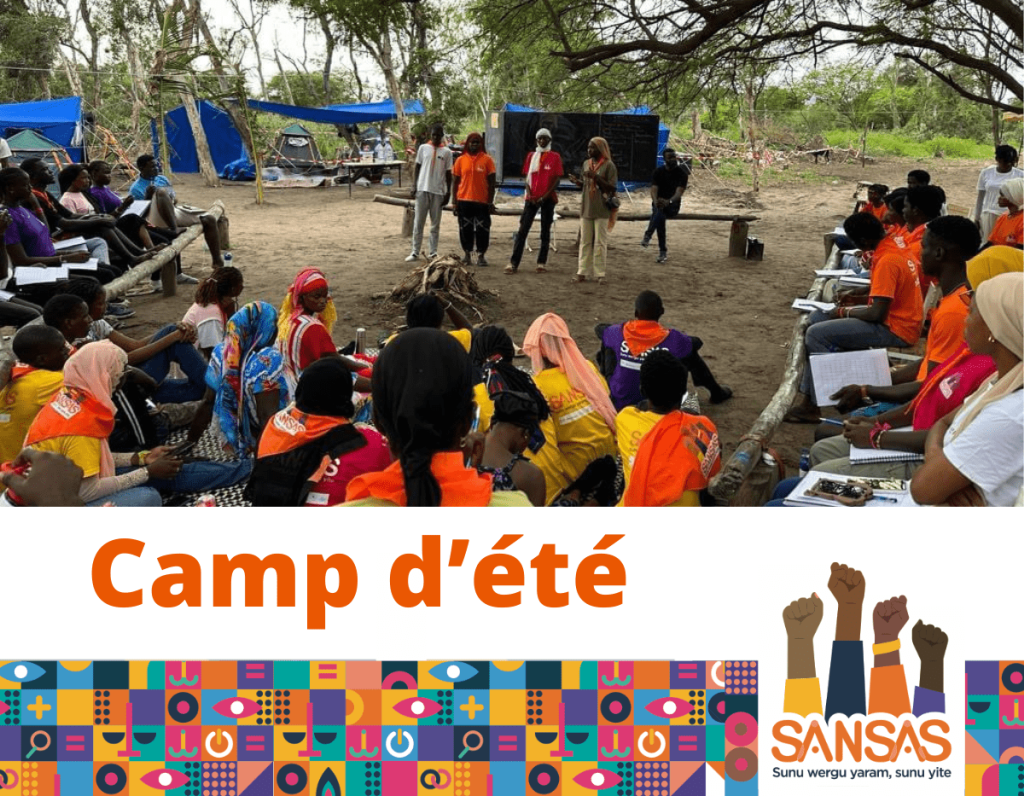
For 10 days, a summer camp organized by RAES and Jeunesse & Développement as part of the Sansas Project took place in Mboro, Senegal. Seventy young people and adolescents involved in this project were able to share, express themselves, and co-create content on their rights and health. Equipop, which has been involved since the launch of Sansas, helped run the camp, in particular by discussing reproductive rights and health with the young people and amplifying their voices to ensure that these rights are respected.
For 10 days, 70 young leaders involved in the Sansas project gathered in the heart of the Mboro forest. Coming from different regions and departments (Mbour and Sédhiou), cultures, and beliefs, they participated in a summer camp organized by RAES and JED as part of the Sansas project.They shared their experiences, co-learned, co-constructed, and challenged themselves in sports and cultural activities in the field of health and well-being.
Ratanga Vibes, a way of life
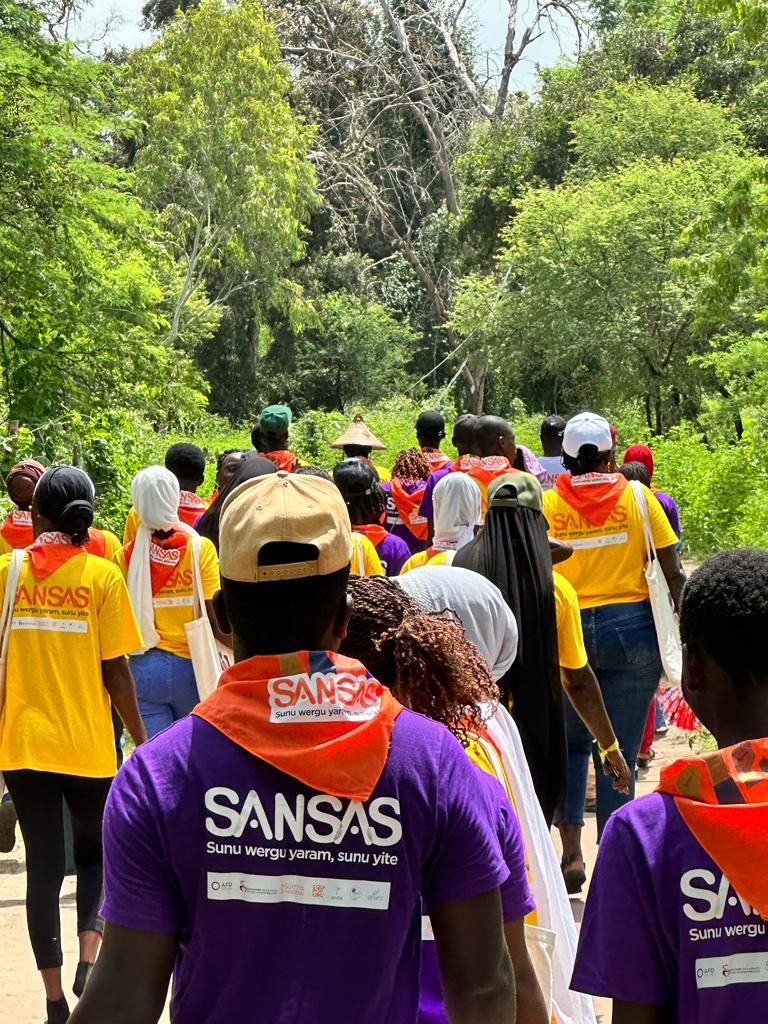 Equipop participated to this emotionally charged week for the Strengthening the knowledge and skills of young people and adolescents on ARHR (Adolescent and Young People's Reproductive Rights and Health).
The camp, called "Ratanga Vibes," has was punctuated by sporting and cultural activities and workshops to strengthen the J&A's knowledge and skills in DSRAJ, advocacy, media training, etc. The evening gatherings were an opportunity for convivial moments, get-togethers, and more informal exchanges.
For Equipop, the camp served as a springboard for understanding young people's knowledge of their rights and the Senegalese legal framework, and for measuring the degree of empowerment they had gained through the project.
Equipop participated to this emotionally charged week for the Strengthening the knowledge and skills of young people and adolescents on ARHR (Adolescent and Young People's Reproductive Rights and Health).
The camp, called "Ratanga Vibes," has was punctuated by sporting and cultural activities and workshops to strengthen the J&A's knowledge and skills in DSRAJ, advocacy, media training, etc. The evening gatherings were an opportunity for convivial moments, get-togethers, and more informal exchanges.
For Equipop, the camp served as a springboard for understanding young people's knowledge of their rights and the Senegalese legal framework, and for measuring the degree of empowerment they had gained through the project.
Empowering young leaders, at the heart of Sansas
During the camp, Equipop interviewed five young leaders (three girls and two boys) from the Mbour and Sédhiou areas and produced short videos in which they talked about their empowerment process since the start of the Sansas project. Empowerment means "taking control" of one's own life and community. It is a path to individual and collective emancipation that is part of a more political approach, enabling young people to enter positions of power to create more egalitarian societies. At the start of the Sansas project, the young leaders took part in thematic (on SRHR and gender issues) and technical (leadership and advocacy techniques) capacity-building sessions provided by Equipop and RAES. Since then, these young leaders have been involved in social mobilization activities to carry out community activities: film debates, educational talks, radio campaigns, etc. They are mobilizing to refer their peers to health centers and are involved in political mobilization actions. "This is the first time we have felt so involved and valued in a project," confirms a young leader. At every stage, we are asked for our opinion. It is essential that young people are at the heart of everything, because we are the ones who are affected and we are the leaders of tomorrow." Young people are thus becoming real resource persons on SRHR and gender equality issues within their communities.
“Knowledge is power! Make your voice heard on DSRAJ”
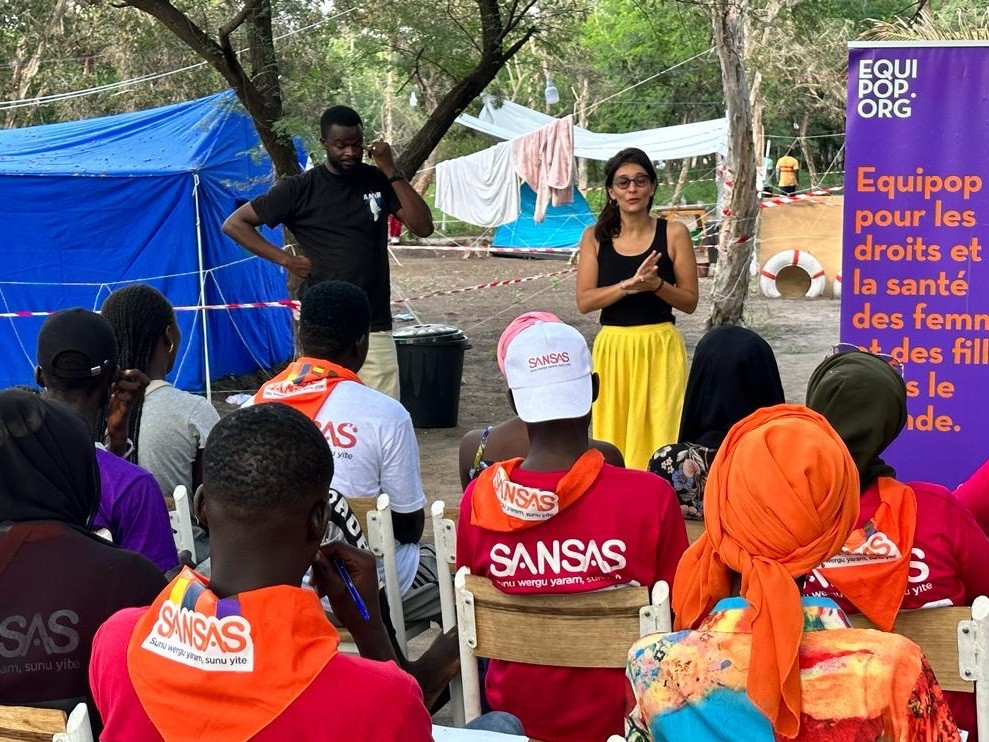 The camp also provided Equipop with an opportunity to host a session entitled: "Knowledge is power! Making your voice heard on DSRAJ."
“The first step is to know your rights, reminded the 70 teenagers and young people, Sarah Memmi, SRHR advisor at Equipop. It is an essential prerequisite for making your voice heard, calling on the authorities, and fighting for your rights..
Equipop also presented an animated video explaining Senegal's legal framework on SRHR and gender. It was based on a report on the subject that Equipop had produced at the start of SANSAS to better understand the issues at stake in the local context. The screening was an opportunity to recall the foundations of SR law in Senegal, namely the criminalization of rape. Equipop then led a discussion on how to deal with sexual and gender-based violence, at the intersection of the personal and the collective. Several young people shared their personal experiences of supporting loved ones who had been victims of violence. Collectively, these exchanges are a particularly valuable tool for breaking taboos and improving the reproductive health rights of adolescents and young people.
The camp also provided Equipop with an opportunity to host a session entitled: "Knowledge is power! Making your voice heard on DSRAJ."
“The first step is to know your rights, reminded the 70 teenagers and young people, Sarah Memmi, SRHR advisor at Equipop. It is an essential prerequisite for making your voice heard, calling on the authorities, and fighting for your rights..
Equipop also presented an animated video explaining Senegal's legal framework on SRHR and gender. It was based on a report on the subject that Equipop had produced at the start of SANSAS to better understand the issues at stake in the local context. The screening was an opportunity to recall the foundations of SR law in Senegal, namely the criminalization of rape. Equipop then led a discussion on how to deal with sexual and gender-based violence, at the intersection of the personal and the collective. Several young people shared their personal experiences of supporting loved ones who had been victims of violence. Collectively, these exchanges are a particularly valuable tool for breaking taboos and improving the reproductive health rights of adolescents and young people.
The video also served as a reminder that in Senegal, access to contraception is a right for everyone, regardless of age, origin, social class, religion, etc., and that emergency contraception is also permitted and should be accessible. Discussions also focused on the youth approach and what is expected of healthcare providers. "It's important for us young people to know our rights. If we know our reproductive health rights, we will have the power to claim them from providers!" said a young female leader from Mbour, applauded by her peers. "We must challenge healthcare providers to respond appropriately to our rights!" said a young leader from Goudomp.
Better understanding for better mobilization of authorities
Equipop's work with J&A as part of the project also involves engaging with political authorities at the national and local levels on issues specific to the project's five areas of intervention: better understanding the challenges of pregnancy in schools, raising awareness of the extent of sexual exploitation, strengthening EVF (family life education) clubs in schools, monitoring the commitments made by district chief medical officers regarding access to healthcare facilities, and increasing exchanges between young people and healthcare providers. These social and political mobilization activities are expected to begin in the five districts of Goudomp, Bounkiling, Sédhiou, and the two districts of Mbour in December 2023. Young people are already highly mobilized to continue this work and call on the authorities to uphold their rights!