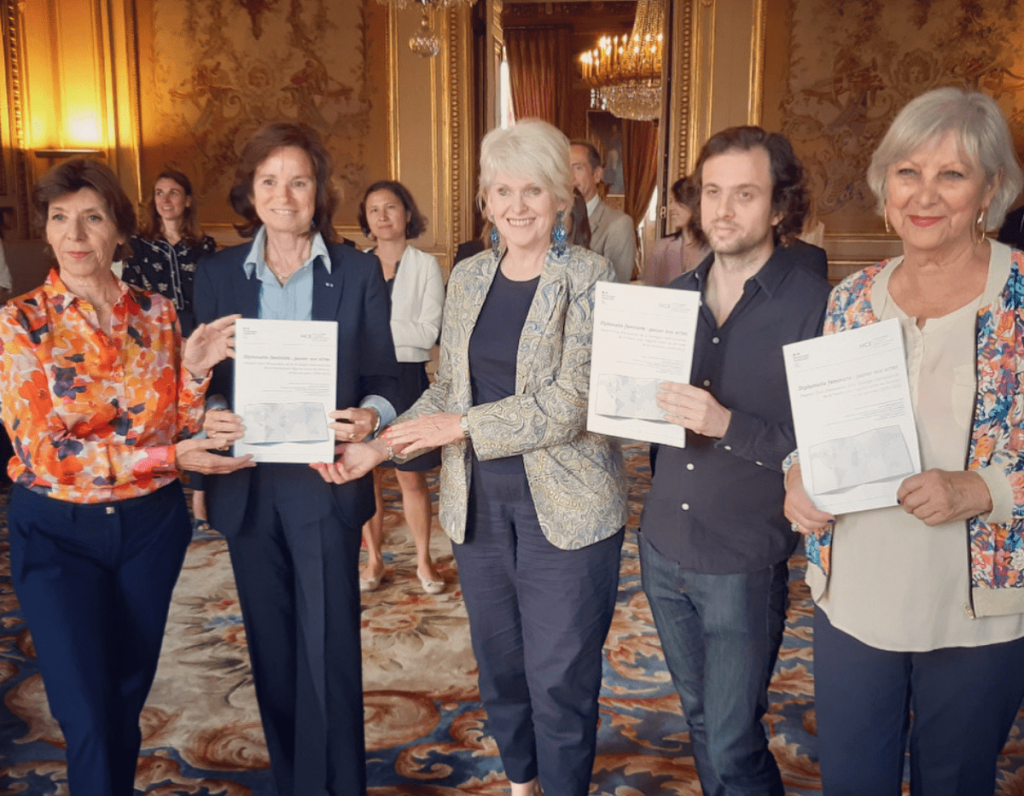
The High Council for Equality has submitted its assessment report on France's "feminist diplomacy" strategy to Ministers Catherine Colonna and Isabelle Rome. Equipop contributed significantly to this report, which draws the government's attention to the level of ambition required to pursue a truly feminist foreign policy.
Yesterday, Monday, July 3, 2023, the High Council for Gender Equality (HCE) submitted its evaluation report entitled "Feminist Diplomacy: Taking Action - Final Evaluation Report on France's International Strategy for Gender Equality (2018-2022)" to Catherine Colonna, Minister for Europe and Foreign Affairs, and Isabelle Rome, Minister Delegate for Gender Equality, Diversity, and Equal Opportunities.
This is the culmination of several months of work by the "Feminist Diplomacy: International and European Issues" commission, co-chaired by Jocelyne Adriant-Mebtoul and Nicolas Rainaud, advocacy manager at Equipop. The commission members conducted some 20 hearings with a highly diverse panel of representatives from high-level institutions, such as ambassadors in capitals or at multilateral bodies (UN, NATO), the management of operators active in a wide range of fields (French Development Agency, Expertise France, Agency for French Education Abroad, Institut français), as well as the Directorate General of the Treasury.
Define, assume, finance
The report takes stock of the implementation of the 2018-2022 international strategy for equality, published one year before the official adoption of the term "feminist diplomacy" by the MEAE. After five years, the HCE points to three main shortcomings: French feminist diplomacy lacks a solid conceptual basis, it is not given enough political support, and it has insufficient financial and human resources. Progress has been made, but in order to move towards an effective feminist foreign policy, a real step forward is needed. With this in mind, the HCE has issued 18 recommendations based on three key areas: "define, commit, finance."
- clearly define the concept of "feminist diplomacy" or "feminist foreign policy" in an inclusive manner and in collaboration with feminist organizations;
- affirm the government's commitment at the highest level, particularly in European and international bodies;
- provide the strategy with adequate human and financial resources.
The HCE's recommendations must now be taken into account in the development of France's next international strategy for gender equality (2023-2027). The HCE will participate in discussions throughout the process. Equipop will continue to contribute to this work on behalf of the HCE, but also on its own behalf in various working groups, in order to prioritize the expectations of West African feminists.
[vc_single_image image= »34557″ img_size= »large » alignment= »center » onclick= »custom_link » img_link_target= »_blank » el_id= »https://www.haut-conseil-egalite.gouv.fr/IMG/pdf/hce-inter-rapport_diplomatie_feministe_2018_2022-vdef.pdf » link= »https://www.haut-conseil-egalite.gouv.fr/IMG/pdf/hce-inter-rapport_diplomatie_feministe_2018_2022-vdef.pdf »]