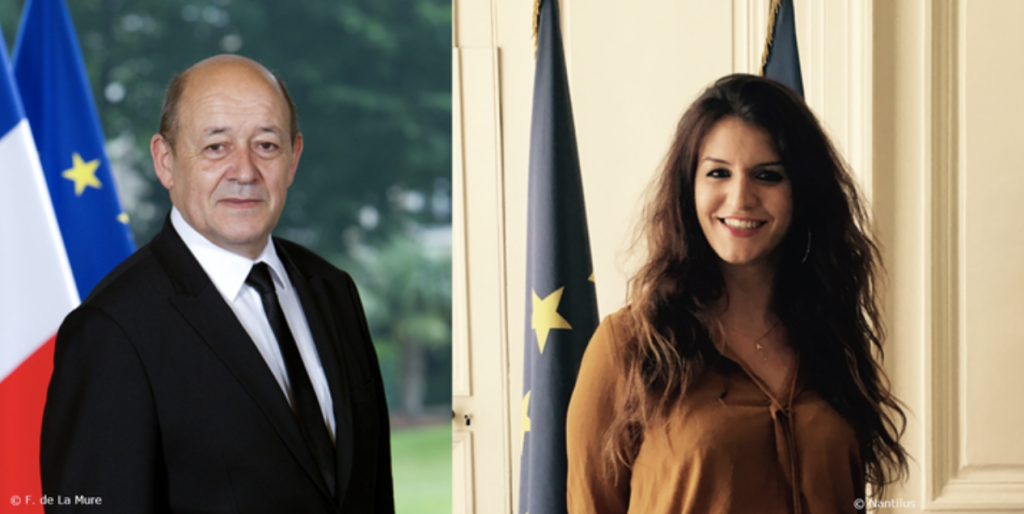
At the beginning of 2019, the President of the Republic loudly proclaimed that France would adopt a truly feminist diplomacy. Jean-Yves Le Drian elaborated on this announcement alongside Marlène Schiappa in an op-ed published in Libération on March 8. In doing so, France joins the ranks of countries—from Sweden to Australia to Canada—that place the fight against gender inequality at the heart of their foreign policy approach. Equipop welcomes this development. It is a very significant step forward for our country's international action. But for this political will to have the credibility it deserves, it must be woven into all of France's foreign policy tools and initiatives, starting with the future framework law (LOP) on solidarity-based development and the fight against global inequalities, which will set the guidelines for 2020-2025.
LOP: in the draft text, the numbers don't add up for feminist diplomacy
On Friday, March 22, Equipop participated in a second exchange with the Minister for Europe and Foreign Affairs and other members of the National Council for Development and International Solidarity (CNDSI), specifically dedicated to the revision of the LOP of July 7, 2014. Our message was simple: it's not enough! The commitment expressed at the highest level that France will pursue a feminist diplomacy is not sufficiently reflected in the draft law. Therefore, first, this political priority must be given greater visibility in the text and, second, the means for its implementation must be more clearly established.
The feminist approach is not sectoral but cross-cutting. The text must treat it as such, which is not currently the case. The word "feminist" appears for the first time only on page 23. Furthermore, neither the principles of action nor the strategic guidelines presented make any mention of it at this stage. This feminist approach must also be reflected in the choice of words. Words matter, as the minister himself has emphasized on numerous occasions, including within the CNDSI. However, the semantics used in the bill contribute to making women invisible (dominance of the masculine, no systematic feminization of names, use of the expression "human rights" even though the minister had spoken in favor of the name "Human Rights and Development Strategy").
With regard to the priorities outlined in this text, we naturally welcome the promotion of a rights-based approach, and in particular the fact that France is clearly positioning itself in favor of defending the most basic and controversial rights: the rights to freely dispose of one's body and to decide on one's sexuality. We must also welcome the prioritization of promoting better representation of women in decision-making spaces and better access to resources through, on the one hand, the funding of feminist associations and movements and, on the other hand, the economic empowerment of women. However, we believe it is essential that this text specifies the methods and means to be used.
"Put our money where our mouth is."
With regard to financial resources, as proposed by Ms. Clapot and Ms. Dumont in their report on the place of women's rights in French diplomacy, it is a question of " put our money where our mouth is ." In this regard, it is essential to move towards the integration of gender-responsive budgeting by creating an annex to the finance bill ("budget yellow") detailing the funds allocated by France to women's rights at home and abroad (recommendation 36 of the report).
Furthermore, let us agree once and for all on the objectives relating to gender-responsive ODA, and in particular on the markers that enable us to monitor our commitments. We propose that France set itself the target that by 2025, 85% of aid should be marked 1 or 2 and 20% should be marked 2 (1). This text must be accompanied by a program to achieve this, because at the moment it is not clear how we will move from the current 28% to 50% and then 85%. This is even more difficult for marker 2, where we are currently at around 3%.
The Minister for Gender Equality and Anti-Discrimination recently announced a €120 million fund for feminist associations. This represents an unprecedented boost for the advocacy work and grassroots interventions of these largely underfunded agents of change. It remains to be seen how these €120 million will be allocated. Will it go through the AFD (French Development Agency) only? The €120 million must appear in the budget planning. What types of projects will it support? What will the financing arrangements be for small organizations?
Finally, in terms of both method and resources, we cannot simply hope that this ambitious approach will be based on the goodwill of the teams working within the ministry and agencies. We need dedicated professionals and we must continue our efforts to ensure that this approach is embraced, both at the ministry level and by the main operators, because there is a great deal of resistance and very little support for this issue.
Ultimately, the draft deserves to be reworked if the goal is indeed to translate political rhetoric promoting gender equality into concrete action as a priority for France. Without this, the rhetoric will remain wishful thinking and empty words.
(1) The OECD Development Assistance Committee (DAC), which monitors aid for gender equality and women's rights, has defined markers to identify gaps between countries' political commitments and financial support. Monitoring these markers enhances the transparency and accountability of funding for gender equality and women's rights. A score of 1 is given to any project or policy that includes gender equality as an important objective, even if it is not the main one, and a score of 2 is given to any project or policy for which gender equality is the main objective.