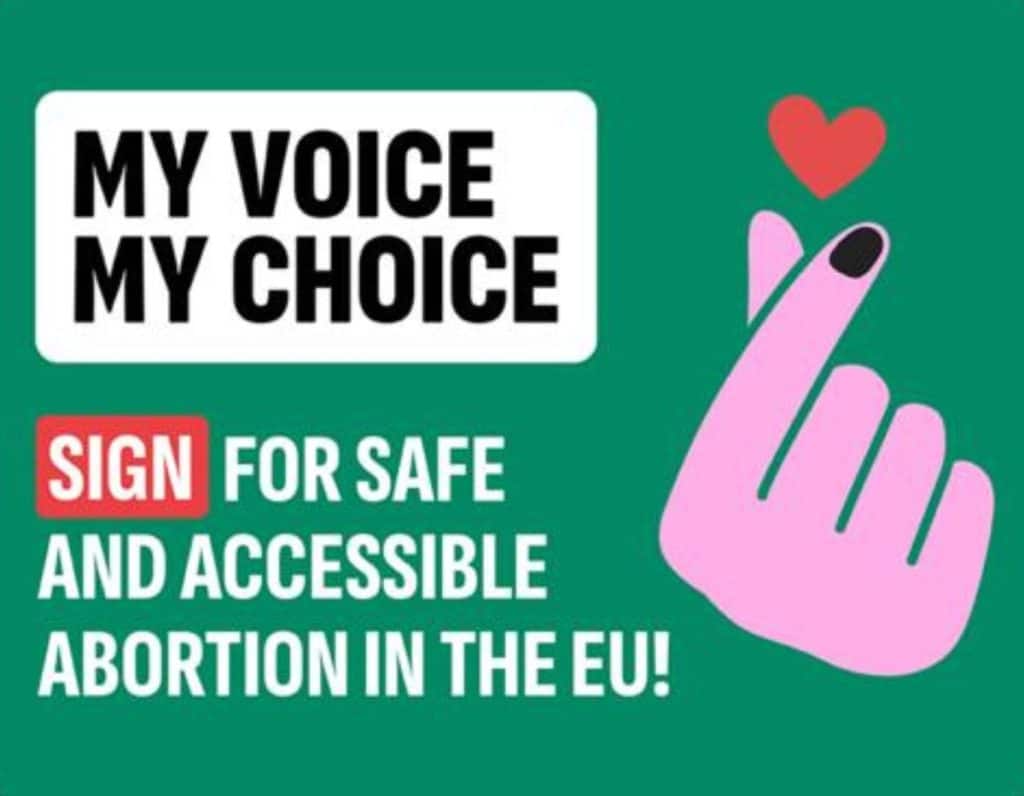
Several major European feminist organizations have launched "My Voice My Choice," a European citizens' initiative calling on the European Union to provide free, safe, and accessible abortion services to anyone in Europe who wants one. In a context where the far right, historically opposed to the rights of women and LGBTQIA+ people, is achieving historic results in the European elections, Equipop supports this crucial initiative to guarantee access to this fundamental right for all, and calls for it to be signed and shared by as many people as possible.
“My Voice, My Choice”: for free, safe, and legal abortion in Europe
On April 24, a few weeks after the historic victory that saw abortion rights enshrined in the French constitution, thanks to the massive mobilization of feminist movements, several major European feminist organizations launched the European Citizens' Initiative "My Voice My Choice”, which aims to guarantee free, safe, and unrestricted access to abortion in Europe. The initiative proposes the creation of a financial mechanism by the European Union to help Member States that volunteer to provide legal and safe abortion services to anyone in Europe who still does not have access to them, in a spirit of solidarity. If it collects one million signatures, this initiative will have to be examined by the European Commission. At a time when the fundamental rights of women and LGBTQIA+ people, and in particular sexual and reproductive rights and health, are under attack from anti-rights actors and far-right movements around the world and in Europe, and at a time when the far right has never been so numerous, both in the European Parliament and on the European national political scene, such an initiative is absolutely vital to combat this backlash against gender equality. Although human dignity, gender equality, and non-discrimination are fundamental to the European project, today in Europe, nearly 20 million women still do not have access to abortion.
Abortion, a right that remains restricted and under threat in Europe
Although most European Union member states have decriminalized abortion, many still restrict this right, sometimes making it virtually inaccessible. In Poland, for example, abortion is prohibited except in cases of rape, incest, or if the pregnant person's life is in danger, which they must prove. In Malta, it is only permitted if the pregnant person's life is in danger or if the fetus is not viable. In Hungary, people who want to have an abortion can do so within 10 weeks but must bear the full cost, listen to the fetus's heartbeat, and undergo a psychological interview, all of which are obstacles designed to dissuade them from having an abortion. Barriers to accessing abortion do not only exist in countries where it is prohibited. The lack of coverage for abortion-related costs, as well as the shortage of personnel performing this procedure and geographical disparities in access to public healthcare, which can generate additional financial costs, are also major obstacles to accessing abortion rights. In Austria, the cost of abortion, between €300 and €1,000 and subject to 20% VAT, is entirely borne by the person seeking an abortion. In Spain, although abortion is permitted without conditions within 14 weeks, the majority of doctors in public hospitals are conscientious objectors. Women must go to a private clinic to have an abortion and pay significant medical fees. The right to abortion must also be viewed through the lens of intersectionality, as marginalized groups currently have the least access to safe and legal abortion services. Inequalities in access to information on sexual and reproductive health, discrimination in access to healthcare, and the persistence of racist, LGBTQIA+phobic, ableist, and fatphobic biases, discourse, and attitudes within medical institutions all act as barriers to access to abortion for people from marginalized groups. Furthermore, the historic rise of far-right parties in Europe jeopardizes progress in gender equality and the fundamental rights of women and LGBTQIA+ people. Where it is in power, the public policies pursued by the far right are a practical implementation of the agenda of anti-rights movements. In Italy, abortion is legal within the first 90 days of pregnancy but is difficult or even impossible to access depending on the region, with most doctors invoking the conscience clause. Since 2022, the government has been led by Giorgia Meloni of the far-right Fratelli d'Italia party, who opposes abortion rights. It has implemented several measures further restricting abortion rights, such as recently allowing anti-rights groups to enter family planning clinics. However, barriers to accessing abortion rights in Europe have serious and very real consequences. Studies all agree that not considering abortion a fundamental human right and essential healthcare does not reduce the use of abortion. On the contrary, it directly endangers the physical and psychological health, integrity, and even the life of the person seeking an abortion, forcing them to resort to dangerous alternatives or to continue with an unwanted pregnancy, which itself carries risks for the pregnant person and the fetus. Inaccessibility to abortion rights also places significant economic pressure on those seeking abortions and their families, and has a significant impact on their professional and educational lives. Finally, restricting this right reduces women to a reproductive role and deprives them of their right to freely control their own bodies.