From economic empowerment to public advocacy, including increased participation by women and young people in decision-making forums: the experiences of twelve feminist and youth organizations, supported by Equipop and AFD, show that flexible funding and initiatives rooted in local realities can contribute to concrete changes in the implementation of the Women, Peace, and Security and Youth, Peace, and Security Agendas.
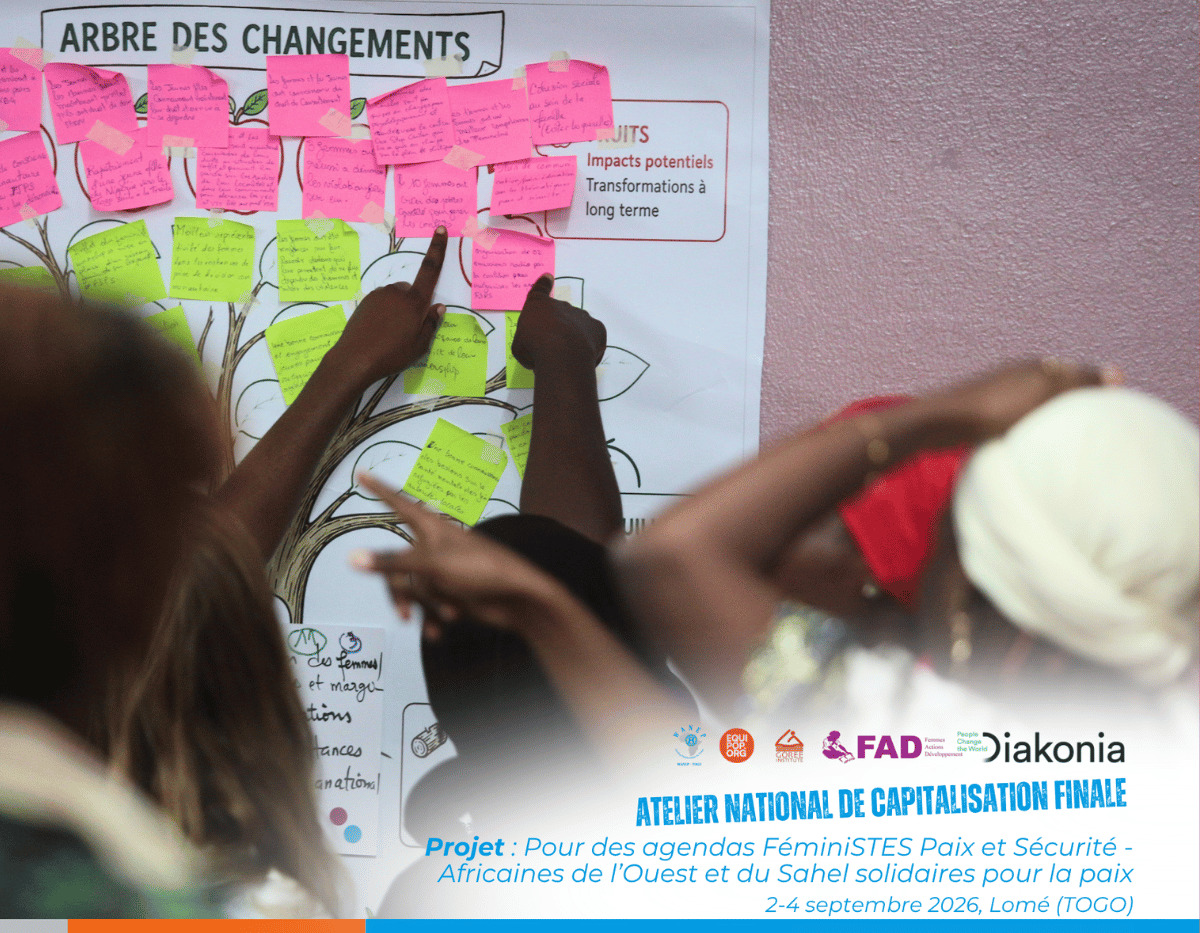
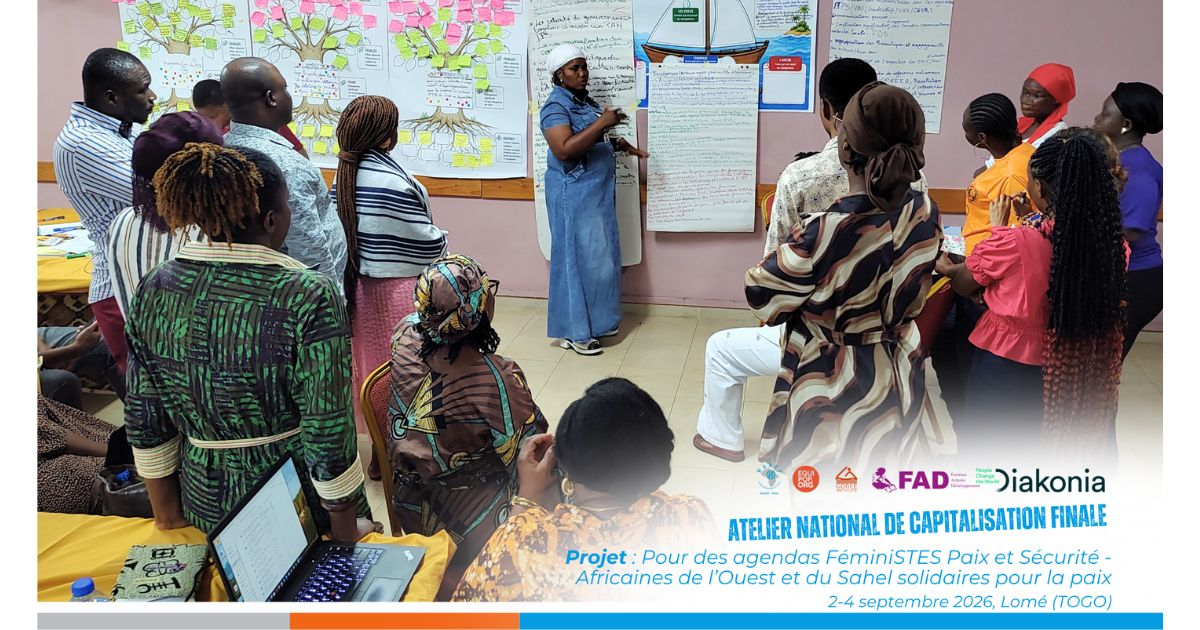
From September 2 to 4, 2026, in Lomé, twelve Togolese feminist civil society organizations analyzed the results achieved as part of the project “Toward Feminist Agendas, Peace and Security—West African and Sahelian Women United for Peace,” as well as the lessons they have drawn from the experience and their actions, during a national knowledge-sharing workshop. Training, individualized support, flexible funding, and support for both formal and informal initiatives: the approach implemented by Equipop enabled each organization to act in a way that closely reflected local realities.
Implemented in six countries (Benin, Burkina Faso, Côte d’Ivoire, Niger, Chad, and Togo), this project aims to provide technical and financial support to feminist civil society actors working on the Women, Peace, and Security and Youth, Peace, and Security agendas. It is implemented by a consortium comprising Equipop (lead partner), FAD, Diakonia, and the Gorée Institute, with financial support from the French Development Agency (AFD).
What made the difference? First, the commitment, determination, and dynamism of feminist organizations in the Savanes, Maritime, and Central regions. Second, the approach adopted by Equipop: training on feminist approaches and on the FJPS agendas, for example, as well as support for organizational self-assessment, complemented by individualized guidance and flexible funding, allowing each organization to use these resources according to its needs and priorities. Some chose to fund their strategic plans; others to strengthen their support for local women’s organizations; and still others to acquire the materials and equipment necessary to carry out their initiatives .
Another distinctive feature of the project is its broad scope. The initiative is not limited to formal CSOs; it also supports informal movements and local activists working on relevant feminist projects. This approach, which is attuned to the needs and realities of each participant, helps explain the changes discussed during the workshop.
The first concerns the development of income-generating activities (IGAs), which are an important tool for preventing violence and empowering women. Women’s financial empowerment may be seen by their husbands as an asset when it helps improve the household’s standard of living, but it can also become a source of conflict by altering the dynamics of power relations within some households: “Since I joined the group of women engaged in IGA, there has been less violence at home. I bring money home, which makes my husband happy.” Beyond these effects on family life, financial empowerment can also lead women to take on greater responsibilities within their communities. In Tchaoudjo, in the Central Region, a woman who developed small-scale agricultural enterprises as part of the project went on to become deputy mayor of her town—a concrete example of empowerment.
The second change concerns women’s and young people’s awareness of and exercise of their rights. Numerous accounts indicate that women are speaking out more in public spaces, particularly on gender-based and sexual violence (GBV). In Sokodé, imams trained on these issues by feminist CSOs ask for the ages of prospective spouses before officiating a marriage, to ensure that the young woman is of marriageable age.
The third change highlights the increased capacity of CSOs to create spaces for dialogue between young people and public authorities on peace and security issues. In Togo, they found a willing ear in the Director of Youth Affairs, who participated in several of their meetings, including the event organized as part of the celebration of Resolution 2250. On that occasion, he committed to developing a National Youth Action Plan by the end of 2026. “It’s very important for us to stand alongside youth organizations, to meet with them, to listen to them, and to understand their challenges, so that we can truly grasp the realities on the ground. We conduct assessments, but most of the time, these assessments aren’t carried out at the grassroots level. This project has therefore truly allowed us to connect with young people and women through the various organizations.”
The project “Toward Feminist Agendas for Peace and Security—Women of West Africa and the Sahel United for Peace” is funded by the French Development Agency (AFD) and implemented by a consortium comprising Equipop, FAD in Niger, Diakonia in Burkina Faso, and the Gorée Institute in Senegal, across six countries in West Africa and the Sahel: Benin, Burkina Faso, Côte d’Ivoire, Niger, Chad, and Togo.