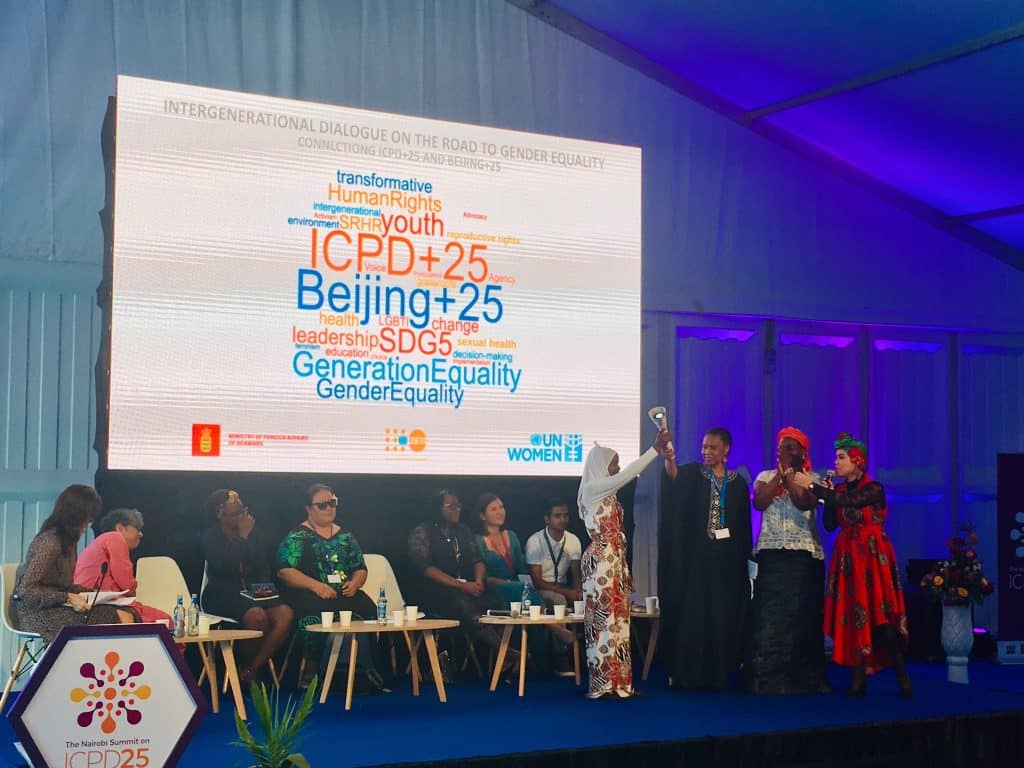
From November 12 to 14, a delegation from Equipop will participate in the Nairobi summit—ICPD+25—celebrating the 25th anniversary of the International Conference on Population and Development. This is an opportunity to recall the turning point that was the 1994 Cairo conference, but above all to take stock of what the legacy of Cairo means for the years to come.
Cairo, a turning point: the person at the center of approaches
The International Conference on Population and Development (ICPD), held in Cairo in 1994, marked a paradigm shift in development policy. Until then, the demographic approach had been the norm. In Cairo, the goal was to move beyond this framework and refocus on people's rights and improving their living conditions, particularly those of women. It was in this spirit that Equipop was created a few months earlier to take part in the French delegation to Cairo, led by Simone Veil.
The Cairo Action Program represented a real turning point in the recognition of reproductive health and rights at the international level. Its ambitious content was adopted by all United Nations member countries—and that is another reason why it was such a decisive moment.
Reproductive health recognized as a human right
In total, 200 recommendations were included in the action program for improvements in health, development, and social well-being. A deadline of 20 years was set. This program provided the first international definition of reproductive health and devoted an entire chapter to this topic (Chapter VII). It also recognized reproductive rights as human rights for the first time and, like other rights, as an essential condition for development.
A year later, the Beijing Platform for Action (4th World Conference on Women) reaffirmed the principles of Cairo. It once again enshrined the improvement of women's living conditions and, more broadly, gender equality as pillars of human rights and foundations of social justice. And it went a step further than Cairo, notably with the use of the phrase "The fundamental rights of women include the right to be masters of their own sexuality."
Where are we today? Concepts reaffirmed, but not expanded
Since 1995, two broader, consensus-based frameworks have emerged: the Millennium Development Goals (MDGs), which were in place between 2000 and 2015, and the Sustainable Development Goals (SDGs). What do the texts in force until 2030 say?
→ SDG 3.7 “By 2030, ensure universal access to sexual and reproductive health-care services, including for family planning, information and education, and the integration of reproductive health into national strategies and programs.”
→ SDG 5.6 “Ensure universal access to sexual and reproductive health care and enable all to exercise their reproductive rights, as set out in the Programme of Action of the International Conference on Population and Development and the Beijing Platform for Action and the outcome documents of their respective review conferences."
We could rejoice that sexual health issues are mentioned twice. The principles of Cairo and Beijing are thus clearly reaffirmed. However, in 2015, conservative states prevented any improvement on the concepts established in Cairo, and the compromise reached was to repeat them in order to avoid mentioning "sexual rights," which did not appear in the Cairo action program (which was therefore limited to reproductive rights and sexual health).
And, in fact, at present, no internationally agreed text internationally agreed text recognizes sexual rights, which include the right to abortion. It is this same concern for compromise that makes the wording of targets 3.7 and 5.6 so convoluted, while others are concise (SDG 3.3: "End AIDS by 2030"). Writing four-line targets rather than mentioning universal access to SRHR, sexual and reproductive health and rights (which, for example, have been the focus of a specific strategy by the French Ministry of Foreign Affairs since 2016): this is what underpinned the SDG negotiations.
Consequently, it is because the Cairo and Beijing texts have not yet been superseded that they remain relevant today. This is regrettable, because it means that in 2030, when the United Nations member states take stock to determine whether the Sustainable Development Goals have been achieved, the recommendations issued 36 years earlier will be used as a basis for their assessment.
Modernizing Cairo's heritage
One conclusion is therefore clear: in the near future, we must build on the legacy of Cairo, but not be content with that alone. For organizations such as Equipop and its partners, this will mean adopting a two-pronged approach.
On the one hand, we must continue to work tirelessly to ensure that SRHR are included in their entirety in international standards, i.e., by adding sexual rights to the current formula of "sexual and reproductive health and reproductive rights." This is the "spirit of Cairo," adapted to the context of 2019.
At the same time, without waiting for this turning point to materialize, we must activate the main levers in terms of programs and advocacy to make concrete progress on SRHR for people around the world. And if we had to name just one, comprehensive sexuality education seems to be the most crucial.
It is clear that while the Cairo and Beijing conferences have led to significant progress in many areas related to women's and girls' rights, there is still a long way to go. That is why the celebrations of their 25th anniversary in 2019 and 2020 must be focused on the future and on action. With this in mind, Equipop is present in Nairobi and will be working towards the Generation Equality Forum (Beijing+25) in Paris in July 2020.