In Senegal, gynecological and obstetric violence remains largely unknown and trivialized, even though it undermines the health, dignity, and fundamental rights of women and girls. Still rarely recognized as structural violence in health policies, it perpetuates power relations and fuels gender inequalities.
During discussion groups organized by the VGO-Senegal consortium as part of the project to combat VGO in Senegal, "Our bodies, our health, " participants expressed a common need: to better understand their bodies and their rights, to be able to defend themselves against violence experienced in healthcare settings, and to strengthen their capacity for collective action.
From this liberated discourse and shared aspiration arose the idea of creating workshops designed as a concrete, political, and collective response to gynecological and obstetric violence.
Feminist self-defense: a tool for emancipation against all forms of sexual and sexist violence
Feminist self-defense is part of a comprehensive approach to combating all forms of sexual and sexist violence—whether physical, verbal, psychological, or institutional, and regardless of where it occurs (healthcare facilities, academic settings, professional environments, etc.). It recognizes that gynecological and obstetric violence are not isolated incidents, but part of a continuum of sexist violence rooted in patriarchal and medicalized systems. These systems legitimize power relations in healthcare settings, render women's suffering invisible, and impose oppressive norms on their bodies. Feminist gynecological self-defense, as a political and collective practice, deconstructs these mechanisms of domination. It challenges sexist norms and allows each woman to question oppressive norms, regain control of her body, her voice, and her ability to act. This approach has also led to a better understanding of the symbolic power that caregivers wield over users of healthcare services. Beyond simple physical defense, it involves mental and verbal empowerment based on sisterhood, solidarity, knowledge of rights, and feminist resistance. It is an invitation to overturn power relations, to assert oneself in all spaces—including medical ones—and to build a society where women's rights are truly respected.A feminist and inclusive methodology driven by a team of committed experts
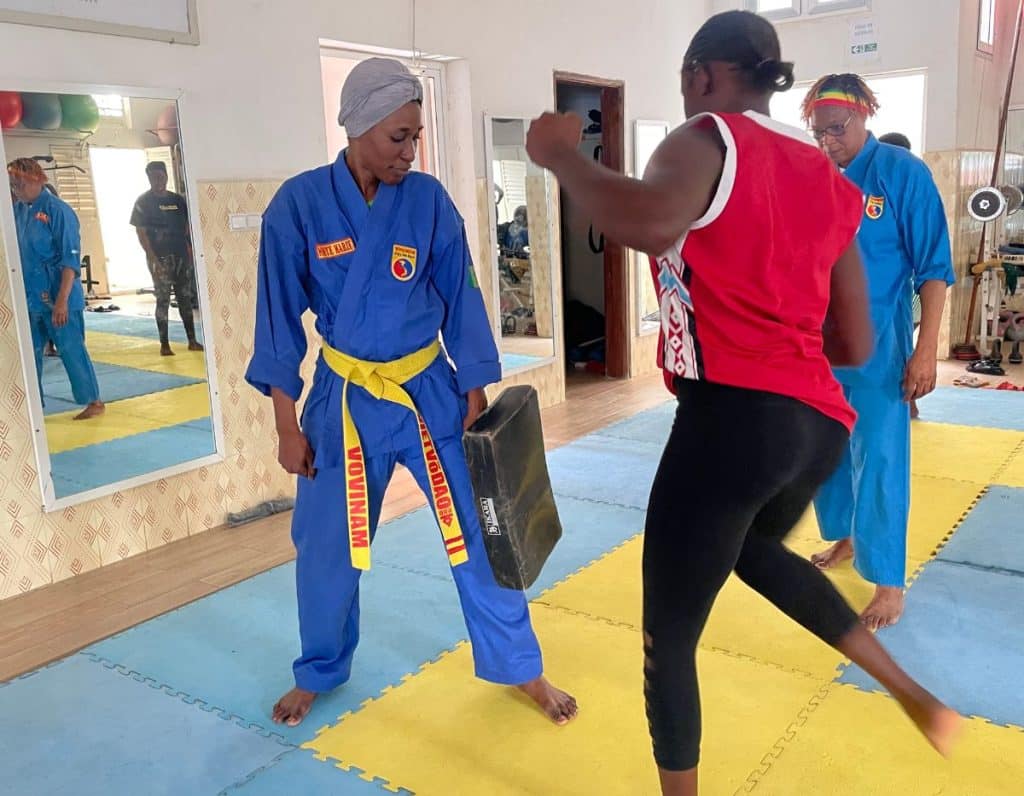
The feminist gynecological self-defense program was developed jointly within the consortium, taking a critical approach that took into account the intersectionality of the participants and the expertise mobilized. This initial experiment brought together 60 participants aged 15 to 65, divided into four groups. For 45 days, they attended sessions combining psychological, verbal, and physical self-defense, concluding with a final group session. The psychological and verbal workshops, led by Aminata Libain Mbengue, a feminist psychologist, addressed assertiveness, emotion management, and the deconstruction of medical and systemic violence. These sessions also included self-care tools and improved knowledge of the body (self-examination of the vulva, screening for cancer and sexually transmitted infections, etc.). She highlighted the link between gender-based and sexual violence (GSV) and gynecological and obstetric violence (GOV), proposing tools to understand them as a continuum and resist them in all areas of life. The physical sessions were led by Coach Marie, Coach Sadio, Coach Mame Diarra, and Coach Adama, all champions of Africa or the world in martial arts and committed to the feminist transmission of Vovinam. Participants learned techniques for escaping, striking, defending against grabs, and using everyday objects. Stress management, fear, emotional reactions, and first aid were also covered in an inclusive and supportive environment. The participants experienced realistic scenarios... to integrate these techniques into an inclusive and supportive environment. Particular attention was paid to the chosen mix of participants, allowing each woman to learn the tools at her own pace, in a safe and non-judgmental environment. The complementarity between mental, verbal, and physical dimensions, supported by a committed multidisciplinary team, enabled comprehensive support. It strengthened the individual and collective empowerment of the participants. Participants were thus able to develop concrete strategies to assert their rights, defend themselves against violence, and build networks of feminist solidarity. Beyond individual empowerment, this initiative has contributed to the development of a shared culture of resistance, promoting intergenerational transmission and the perpetuation of lasting collective power.Defend yourself, but above all, don't be alone anymore.
The participants' testimonials illustrate a profound transformation."I feel stronger. I know I can defend myself, but above all, I am no longer alone." Mariama, mother in Rufisque "This is the first time I've talked about what happened to me at the hospital. Now I know it was violence." Fatou, young girl in BargnyThese words are political. They bear witness to the birth of a collective consciousness, an ability to name violence and assert one's rights. Several women now want to pass on what they have learned by becoming community ambassadors for feminist gynecological self-defense.
"It is the participants themselves who, by taking ownership of the tools, become agents of change in their neighborhoods. They reinforce a dynamic of local solidarity and social transformation driven by those most directly affected." Aminata Libain Mbengue, psychologist and feminist.