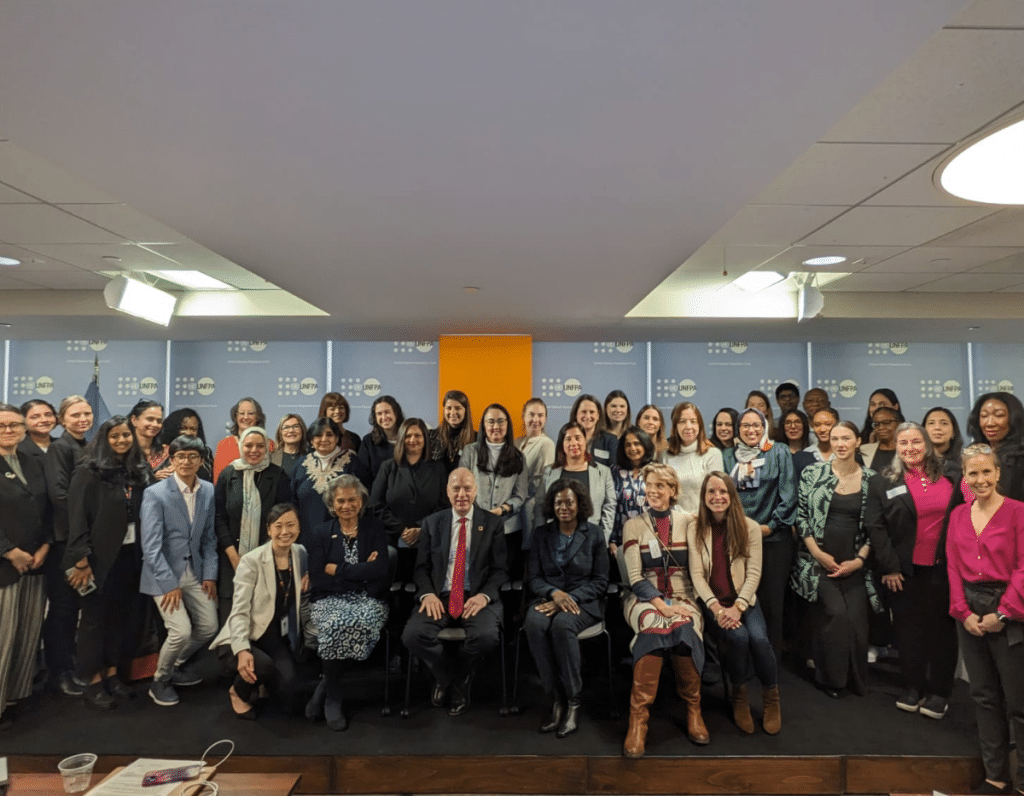
In this year of ICPD+30, Equipop was invited by UNFPA to take part in the Expert Group meeting to review achievements in reproductive agency, collectively refine measurement indicators, and plan for the future of SRHR. Equipop proposed broadening the methodology to include an intersectional feminist approach that takes into account the entire life cycle of girls and women and monitors the phenomenon of "backlash" in order to better respond to it.
As we approach the final third of the 2030 Agenda for Sustainable Development, and as we prepare to celebrate the 30th anniversary of the ICPD (Cairo Conference on Population and Development, 1994), thethe United Nations Population Fund (UNFPA) is questioning the effectiveness and real power for change of indicators 5.6.1 and 5.6.2 of Sustainable Development Goal (SDG) 5, dedicated to the empowerment of girls and women. They measure target 5.6, "Ensure universal access to sexual and reproductive health care and enable all to exercise their reproductive rights, as set out in the Programme of Action of the International Conference on Population and Development and the Beijing Platform for Action and the outcome documents of their respective review conferences." The Future Summit, to be held in September 2024, represents an opportunity to form a bold and ambitious normative framework for gender equality and SRHR. It is also a space where we must fight against the backlash and attacks on feminist movements. Equipop, along with some 50 experts from civil society, academia, government, and international organizations, took part in the meeting of the Expert Group on March 20 and 21, 2024, in New York.
| Indicator 5.6.1: Proportion of women aged 15 to 49 who make their own decisions about sexual relations, contraceptive use, and reproductive health care, based on their own knowledge. |
| Indicator 5.6.2: Number of countries with laws and regulations guaranteeing women and men aged 15 and older equitable and unrestricted access to sexual and reproductive health care, as well as information and education in this area. |
The group closely analyzed indicators 5.6.1 and 5.6.2, which fall under the responsibility of UNFPA. The general observation was that quantitative methodological approaches have limitations, producing data that does not really impact the lives of those most affected. The need was therefore identified to involve CSOs, young people, and feminists in order to move towards an approach based on reproductive justice, which would include qualitative and person-centered aspects to take into account individual preferences, needs, and values, as well as the local, national, and regional context in which SRHR decisions are made (measurement ecosystem).
Sharing the conclusions of the Cotonou SRHR Symposium
Equipop's main contributions were made during Panel 4, entitled "Civil Society Perspectives." First, we shared examples of initiatives (SRHR Symposium, Caravans, #CompterPourToutes) that aim, among other things, to raise awareness of existing SRHR laws and regulations in order to make them more accessible and give marginalized people the opportunity to express themselves and reclaim their bodies. The discussion groups and intergenerational, transnational, and intersectional spaces co-created by Equipop are an important source of qualitative data and highlight forgotten topics such as female pleasure, positive and enthusiastic sexuality, gynecological and obstetric violence, medical racism, and menopause. This first point ties in with the major challenge raised during the discussions, which concerns indicator 5.6.2 in particular and emphasizes the fact that most countries have the necessary laws and regulations in place, but that this in no way guarantees their implementation or an ecosystem conducive to SRHR. Our attention should instead turn to the proliferation of these texts, in order to clarify their interpretations and remove the obstacles that prevent their effective implementation. Secondly, we suggested taking into account the innovative potential of intersectional, holistic, and gender-sensitive feminist approaches, which complement quantitative methodologies and allow us to go beyond numerical data to take into consideration the experiences and practices shared by those most affected. Finally, we discussed adding an indicator that would measure the use, accessibility, and actual implementation of laws and regulations on SRHR, or an indicator that would measure how girls and women are received in health facilities. This second point echoes the challenge raised in relation to indicator 5.6.1, which focuses heavily on contraceptive use among married women of childbearing age and is therefore not sufficiently inclusive to consider women throughout their entire life cycle, as well as different sexual orientations and types of relationships. It was also noted that indicator 5.6.1 does not take into account the satisfaction component or the environment in which a decision was made (sociocultural, economic-political, power relations, gender norms). Equipop identified as a major challenge the rise of the "backlash, " the constant questioning of the rights of girls and women, as well as gender minorities. Consequently, we proposed to take seriously the idea of an indicator that would measure this phenomenon, an idea that emerged during the discussions and which highlighted the need to present a united front against regression.