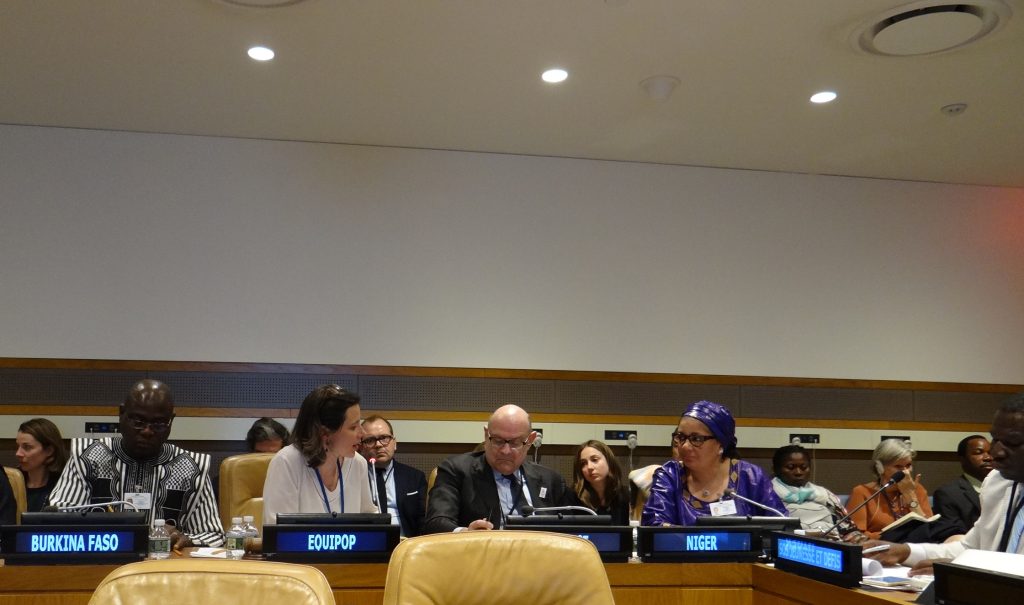
On April 3, 2017, the French government and Equipop co-organized a session to highlight the importance of addressing young people's sexual and reproductive health needs. Before a packed audience, the focus was on West Africa, thanks to high-level representation.
Two weeks after the end of the CSW, another commission of the United Nations Economic and Social Council (ECOSOC) is meeting in New York: the Commission on Population and Development, now in its50th session. While the plenary sessions and negotiations leading up to the final text will take place over five days, the French government and Equilibres & Populations organized a "side event" on Monday.
Its objective was threefold. First, it sought to highlight the issue itself: the specific sexual and reproductive health needs of young people, a cross-cutting issue involving social progress, public health, demographics, development, and political stability. The second objective was to focus on West Africa, a region where this issue is particularly acute. Finally, and just as importantly, it sought to create political momentum through a high level of participation. In fact, two West African ministers took the floor: Rakiatou Christelle Kaffa Jackou, Minister of Population of Niger, and Smaïla Ouedraogo, Minister of Youth of Burkina Faso. France was represented at the CPD for the first time by a member of the government, Jean-Marie Le Guen, Secretary of State for Development and Francophonie.
The executive director of UNFPA, the UN agency responsible for these issues, also made a point of speaking personally at the event. West African civil society made its voice heard through Célestin Compaoré, coordinator of SOS Jeunesse et Défis, a partner association of Equilibres & Populations in Burkina Faso and a member of the Alliance Droits et Santé network alongside it. The executive director of Equilibres & Populations, Aurélie Gal-Régniez, introduced and moderated the discussions.
A shared priority, a strong political commitment
The ministers from Niger and Burkina Faso emphasized the importance, in their respective countries where more than half of adolescent girls have their first sexual intercourse between the ages of 15 and 19, often within marriage, of meeting the needs of this key population in terms of appropriate information and services. Niger in particular presented an ambitious multisectoral program developed with the support of the World Bank as part of the "Sahel Women's Empowerment and Demographic Dividend Project (SWEDD)," which aims to empower young girls, provide access to contraception, and promote sex education.
Burkina Faso, for its part, highlighted its program to develop listening and guidance centers for young people. The French Secretary of State for Development said he was "extremely impressed by the political courage of African leaders who are embracing the idea of reforming their societies and implementing public policies to promote women's empowerment and equip themselves with the means for their development ." He denounced the dangerous attack on women's rights by the US Gag Rule policy and affirmed France's willingness to join the "She Decides" initiative launched by the Netherlands.
Strategies to promote
A consensus emerged on the value of certain strategies. Strengthening young people's ability to make informed choices was identified as a priority. In this context, the implementation of comprehensive sexuality education remains a crucial challenge, as the Executive Director of UNFPA pointed out. However, meeting the needs of adolescents requires promoting an enabling environment and supporting changes in attitudes and laws. "Adults must also be educated," reiterated the Minister of Burkina Faso. This includes training medical staff to provide services that are tailored to young people, confidential, and non-judgmental.
More broadly, this involves promoting social dialogue with all citizens on this societal issue. Finally, the link between promoting sexual and reproductive health among young people and promoting gender equality has been highlighted on numerous occasions. Both approaches require breaking down deeply rooted stereotypes in our societies and reconsidering the distribution of power within them.
Foundations for the future
This event, held on the first day of a long week of negotiations between United Nations member states, highlighted fundamental issues that may not be addressed directly in the final text of the CPD. With this in mind, Equilibres & Populations will continue its work in support of national delegations throughout the week. And, of course, beyond this week and beyond the United Nations, Equilibres & Populations and its partners inthe Rights and Health Alliancewill continue their work to support policies and programs that translate this stated political will into action.