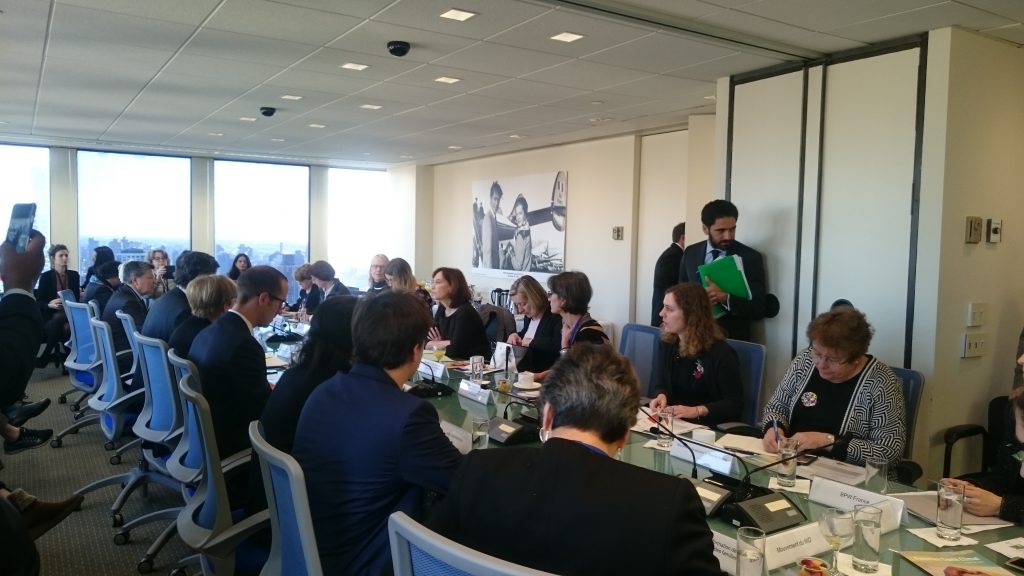
On Friday, March 24, the 61st Commission on the Status of Women concluded in New York. Equilibres & Populations followed the negotiations, which were more tense than ever. In this context, the final text is relatively satisfactory in substance—a result due in part to the activism of certain states, such as France, and the vigilance of civil society.
Every year, the Commission on the Status of Women (CSW) is the major international event on gender equality issues. Beyond sharing experiences on a predefined theme, which this year was "women's economic empowerment in a changing world of work," the main challenge remains, year after year, to assess diplomatic power relations. However, for the 61st meeting of the commission, the context was more tense than ever. It was the first meeting since Donald Trump's election. A much more conservative American position than in the previous eight years was anticipated. The risk of a deadlock in negotiations was therefore real, as the American voice was expected to reinforce those of Russia, the Vatican, and other states that systematically slow down the adoption of progressive language on women's rights.
Endless negotiations
In fact, diplomatic negotiations were extremely delicate during the weeks of talks. Some evenings, discussions lasted until 5 a.m., symbolizing the difficulty of reconciling different points of view. In the end, even though the Nordic countries, for example, threatened not to sign the final text, the commission did eventually produce its "agreed conclusions." And, in terms of the substance of the issues, this text is far from disastrous. It is on the issues central to the work of Equilibres & Populations that the situation is least clear-cut. While the commission calls on governments to ensure access to "sexual and reproductive health and reproductive rights," this is a way of avoiding the term "sexual rights," which is much broader and guarantees effective respect for women's rights. However, such a status quo was largely predictable and almost desirable given the risks of regression in this area. To demonstrate its desire to defend these issues and not let conservative states gain ground, France issued a statement on behalf of 22 European Union countries, recalling that sexual and reproductive rights are essential prerequisites for the development of men, women, and girls.
Some notable advances
Progress has been made in other areas. The Commission calls on governments to develop and adopt gender-sensitive strategies to increase women's resilience to the impacts, particularly economic, of climate change. Violence and harassment against women was also mentioned, with a particular focus on the need to strengthen laws and policies promoting the return of victims of harassment and violence to the labor market. Finally, the language concerning "families" is constructive in that it recognizes the reality of diverse family structures.
Equilibres & Populations therefore notes that, despite increasing pressure, some of the demands made by feminist associations have been heard. We will continue to closely monitor negotiations relating to women's rights: we will be back in New York next week for the 50th Commission on Population and Development.