On March 8, the Ministry of Foreign Affairs unveiled its third gender strategy. It strongly builds on the work of the two previous strategies, although the issue of financial resources remains a concern. Four days later, Marlène Schiappa's speech at the UN clearly demonstrated France's political commitment to promoting gender equality. Let's take a look back at this pivotal week.
A new strategy extended to the whole of French diplomacy
International Women's Day provided an opportunity to renew France's strategic ambition to promote gender equality. On March 8,France launchedits International Strategy for Gender Equality (2018-2022), as announced in early February by theInterministerial Committee for International Cooperation and Development. The text is a continuation of the two previous strategies from 2007 and 2013. Reaffirming France's commitment to promoting gender equality, it develops several principles for action and concrete methodological elements that remained vague in the two previous versions. Another major difference is that, whereas the two previous strategies were confined to the field of French development policy, the 2018-2022 strategy extends to French foreign policy as a whole.
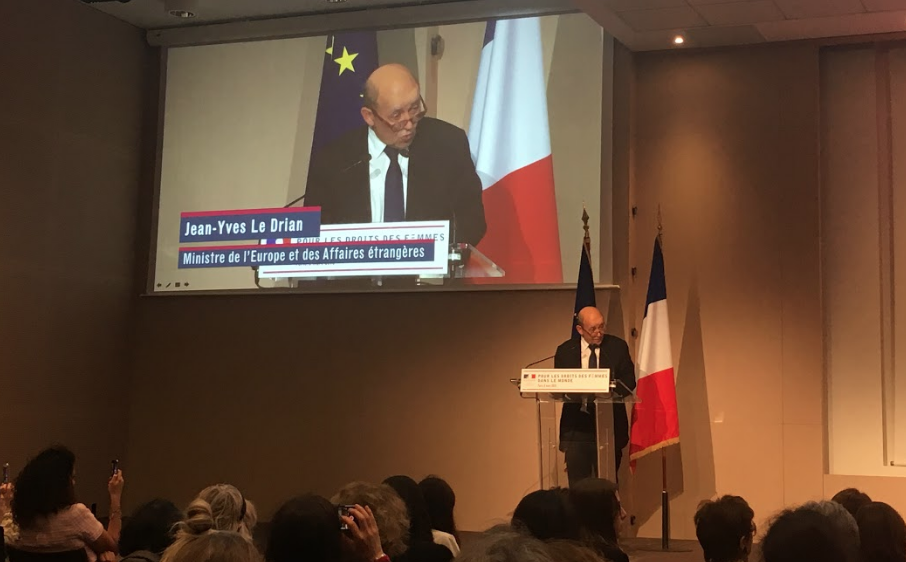
On March 8, the presentation of this new strategy was accompanied by proactive speeches from Marlène Schiappa and Jean-Yves Le Drian. The Secretary of State for Gender Equality and the Minister for Europe and Foreign Affairs used the term "feminist diplomacy." Sexual and reproductive rights and health, which are the most threatened rights worldwide, were also given special attention.
It was also in this context that Jean-Yves Le Drian declared himself "in favor of now definitively using the term 'human rights' rather than 'rights of Man.'" While this change is certainly a matter of language, it is nonetheless important.Equipop has been advocating the use of the term "human rights" for several yearsand welcomes this decision.
Is additional funding in line with strategic ambitions?
However, given the ambitious nature of this strategy, Equipop and its civil society partners question the financial resources made available. First of all, it is regrettable that the target of 50% of public development aid being "gender-responsive" chosen for this third strategy is not higher. This was already the threshold set between 2013 and 2017, and France is still far from reaching it (less than 30%). Furthermore, no clear budget for the implementation of the strategy has been mentioned. Announcing such a budget would have made the strategy more transparent and coherent.
Nevertheless, Marlène Schiappa provided a partial but relevant response to these questions on March 12. At the 62nd United Nations Commission on the Status of Women (CSW), the minister mentioned "an additional €10 million increase in funding for the 'She Decides' initiative for sexual and reproductive rights." This funding alone will not be enough to meet the challenges that the strategy aims to address. However, it is a step in the right direction and lays the foundations for a dynamic that needs to be amplified.
Even if we doubt the purely additional nature of these commitments, this is news we can welcome. On the one hand, because it demonstrates a desire to improve the allocation of funding dedicated to SRHR (Sexual and Reproductive Health and Rights). Until now, France had tended to label projects that were quite far removed from this field as SRHR. Secondly, because Marlène Schiappa made a strong speech at the United Nations, in a tense international context, particularly with regard to abortion rights.
Equipop hopes that these recent events will mark the beginning of the concrete implementation of the ambitions set out in the third gender strategy.