The first CICID meeting of the five-year term was held on February 8, chaired by Prime Minister Edouard Philippe. It established a strategy that highlights the main themes promoted by Equipop. However, the budgetary trajectory for implementing these priorities remains unclear, and French civil society remains mobilized on the issue.
The first Interministerial Committee for International Cooperation and Development (CICID) of the five-year term met on February 8, 2018. Chaired by the Prime Minister, its mission is to set the broad guidelines for French international cooperation and development policy. The CICID produced a written document in the form of a summary of conclusions. Equipop's advocacy—like that of all French development stakeholders—will be based on this document. In this article, we examine its main elements.
A major budgetary effort required
Unlike other European countries such as the United Kingdom and Germany, France is struggling to meet the commitment it made nearly 50 years ago to devote 0.7% of its Gross National Income (GNI) to official development assistance (ODA). The President of the Republic, Emmanuel Macron, committed at the beginning of his term to reaching 0.55% by 2022.
Since then, civil society has been eagerly awaiting the establishment of a path toward this 0.55% target. This path has been set within the framework of the CICID, but, asCoordination SUD puts it, only "half-heartedly," and it will not really take shape until 2020.
Gender, health, education: three priorities
Furthermore, civil society organizations are concerned about the linking of irregular migration issues with development aid, as the sole purpose of development aid should remain the fight against extreme poverty. On the other hand, there are real reasons for satisfaction: with regard to Equilibres & Populations' areas of action, health, gender equality, and education are three of the five priorities set by the government. In general, these guidelines are not surprising, given that they are in line with recent statements by the President of the Republic. The advocacy work carried out by civil society in recent weeks has contributed significantly to their inclusion in the final document, particularly with regard to health. From the perspective of Equipop, whose work lies at the intersection of these three areas, they create a real coherence in the structure of French development policy.
Although the 2016-2020 strategy on sexual and reproductive health and rights (SRHR) issues mentioned in the 2016 CICID conclusion statement is not referenced in its most recent version, SRHR-related issues are still included. First, directly, through references such as this one: "[France] will support countries in their demographic transition by focusing on interventions in the areas of sexual and reproductive health, education, particularly for girls, and the production of knowledge on the social determinants of fertility," or with the confirmation of €10 million in funding for the French Muskoka Fund. Second, indirectly, because the CICID conclusions endorse the implementation of two fundamental strategies for guaranteeing SRHR: the international strategy for gender equality for 2018-2022 and France's global health strategy for 2017-2021.
African youth, drivers of change
Finally, in the preamble to the document, the government highlights the importance of mobilizing young people, both in France and in Africa, and announces that it will step up its efforts to promote civic engagement. Convinced of the essential role played by young people in social and political mobilization and promoting this in its methods of action, as in the "Generation PF"campaign, Equipop welcomes this new strategic direction taken by the government and will work to ensure that it takes concrete form.
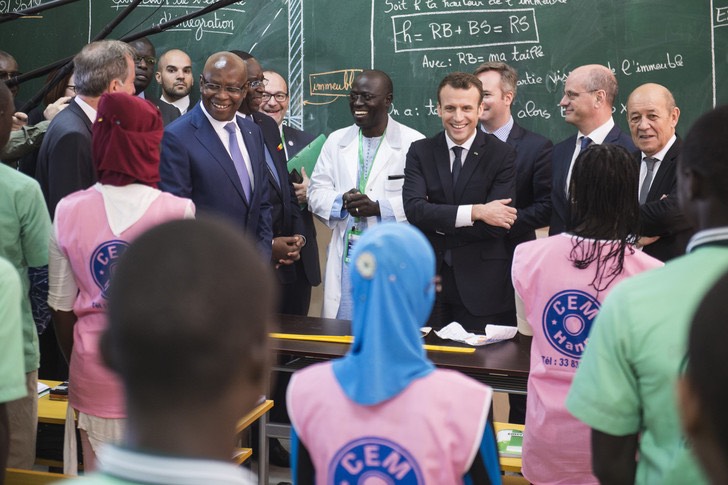
Photo: French President Emmanuel Macron, Senegalese President Macky Sall, and French Foreign Minister Jean-Yves Le Drian visit a classroom during the inauguration of the Bel-Air middle school in Dakar on February 2, 2018. / Abaca Press/Sipa USA via AP, viaLa Croix.