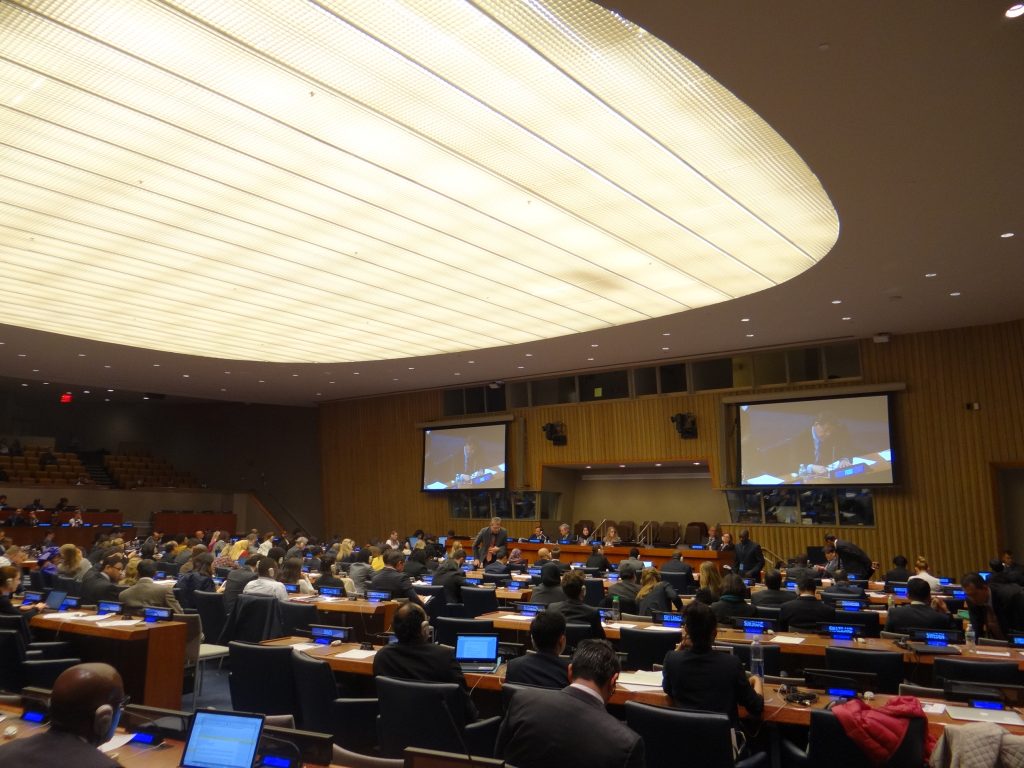
Equilibres & Populations and membersof Alliance Droits et Santé participated in the 50th Commission on Population and Development at the United Nations. The session ended in failure: strong differences regarding SRHR and comprehensive sexuality education prevented member states from reaching a final agreement.
" I regret to withdraw the draft resolution entitled "Age structure of the population and sustainable development" because we have been unable to resolve our differences and reach a compromise ." With these words from the Qatari chair, the week of negotiations at the 50th session of the Commission on Population and Development at the United Nations headquarters in New York came to an end on Friday, April 7. The previous month, however, member states had reached a compromise at the end of the Commission on the Status of Women (CSW).
This is not fundamentally surprising, given that the issues addressed at the CPD are more specific than those at the CSW, and focus precisely on points that are the subject of strong disagreement between states. However, this negative sequence shows that mobilization in favor of SRHR and women's rights at the international level remains essential. Otherwise, conservative positions will inevitably gain ground in the coming years.
Blockages on concepts that have already been approved
As might have been feared, the United States played a pivotal role. Long defenders of women's rights, the United States now takes a very conservative stance. A month ago, they were less proactive—proof that the Trump administration is effectively putting its theoretical positions into practice. At the CPD, the United States shifted the balance of UN negotiations by supporting the positions of Arab and African states and systematically rejecting proposals related to SRHR or comprehensive sexuality education. The result illustrates this shift in the balance of power: language that had previously been accepted within the United Nations, and which is therefore no longer supposed to be controversial, was this time rejected.
France, on behalf of 31 countries, lamented this lack of consensus at the closing ceremony, while reiterating the importance of sexual rights, particularly for adolescents, and comprehensive sexuality education to capitalize on the demographic dividend.
The growing involvement of actors in West Africa
Equilibres & Populations, in partnership with the French government, co-organized an event focusing on the sexual and reproductive health needs of young people in West Africa. Held on the first day of negotiations, this session featured presentations by the Minister of Population of Niger, the Minister of Youth of Burkina Faso, the French Secretary of State for Development and Francophonie, the Executive Director of UNFPA, the Coordinator of SOS Jeunesse et Défis, a Burkinabe association that is a member of the Alliance Droits et Santé network, and Aurélie Gal-Régniez, Executive Director of Equilibres & Populations.
The participation of SOS Jeunesse et Défis Coordinator Célestin Compaoré, which lasted the entire week, was facilitated by Equilibres & Populations. With French-speaking West African countries underrepresented in UN negotiations, it was important for civil society to begin playing a role in this area. In the medium term, this will not only ensure that diplomatic discourse in New York is consistent with policies and programs implemented at the national level, but also strengthen the camp defending SRHR—which, as we have unfortunately seen during this CSD, is once again becoming crucial.