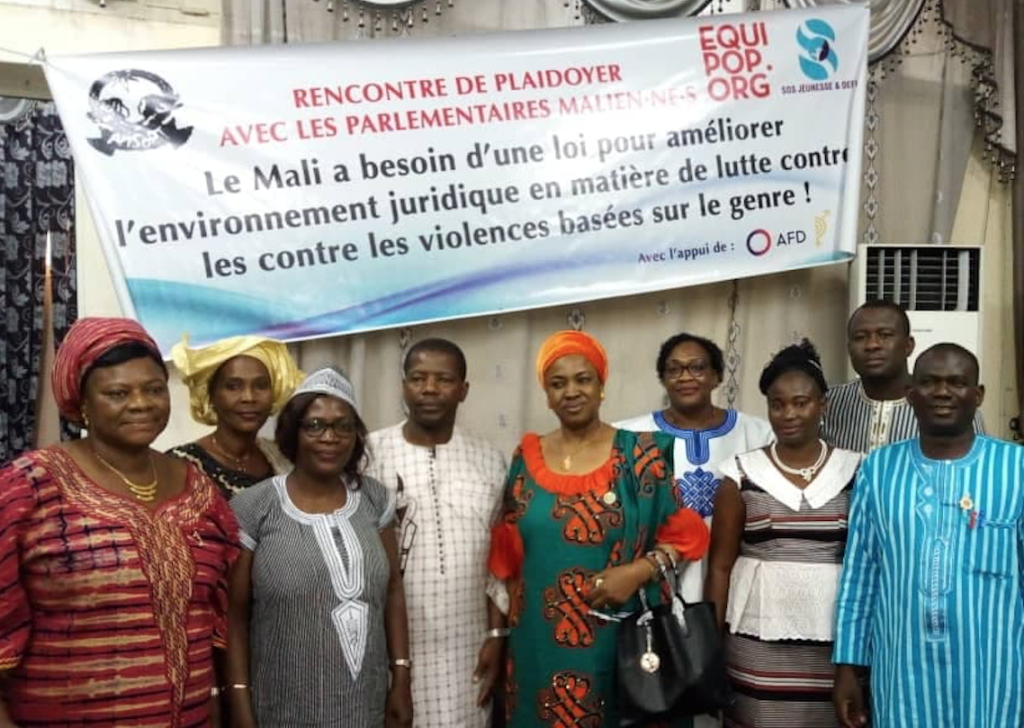
On June 25 and 26, a delegation of Burkinabe parliamentarians traveled to Bamako, Mali, to share their legislative experience in combating female genital mutilation (FGM) with Malian lawmakers.who are in the process of adopting the law on FGM.who are in the process of adopting the law on gender-based violence. Unlike Burkina Faso, there is currently no law in Mali that condemns gender-based violence such as female genital mutilation. This situation leaves a legal vacuum that allows for significant violations of the rights of women and girls.
The rate of gender-based violence (GBV) in Mali is one of the highest on the African continent. 76% of women aged 15 to 49 have undergone female genital mutilation. Many women and girls are forced into marriage: 52% before the age of 18, according to UNICEF. Several NGOs are working on the ground to put an end to this situation.
Equipop, which has been working in the field for several years, is stepping up its efforts to combat this violence, notably with the "Protecting Future Generations" project, which is currently being implemented. However, in Mali, there is no law to guarantee the rights of women and girls against FGM and forced marriage. To remedy this, AMSOPT, in collaboration with SOS/JD, organized a study trip to Bamako with a delegation of Burkinabe parliamentarians. The delegation was composed of Ms. Konaté Salimata and Messrs. Thiombiano Ludovic and Some Bernard, respectively from the Gender, Peace, and Law committees. Ms. Sanon Viviane, from the Ministry of Women's Affairs, also took part in the trip.
These two days were intended to give new impetus to the process of adopting the law against GBV in Mali. Around thirty parliamentarians, all members of the network to combat GBV, were presentto exchange views with Burkinabe parliamentarians. In Burkina Faso, a law has been in place since 1996 that condemnsto exchange views with Burkinabe MPs. In Burkina Faso, a law has been in place since 1996 condemning any attack on a woman's genitals. The obstacles to the implementation of a law on GBV were also identified, and the Malian parliamentary network,against GBV, headed by Ms. Fatoumata Niambaly, has committed to undertaking strong high-level advocacy actions with the Ministries of Justice and Women to emphasize the need for a legal framework condemning such violence.
This exchange meeting between Burkinabe and Malian parliamentarians, facilitated by Equipop, was an opportunity to relaunch the process of adopting the law on GBV in Mali, even though it is struggling to come to fruition in a context of growing violations of the rights of women and girls. A new study trip will be organized in the coming months. Malian MPswillwill travel to Burkina Faso to meet with other parliamentarians from that country and continue the work that has been started.