Feminists from different countries have accumulated knowledge, strategies, and successes in their local struggles. International feminist solidarity allows these practices to be shared and used as inspiration to strengthen the fight on an international scale. To facilitate this sharing, Equipop organized a feminist exchange tripduring the Brisons le Silence festival organized by our partner Filactions. It is part of the Feminist Generations: Lyon and its metropolitan area, a territory of equality. Here is the story of six days of encounters and collective inspiration:
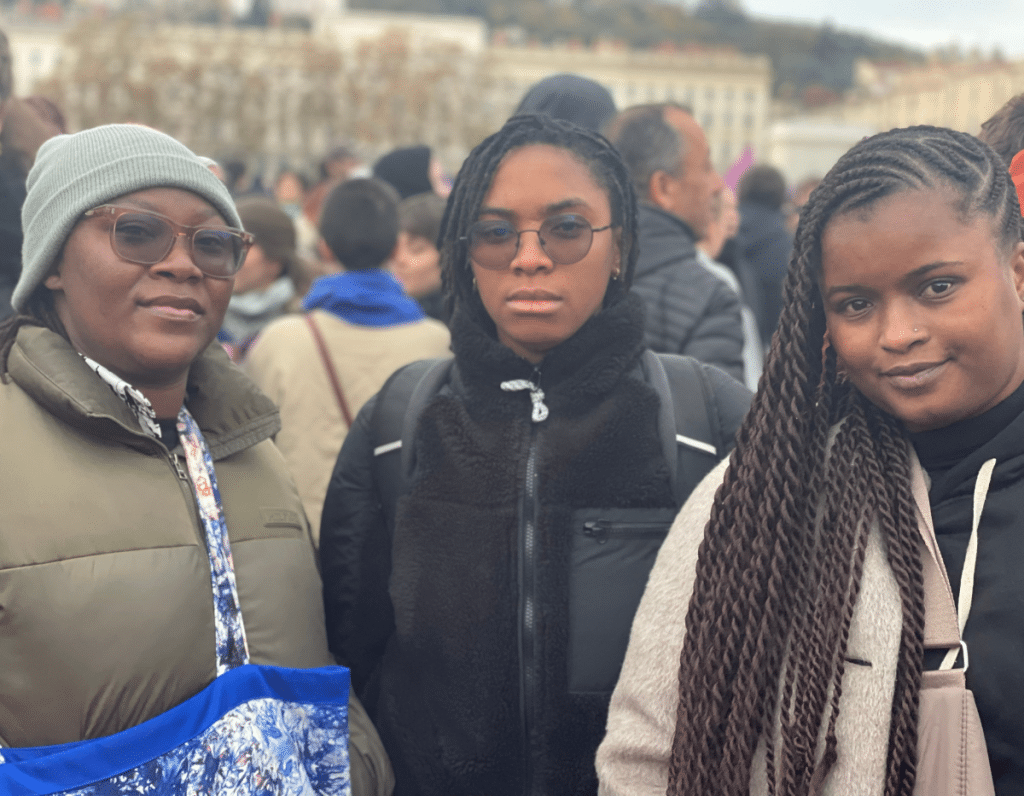
Their names are Amandine Yao (Gouttes Rouges), Kadiatou Konaté (CJFLG), and Chanceline Mevowanou (JFAD). Involved in feminist associations, they are key players in West African feminist movements. Their experiences and expertise as activists are rich and varied. Amandine breaks down the clichés and taboos surrounding menstruation in Côte d'Ivoire, as well as the algorithms of web activism. Since the age of 14, Kadiatou has been fighting for girls' rights, against gender-based violence and sexual mutilation, from Guinean communities to the highest political and institutional authorities. Chanceline is involved in various spaces committed to women's rights, in Benin and beyond, and feeds into feminist movements' thinking with strategies and optimistic visions of a more just society. All three know each other and work together in the West African sub-region, alongside dozens, if not hundreds, of other activists who are pushing the boundaries of gender equality. They have agreed to take part in the feminist exchange trip organized in Lyon in November 2024 by Equipop.
Breaking down barriers in feminist struggles
Patriarchal systems, gender inequality, and gender-based and sexual violence know no borders. Injustices vary depending on cultural, economic, or political contexts, but they are part of global power structures that oppress women and LGBTQIA+ people. By collaborating with other movements, feminists strengthen their power to act and their ability to bring about structural change. During the feminist exchange trip, our three guests were able to talk with their counterparts in Lyon—meeting with more than 20 activists in total—and discover or participate in transformative initiatives in the Auvergne-Rhône-Alpes region. During a one-day workshop with actors in popular education and international solidarity, West African feminist activists discussed social, political, and legislative challenges, while emphasizing the importance of adapting funding and preventing the instrumentalization of feminist struggles.
During a "coffee debate" with feminist student associations such as CLIT (Lyon University of Medicine) and Eh Mademoiselle (Sciences Po), the question arose of how to build momentum while working in very specific fields, and how to pool our efforts in the face of systemic challenges at different levels. This is precisely what the next phase of the Feminist Generations project: to provide financial and technical support to young feminist associations in the Lyon region and to cultivate the discussions and connections forged during the trip in order to collectively create feminist knowledge and tools (to be continued, therefore)."Intentionally building feminist movements starts with getting to know each other, breaking down barriers, and confronting clichés. We need to create lasting and evolving connections, while mobilizing together to find common strategies." – Kadiatou Konaté
Enriching reflections on our attitudes and creating connections
This trip helped strengthen transnational feminist solidarity by addressing intersecting forms of oppression—class, race, gender—and reinforcing global feminist actions for true equality.
A discussion at the Bron Asylum Seekers Reception Center (CADA) provided an opportunity to hear the perceptions and experiences of the women staying there, raising the question of their place in the fight for women's rights, both in France and in West Africa. A discussion on menstrual health products with Tina Youan Ilupeju, president of the Adeen Tahny IY association, highlighted the importance of taking into account people's real needs in different contexts when choosing the solutions offered. Discovering the archives and tools of Planning Familial 69 and Filactions, historic feminist popular education associations, was an opportunity to enrich methods and toolkits. Also at the heart of several discussions was the idea of inviting more men to take responsibility in the fight for gender equality, while encouraging them to sincerely question their privileges. This would help to avoid recreating oppressive logic, particularly that which values "models of male engagement" that are often steeped in patriarchal dynamics.
This week of exchanges also invited Western feminists to fight against the invisibility of African women's struggles for their rights and the specificities of African feminist movements. Amandine, Chanceline, and Kadiatou encouraged the actors and associations they met to integrate the dimensions of sisterhood and international solidarity into their prevention actions and to involve activists from other geographical areas in their activities. The goal? To build a transnational movement and encourage, particularly among young people, the emergence of a feminist generation that is open to the world and aware of the challenges of international solidarity.
" These discussions are windows that we open in the hope that the exchange of perspectives will continue—and we will continue, together, to change things at our own level until we revolutionize the world. " – Chanceline Mevowanou
Breaking free from sexist social norms: towards a feminist education for children and adolescents
Popular education and culture are powerful tools for raising awareness among young people about gender-based and sexual violence. By mobilizing forms of artistic expression, interactive workshops, and spaces for dialogue, these methods enable young people to question gender norms and analyze mechanisms of domination in a concrete and accessible way, promoting their empowerment. This is one of the levers of the Brisons le Silence Festival, organized by the Filactions association, which raises awareness and denounces violence against women and LGBTQIA+ people, reaching more than 5,000 people each year. For example, we attended the play Dos au mur (Back to the Wall) with around 60 high school students. Directed by Anne-Pascale Paris, this play presents scenes depicting male violence. It aims to deconstruct prejudices and stimulate constructive discussions on sexist and sexual violence. After the performance, Amandine Yao, Kadiatou Konate, and Chanceline Mevowanou had the opportunity to talk with the young audience members about their struggles and, more generally, about the issues raised by the play.
Issues surrounding feminist popular education, particularly sex education, were at the heart of the conference entitled “Sexist and sexual violence: for a feminist education for children and adolescents!" organized by Filactions and Equipop as part of the festival and series Sororités Francophones. Faced with alarming statistics and normalized violence, the three West African activists, Céline Roussat (prevention professional working with 6-11 year olds for Solidarité Femmes Beaujolais) and Lolita Rivé (school teacher and producer of the documentary podcast "What is love, teacher? ") emphasized the importance of education on consent, equality, and body awareness from an early age. While adapting to the age of the children, these approaches help to deconstruct patriarchal norms, encourage open discussion, and give young people the tools to understand their rights and develop critical thinking skills." Education is the key to a more egalitarian society. It is not a luxury, but a necessity to protect our children and deconstruct violence. " – Amandine Yao
Recharging your batteries: hope and militant joy
Finally, this exchange trip was also a valuable opportunity for everyone to engage in activism and recharge their batteries. Taking to the stage of the open stage "La Miaulerie" or listening to powerful and committed texts, poems, raps, and songs was "an inspiring experience that reminds us that creativity is an ally in the feminist struggle and a powerful means of expression" (Chanceline Mevowanou). Participating in Filactions' Happening des femmes en blanc (Women in White Happening) to denounce gender-based violence and marching through the streets of Lyon, singing and shouting feminist slogans with thousands of people during the November 23 demonstration was "an unforgettable activist experience" for all three of them. It was an inspiration to cultivate a culture of "taking to the streets" and cohesion among feminist organizations in order to organize mobilizing actions of this magnitude. " Seeing all those people, the militant joy, made me forget my fatigue. The slogans: I wrote them all down." – Kadiatou Konaté
TheFeminist Exchange Tripwas organized as part of theFeminist Generations: Lyon and its Metropolis, Territories of Equality project, financially supported by the French Development Agency and the Fondation de France.