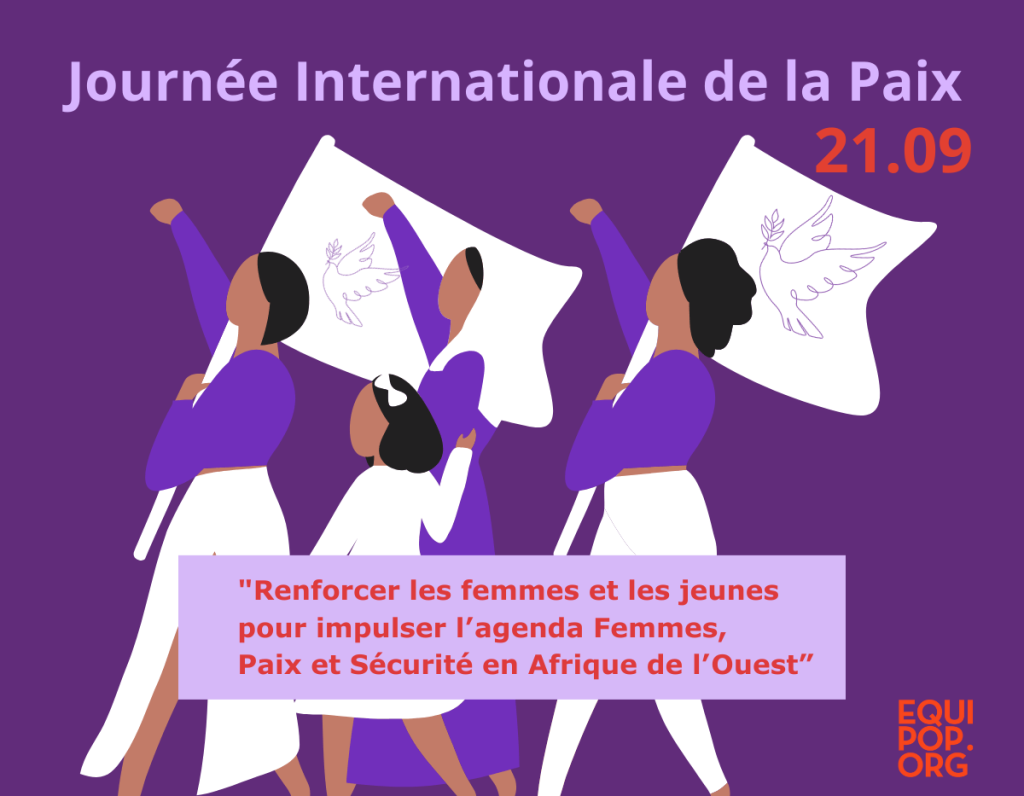
“Empowering and connecting women and young people to drive the Women, Peace, and Security agenda in West Africa” – In a world where various crises, conflicts, and threats to peace and security are on the rise, affecting people in general and girls and women in particular, the International Day of Peace offers us an opportunity to recall the inevitability of peace in order to achieve the SDGs by 2030 in a just, equitable, and sustainable world.
In many parts of the world, due to multiple health, environmental, and security crises, local populations have seen their rights and living conditions severely deteriorate in recent years. In Burkina Faso, Niger, and Chad, The security crisis has exacerbated structural gender inequalities, vulnerability, and exposure to gender-based and sexual violence against women and young people, which were already present in a strongly patriarchal society.
The Women, Peace, and Security Agenda in West Africa
The specific consequences of crises and conflicts on women, as well as the issue of their active participation in prevention, peacebuilding, and peacekeeping, were addressed by the United Nations Security Council in 2000 with the adoption of Resolution 1325 (2000). resolution 1325, the cornerstone of the Women, Peace, and Security (WPS) agenda. This agenda contains nine complementary resolutions. (1820, 1888, 1889, 1960, 2106, 2122, 2242, 2467, and 2493) acknowledges that:"All parties to an armed conflict must take special measures to protect women and girls from acts of gender-based violence, in particular rape and other forms of sexual abuse, as well as from all other forms of violence, respect the civilian and humanitarian nature of refugee facilities, and take into account the special needs of women and girls. States must end impunity and prosecute those responsible for such acts." Furthermore, "States must ensure that women are more represented at all levels of decision-making and monitoring processes in national, regional, and international institutions and mechanisms for the prevention, management, and resolution of conflicts"; "States must integrate, among other things, the gender dimension into all policies and programs, including DDR (disarmament, demobilization, and reintegration).".Gathered at the Generation Equality Forum (GEF) in 2021 (the most important global feminist event since Beijing 1995), CSOs and young activists contributed to the launch of a " global acceleration plan " in terms of gender equality, including " Compact on Women, Peace, and Security and Humanitarian Action ", a coordination and accountability mechanism for the FPS Agenda and targeted humanitarian aid for women and girls. In line with the FPS agenda, the Youth, Peace, and Security (YPS) agenda was established with the adoption of resolutions 2250 (2015), 2419 (2108), and 2535 (2020). At the regional, subregional, and national levels, several legislative, policy, and institutional instruments have incorporated the principles of the WPS and JPS agendas. These include ECOWAS, which was the first body to adopt a regional action plan in Africa and established the ECOWAS Women's Peace and Security Network; the United Nations, which established an integrated strategy for the Sahel; UNOWAS and its partners, which established a "Working Group on Women, Youth, Peace and Security in West Africa and the Sahel" in 2009, or the framework for coordination and monitoring of regional cooperation on development and security policies (G5 Sahel) created by Burkina Faso, Mali, Mauritania, Niger, and Chad in 2014. At the national level, national action plans (NAPs) have been adopted, notably by Burkina Faso in 2012, Niger in 2017, and most recently Chad in January of this year. Despite all this institutional progress, the voices of women and young people remain unheard amid the clamor of military affairs and geopolitical power struggles. They remain underrepresented, marginalized from crisis management bodies at all levels, and struggle to access funding and technical assistance to meet their specific needs and implement their high-impact initiatives.