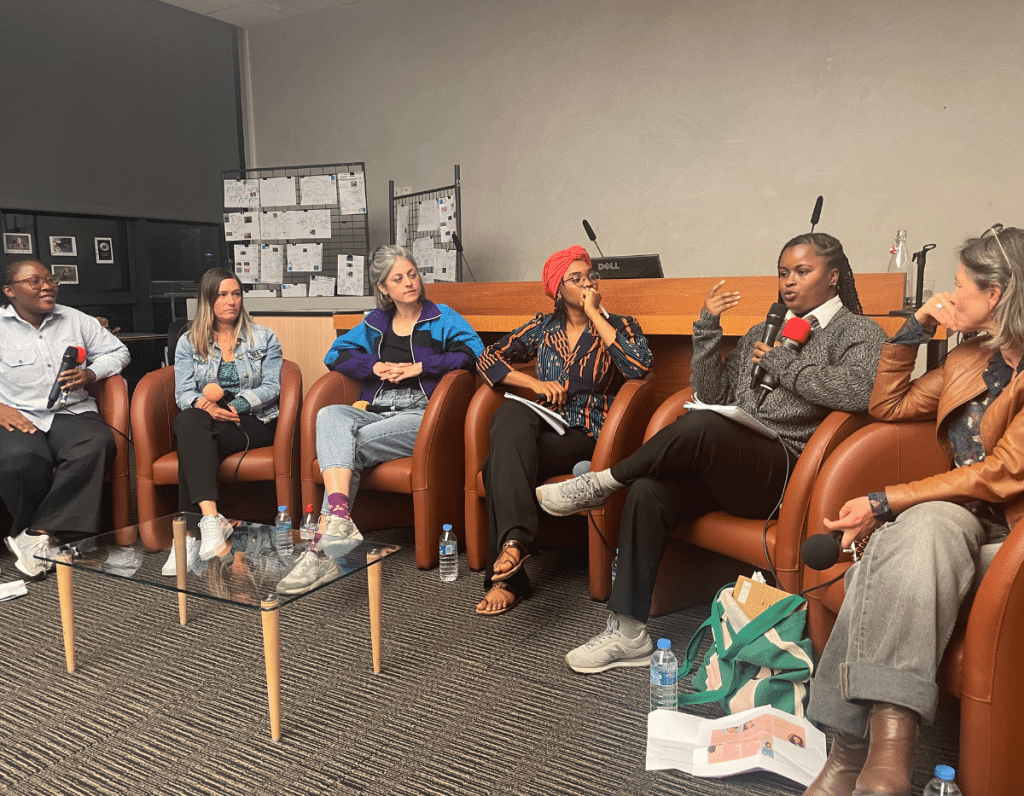
How can we enable children and young adults to identify violence? How can we talk about gender and sexuality in a hostile environment? The challenges of feminist popular education, particularly sex education, were at the heart of the conference "Gender-based and sexual violence: for a feminist education for children and adolescents!" organized on November 21 by Filactions and Equipop as part of the Brisons Le Silence festival in Lyon and the Sororités Francophones cycle.
Kadiatou Konate, Amandine Yao, Céline Roussat, and Lolita Rivé are activists and prevention professionals who fight stereotypes on a daily basis and equip young people to combat violence in Guinea, Côte d'Ivoire, and France. The four of them formed the panel for this round table discussion, moderated by Chanceline Mevowanou, a Beninese feminist activist, and Aurélie Gal Regniez, director of Equipop. Physical, psychological, and sexual violence, as well as incest, particularly affect children and young people. Often, they are unaware that these acts are prohibited and mistakenly believe that they are responsible for them. Céline Roussat, a representative ofthe Solidarité Femmes Beaujolais association, emphasizes the importance of informing them: "Children need to know that they have rights and that they are never to blame for the violence they suffer. Informing them gives them the opportunity to free themselves." The figures are worrying: in France, around 80% of parents still admit to using ordinary educational violence (VEO), according to a survey conducted by IFOP for the Fondation pour l'Enfance. This reality echoes the situation in West Africa, such as in Côte d'Ivoire, where Amandine Yao, an activist with the organization Goutte Rouge, denounces the normalization of violence by children, their families, and society. " This violence is often minimized or ignored, especially when it occurs within families. Our role is to make children aware of their rights and teach them to speak out, despite the taboos. " – Amandine Yao
Feminist sex education: a powerful tool against violence
Feminist sex education is based on knowledge of the body, which is essential for enabling children and young people to understand and enforce their boundaries and make informed choices. It is also based on understanding consent, so that they can set their own boundaries and recognize those of others. It also challenges sexist stereotypes and promotes understanding of power relations, thereby encouraging emancipation from sexist norms. This education, whether provided in or outside of school, must be age-appropriate and go beyond simple risk prevention: it is about talking about violence, but also about empowering children and young people in their emotional lives. In Côte d'Ivoire, Amandine Yao works with young people in schools. She uses age-appropriate tools, such as debates and role-playing, to address topics such as sexual violence and forced marriage. These approaches enable children to understand their rights while feeling safe. In France, Céline Roussat, through Solidarité Femmes Beaujolais, works with children aged 6 to 11. She uses a variety of educational materials, such as books and educational games. " Feminist sex education must be adapted, fun, and progressive. It is by laying the foundations at an early age that we can prevent violence. " – CélineRoussat Lolita Rivet, a teacher, regularly incorporates philosophical debates into her lessons to address these issues: " Children need a space where they can ask questions without fear of being judged. These exchanges allow them to develop critical thinking skills and better understand their own rights. " She emphasizes the importance of an inclusive approach: " Sex education must reflect the diversity of sexual identities and orientations. This allows everyone to feel represented and respected. "
Resistance and opposition to feminist sex education
Feminist sex education faces cultural and institutional resistance. These obstacles are amplified by well-organized anti-rights movements. Kadiatou Konaté, activist in Guinea with the Young Women Leaders Club, denounces this normalization of violence: " These reactionary groups spread dangerous messages that keep young girls submissive. It is crucial to counter these discourses with education that promotes human rights. " In France, Céline Roussat highlights local resistance: " Some families and institutions see sex education as a risk of 'perversion'. But it is by not talking about these issues that we allow violence to continue." Nevertheless, the speakers remain optimistic and determined to overcome these obstacles.
For a future free from gender-based and sexual violence
To ensure high-quality feminist sex education, the speakers proposed several avenues, including training teachers to enable them to address these topics with confidence and pedagogical skill, involving families to break down taboos and promote intergenerational dialogue, and raising public awareness through national information campaigns and appropriate tools. Amandine Yao reiterated the importance of international cooperation: " Sharing experiences between countries is essential. It allows us to find solutions adapted to our respective contexts. " Echoing this sentiment, Lolita Rivet concluded on a hopeful note: " The road ahead is long, but every step counts. It is together, with children, families, and institutions, that we will succeed in changing attitudes. " Far from being a simple educational tool, feminist sex education is an essential weapon against gender-based and sexual violence. It is a crucial step in building a society where every child can grow up with respect for their rights and integrity. " Investing in this education means giving young people the means to protect themselves and become actors in an egalitarian future. " KadiatouKonaté The time has come to break taboos and act together to empower children and bring about a more just society.