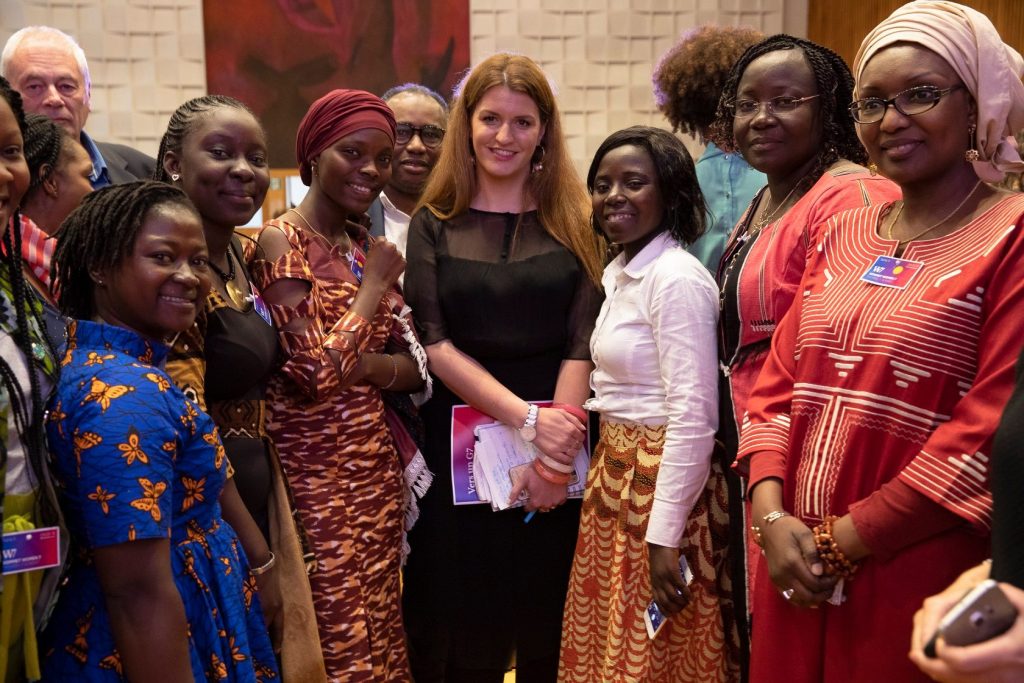
On the occasion of the Women 7 Summit, which took place on May 9 and 10 in Paris, 12 young feminists from Benin, Burkina Faso, Guinea, Mali, Mauritania, and Senegal co-signed an open letter to the heads of state of West Africa. Five major daily newspapers in the sub-region published this statement simultaneously.
Gentlemen, We, young feminists from West Africa, are here today in Paris to speak at the Women 7 Summit, a major gathering of feminist movements from around the world, organized on the occasion of France's presidency of the G7.
This year, France has decided to place gender equality at the heart of the G7 agenda and to open the G7 to the countries of the Sahel. Decisions that will impact the lives of women and girls around the world, including in West Africa, will be taken in the coming weeks.
Back in West Africa, we will be counting on you to strengthen the women's rights agenda in your national policies.
Through our statements in Paris and this open letter, we wish to give a voice to the voiceless, so that this French presidency of the G7 will be a moment of significant political and financial commitment to the rights of women and girls, but also so that West Africa will take concrete measures commensurate with the societal changes needed to achieve gender equality.
Every day, young feminists like us raise awareness among their friends and parents; they lobby influential religious leaders to change attitudes and behaviors, but also the authorities, to strictly enforce the law and increase funding for the fight against gender inequality.
We, young feminists from Guinea, Mali, Burkina Faso, Benin, Mauritania, Niger, Senegal, and Côte d’Ivoire, are at the forefront of the fight for girls’ rights. And we are sparking a revolution among young girls.
But how can we step up our efforts when we have no political or financial support? Our activism, like all feminist activism around the world, including in West Africa, is an obstacle course. Threats and harassment on social media, intimidation—these are our daily lot. Our issues are disturbing because they involve nothing less than overturning the unequal power relations that are deeply rooted in our societies.
This year, the international political agenda offers an opportunity to strengthen the rights of women and girls in West Africa. You have the opportunity to move beyond the usual rhetoric on gender equality issues by taking a firm stand alongside the feminist movements that are transforming society in the G7 countries, West Africa, and around the world. To rise to the challenge, you, the heads of state of West Africa, must:
- Promote women's and girls' right to have control over their own bodies. Investing in economic empowerment and youth employment is good, but it is not enough. The cornerstone is a teenage girl's ability to decide her own future. We therefore need additional funding for education, including comprehensive sexuality education programs.
- Involve and listen to young girls in all decision-making bodies, in a full, effective, and equal manner. As one young feminist said, "Most often, women's issues are discussed by nice men in suits and ties, not by women themselves." But what is decided without us is decided against us.
- Increase funding for the feminist associations we represent. West African countries must recognize the importance of the fight for gender equality and provide financial support to feminist movements.
We are counting on you!
Hadja Idrissa BAH, Guinea, President of the Young Women Leaders Club of Guinea
Rose DIEME, Senegal, Member of the Network of Girls and Young Women Leaders of Senegal (Youth Women for Action—YWA Senegal)
Cornelia GLELE, Benin, Journalist and film director. Member of the West African Network of Young Women Leaders and director of the Cotonou International Women's Film Festival.
Denise Epiphanie HABA, Guinea, Treasurer of the AGBEF/IPPF Youth Action Movement and member of the network of Youth Ambassadors for Reproductive Health and Family Planning in Guinea (Conakry)
Alexia HOUNTONDJI, Benin, Executive Director of the Rayons des Initiatives Culturelles Musicales et des Arts Oraux (Ricmao Asso) association and member of the Benin Youth Parliament
Néné Fatou MARICOU, Senegal, President and founding member of the Network of Girls and Young Women Leaders of Senegal (Youth Women for Action—YWA Senegal)
Dieynaba NDIOM, Mauritania, Member of the Initiative for Reproductive Health (ISR) association and the Women's Voices Collective
Wendyam Micheline KABORE, Burkina Faso, Secretary General and Coordinator of the Pananetugri Initiative for Women's Well-being (IPBF)
Jonas KINDAFODJI, Benin, Youth Ambassador for Adolescent and Youth Reproductive Health in Benin & Coordinator of the Synergy Platform for Action by Youth Civil Society Organizations to Combat Sexual Violence Against Girls and Women
Mistoura SALOU ADJIBADE, Benin, Program Officer for Adolescent and Youth Sexual and Reproductive Health and Rights & Gender at the NGO CeRADIS (Center for Reflection and Action for Integrated Development and Solidarity)
Aminata Badiane THIOYE, Senegal, Head of the Gender and Human Rights Division ofthe National Youth Alliance for Reproductive Health and Family Planning (ANJ-SR/PF)
Oumou Salif TOURE, Mali, Project Manager for Girls' Generation atthe Association of Young People for Active Citizenship and Democracy (AJCAD Mali)
This open letter was published simultaneously in:
- The New Tribune (Benin)
- L’Indépendant (Niger)
- Soir Info (Ivory Coast)
- Le Soleil (Senegal)
- The Republican (Mali)