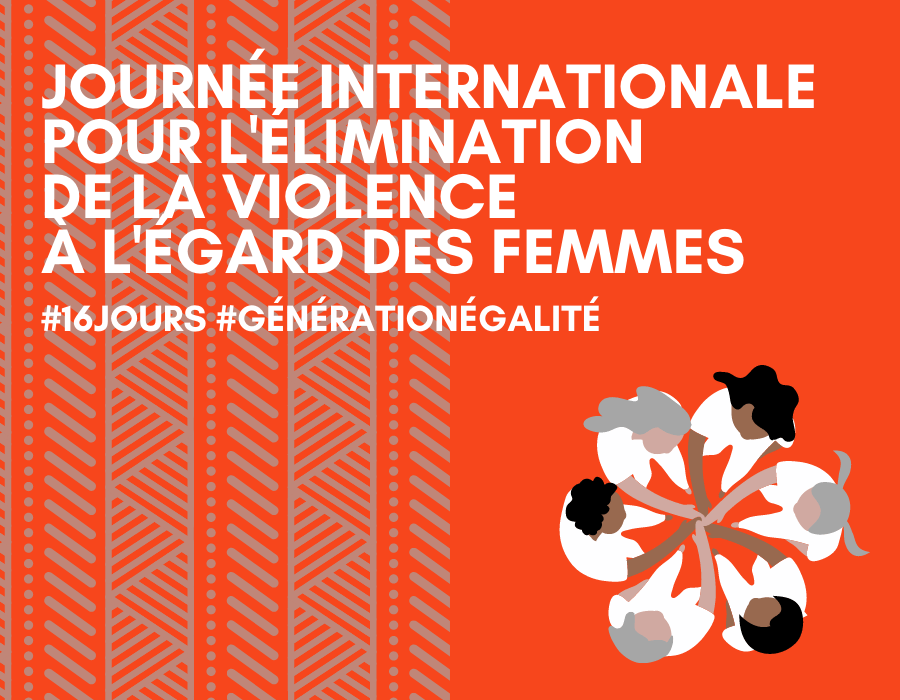
All over the world, gender-based and sexual violence is a tragically common reality for millions of women and girls. Its scale and effects are rarely acknowledged by society, the courts, and political authorities. On November 25, International Day for the Elimination of Violence against Women, we join our voices with those of all the associations in France and West Africa that denounce this violence, and we call for an increase in the resources allocated to combat it.
Very early on in the COVID-19 pandemic, feminist organizations around the world alerted governments to the risk of significant repercussions for women, their rights, and their health. As women's mental burden increased in the home, female healthcare professionals were on the front line of the COVID-19 response, while being excluded from decision-making spaces. At the same time, gender-based and sexual violence increased sharply. From the very first lockdown measures, organizations saw an increase in calls for help on their helplines. Today, the response from governments is still far from sufficient.
A year of rising gender-based and sexual violence around the world
In France, one year after the Grenelle forum on domestic violence, the feminist movement Nous Toutes launched a new call to action, following the success of the 2019 mobilization. Unable to organize large gatherings, French feminists mobilized in public spaces locally and online on a massive scale. The reasons for concern and anger have not diminished in a year: the number of femicides remains scandalously high and rape culture continues unabated. Added to this is the risk of weakening a central mechanism for dealing with violence. The 3919 national helpline for women victims of violence could soon be put out to tender, which could reduce the quality of its service and undermine the national network of associations that has managed it since its creation.
In West Africa, young feminist activists are mobilizing to denounce violence and bring about changes in the law, as in Senegal, where a law criminalizing rape was finally enacted in January of this year, and in Mali, where large marches against domestic violence took place in September. In the same vein, associations and activists have called on decision-makers to address the impact of the Covid-19 crisis on women's rights and health, based on a survey conducted in seven countries. Their demands focus on women's participation in the development and management of Covid-19 responses, the prevention and treatment of violence, and the maintenance of sexual and reproductive health services.
Equipop is publishing a series of interviews with eight feminist activists and community leaders involved in this campaign, starting on November 25, as part of the 16 Days of Activism to End Violence Against Women.
Assess the challenge, take the necessary measures
In 1995, feminist movements around the world achieved major advances for women's rights at the Beijing conference. Just over 25 years later, this ambitious agenda still suffers from a lack of political will. Feminist movements cannot be satisfied with the status quo, let alone a "backlash" against their fundamental rights: it is time for states to recognize the scale of the challenge and fund effective public policies to combat violence. In 2021, France will host the Generation Equality Forum, alongside UN Women and Mexico, which will lead to the launch of six action coalitions for women's rights. In line with its mobilization during the French presidency of the G7 in 2019, Equipop, alongside its partners, wishes to stimulate new inter-associative dynamics in France and West Africa to make the voice of feminist movements heard at this meeting. As co-organizer of the forum and champion of the action coalition for sexual and reproductive rights and health, France must fully embrace the fight against violence against women, both through its national public policies and through its foreign policy.