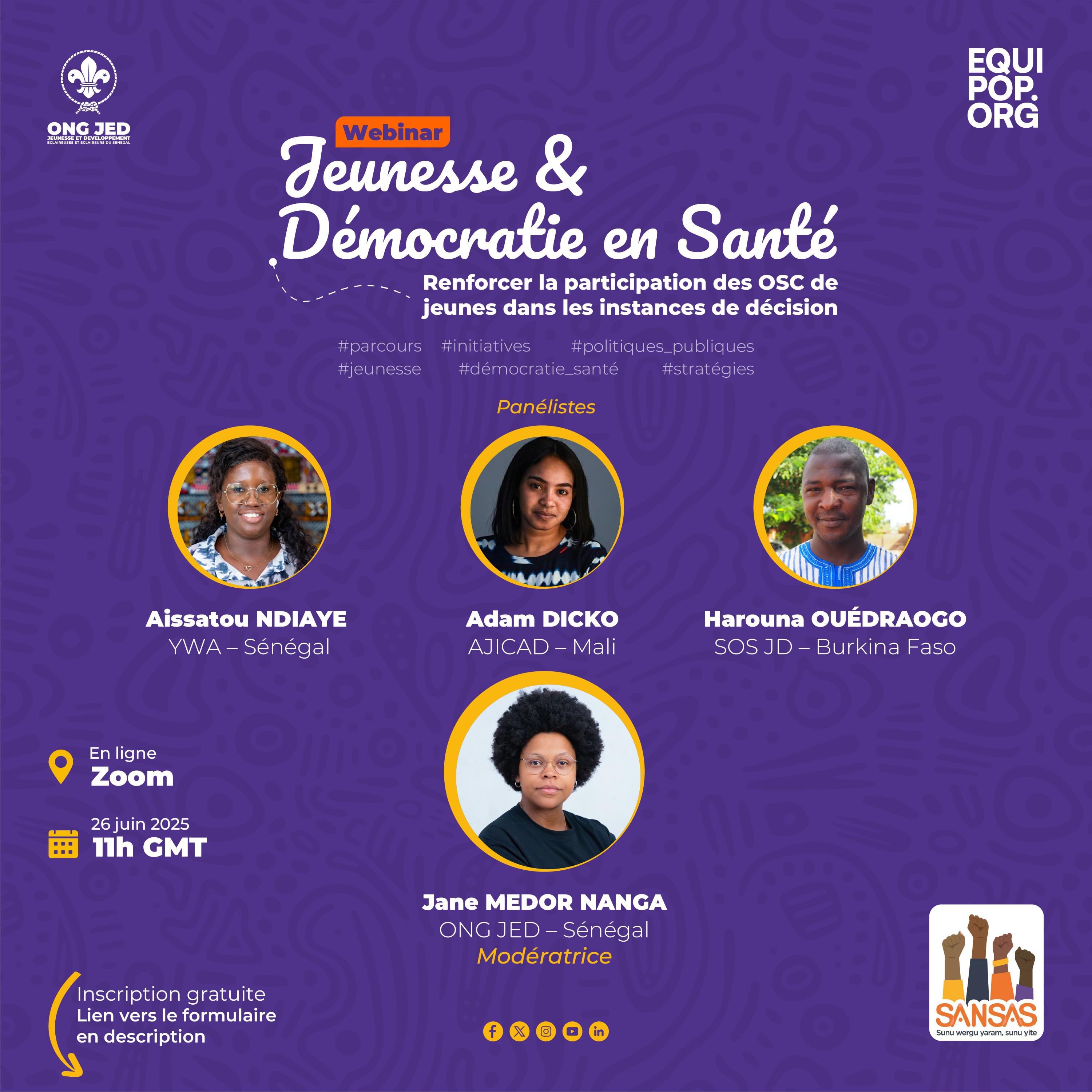
How can young people influence decisions that affect them, particularly in terms of sexual and reproductive health and rights? Three associations from Senegal, Mali, and Burkina Faso answered this question during a webinar organized by the associations JED and Equipop as part of the Sansas project.
Around the table:
– Jane Medor Nanga, Program and Resource Mobilization Officer at Jeunesse et Développement (JED – Senegal), moderator of the discussion
– Aïssatou Ndiaye, President of Youth Women for Action (YWA – Senegal)
– Adam Dicko, Executive Director of the Association des jeunes pour la citoyenneté active et la démocratie (AJCAD – Mali)
– Harouna Ouédraogo, Executive Director of SOS Jeunesse et Défis (SOS JD – Burkina Faso)
With nearly 50 participants, including technical and financial partners, young leaders, CSO members, researchers, and health professionals, their discussions highlighted inspiring advocacy journeys and collective strategies, but also common challenges in the face of political crises and the withdrawal of several international donors.
"If you do it without me, you do it against me": Senegalese youth on the front line
In Senegal, youth involvement in decision-making bodies too often remains symbolic. As part of the Sansas project, Aïssatou Ndiaye worked with YWA, ANJSRPF, and JED to lead a long-term advocacy effort to change the situation.
"For us, it wasn't just a question of having effective representation, but above all, quality representation," she explains.
Thanks to the establishment of a youth advisory framework, several organizations have been able to make their voices heard by the Senegalese Ministry of Health. The result: five seats reserved for youth umbrella CSOs on various reproductive health steering committees. This is a major step forward, enabling young people to participate in the development of ambitious public policies.
AJCAD, from citizen movement to influential organization
Founded in 2014 in Bamako, in the midst of a political crisis, AJCAD has established itself as a national reference in terms of citizen engagement and youth rights.
"AJCAD is not just an NGO, it has become a movement with which young people identify," says its director, Adam Dicko.
With more than 20,000 volunteer members and over 200 citizen clubs across Mali, AJCAD mobilizes both on the ground and digitally. Educational platforms, citizen apps, WhatsApp groups: young people are embracing these tools to make their voices heard, challenge the authorities, and defend their rights.
" We have chosen to always be a force for change. Even when we denounce, we propose, " emphasizes Adam Dicko.
This strategy allows the organization to be recognized and listened to, even in a context marked by the authorities' mistrust of civil society.
SOS JD: community roots as a lever for change
In Burkina Faso, SOS Jeunesse et Défis relies on its local roots to influence national policies.
"Our strength lies in building on community mechanisms, including women, young people, and people with disabilities," explains Harouna Ouédraogo.
The organization relies on model parents, young leaders, and listeners who relay advocacy messages in their communities. It has helped double the budget allocated to family planning and integrate the needs of young people into municipal development plans.
The "champions" trained by SOS JD (elected officials, journalists, activists) become essential relays, capable of directly challenging decision-makers.
"They are the ones who carry our messages into the political and media arenas and help transform social norms," emphasizes Harouna Ouédraogo.
Resisting in a context of multiple crises
The three organizations share the same challenge: remaining resilient despite political, security, and financial crises. The departure of key donors such as USAID, the end of the Algiers Agreement in Mali, and the reduction in international funding are weighing heavily on them.
In response to this, the answers vary:
- develop endogenous resources (AJCAD has set up income-generating activities to self-finance part of its actions),
- demand that aid be localized (SOS JD insists that funding go directly to local organizations),
- rely on local and international alliances (all three participate in regional networks and platforms to pool their strengths).
For youth who are active participants and recognized
From Dakar to Ouagadougou, from Bamako to the international arena, one conviction runs through their testimonies: young people no longer want to be consulted on the sidelines, but want to be fully involved.
This webinar served as a reminder that when young people have access to spaces and resources, they become key players in democracy and health. These exchanges show how the integration of young people into decision-making bodies is not only a matter of representation, but also a lever for democratic and social transformation.
The Sansas project supports these dynamics by strengthening the capacities of organizations, supporting their advocacy, and promoting regional synergies.
By capitalizing on these experiences, the project contributes to a clear objective: to make young people central actors in governance around sexual and reproductive rights and health, in Senegal as well as throughout West Africa.
Replay of the exchange: