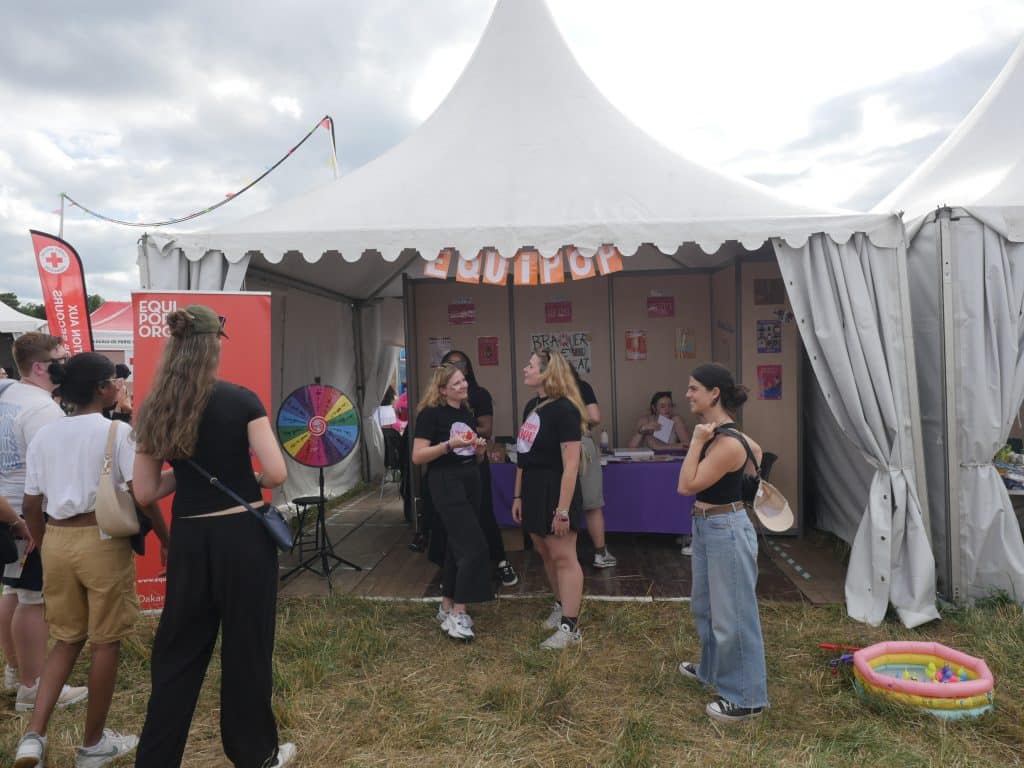
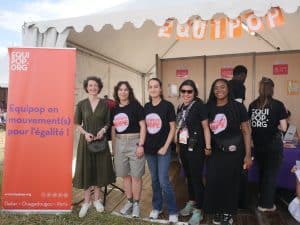
From June 27 to 29, 2025, Equipop participated in the Solidays festival, organized by Solidarité Sida at the Longchamp Racecourse. For this sixth participation, and in a global political context marked by the regression of human rights, our team, accompanied by committed volunteers from Team Hope, set up an interactive and activist booth on the theme: "Take down the patriarchy!" The goal: to make the funding issues related to women's rights, gender equality, and feminist solidarity visible and understandable to a young audience.
This mobilization was part of a broader citizen and international advocacy strategy. A few days after the festival, Equipop and its French-speaking partners traveled to Seville for the 4th International Conference on Financing for Development (FfD4) to speak with one voice: defending gender equality and demanding direct, sustainable, and accessible funding for local feminist organizations. In a context of rising anti-rights movements, our message remains clear: reform of the global financial architecture is essential to build inclusive, sustainable solidarity based on gender justice. Solidays thus represented a strategic moment of citizen mobilization ahead of this international deadline.
An international context increasingly hostile to the rights of women and LGBTQIA+ individuals
Solidays 2025 took place in a worrying climate. Internationally, women's rights, sexual and reproductive rights and health, and the fight against HIV/AIDS are seriously undermined. The end of the PEPFAR program in the United States has led to a sudden halt in essential funding, particularly for community organizations. In several countries, feminist activists and LGBTQIA+ people are being targeted by repressive policies. In Europe, conservative offensives are on the rise. In Hungary, Budapest Pride was banned in 2025, in a climate already marked by laws restricting the visibility of LGBTQIA+ people and limiting access to inclusive sexuality education. These dynamics contribute to the normalization of anti-rights rhetoric in other European countries, which is increasingly present in public debate. France is not immune. The elimination of €2 billion in official development assistance (ODA) constitutes a brutal disengagement, with direct consequences for sexual and reproductive health programs, feminist associations, and the fight against HIV. At the same time, debates on sexuality education and transgender rights are being exploited by reactionary groups. This context makes our presence at Solidays more necessary than ever.
A booth dedicated to explaining the challenges of financing
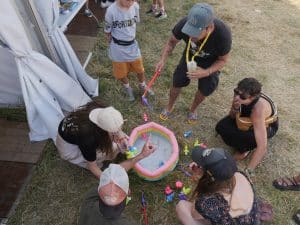
It was in this context that Equipop offered a powerful and educational awareness-raising space. At our booth, transformed into a world of feminist vigilantes in the style of "Robin Hood," festival-goers were invited to explore the mechanisms of international solidarity financing, understand what lies behind budget cuts, and learn about feminist fund initiatives. Upon arrival, passersby were welcomed into an interactive journey punctuated by games, challenges, role-playing, and lively discussions. More than 500 young people were sensitized throughout the weekend. At the front of the stand, a large wheel attracted attention and engaged festival-goers in a series of quizzes and challenges to educate them about the history of feminism and international solidarity. The playful approach encouraged spontaneous discussions on sometimes complex topics. Festival-goers could also take part in Feminist Cluedo, a life-size investigation to unravel the mechanisms of backlash and conservative alliances at work. By collecting clues, they discovered the discourses, strategies, and networks behind the rollback of rights. Right next door, a twisted version of duck fishing allowed participants to become aware of a striking imbalance in international solidarity funding: very little truly feminist funding, compared to a majority of conservative actors or those far removed from the realities on the ground. Finally, our ever-popular glitter stand provided an opportunity to spark discussions based on prejudices to be deconstructed, such as: "Being LGBT is trendy," "Not all men," and "Feminists are extreme." Participants reacted, debated, and shared their own experiences. This festive moment thus became a space for collective reflection on stereotypes, taboos, and sexuality education. Through this lively and participatory approach, our team was able to convey challenging political messages in a creative, accessible, and engaging way. Around 100 new subscribers joined our social media accounts during the festival, extending the engagement that began at the booth.
A political forum and memorable encounters
Beyond the excitement of the booth, Solidays was also a real platform for public mobilization. Clara Dereudre, advocacy officer, took to the stage in front of nearly 1,000 people to challenge festival-goers about the threats currently facing our rights. She denounced the repeated attacks against feminist and LGBTQIA+ movements around the world, while reminding the audience that these reactionary dynamics also affect France. Essential rights, such as abortion and sex education, remain fragile, even on French soil. Clara Dereudre also warned about the disengagement of public authorities, which weakens associations that are crucial to health, rights, and equality. Her message was clear: none of this is inevitable. Everyone can take action: by informing themselves, by getting involved, by voting. Because defending rights is also a collective responsibility. The festival was also a valuable opportunity to strengthen our ties with partners involved in international feminist struggles. In particular, we welcomed the president of the Burkinabe Solidarity Association, with whom we discussed the realities on the ground and the activist strategies pursued by civil societies in West Africa. Finally, our team was able to exchange views with Anne-Claire Amprou, French ambassador for global health. This visit provided an opportunity to discuss the importance of defending a human rights-based approach in global health policies and to reiterate how essential it is for countries such as France to make a concrete commitment by allocating substantial funding to international solidarity, global health, and gender equality, particularly in the context of the replenishment of the Global Fund. Every year, Solidays confirms the importance of taking our struggles to where young people are. In this context of weakening rights and rising extremism, it is more necessary than ever to build strong alliances between feminist movements, actors in the field, institutions, and new generations. It is this collective dynamic that will enable us to defend feminist, equitable, and sustainable international solidarity. In the coming months, this citizen mobilization must continue at the political and institutional levels.
What now?
As the replenishment of the Global Fund to Fight HIV, Tuberculosis, and Malaria approaches, Equipop calls for widespread mobilization to ensure sustainable, accessible, feminist, and truly transformative funding. We advocate for an approach that places the most marginalized people—women, transgender people, migrants—at the center, in order to build truly fair and inclusive public health policies. This mobilization must be accompanied by strong consistency between France's international commitments, particularly in terms of feminist foreign policy, and its budgetary and political decisions at the national level.
Find all our festival highlights on Instagram: @equipop_ong
A huge thank you to Aminata, An-Lan, Anouk, Camille, Clara, Esther, Kassandra, Maëlle, Manon, Marie, Mohamed, Pauline, Philippine, and Sacha.