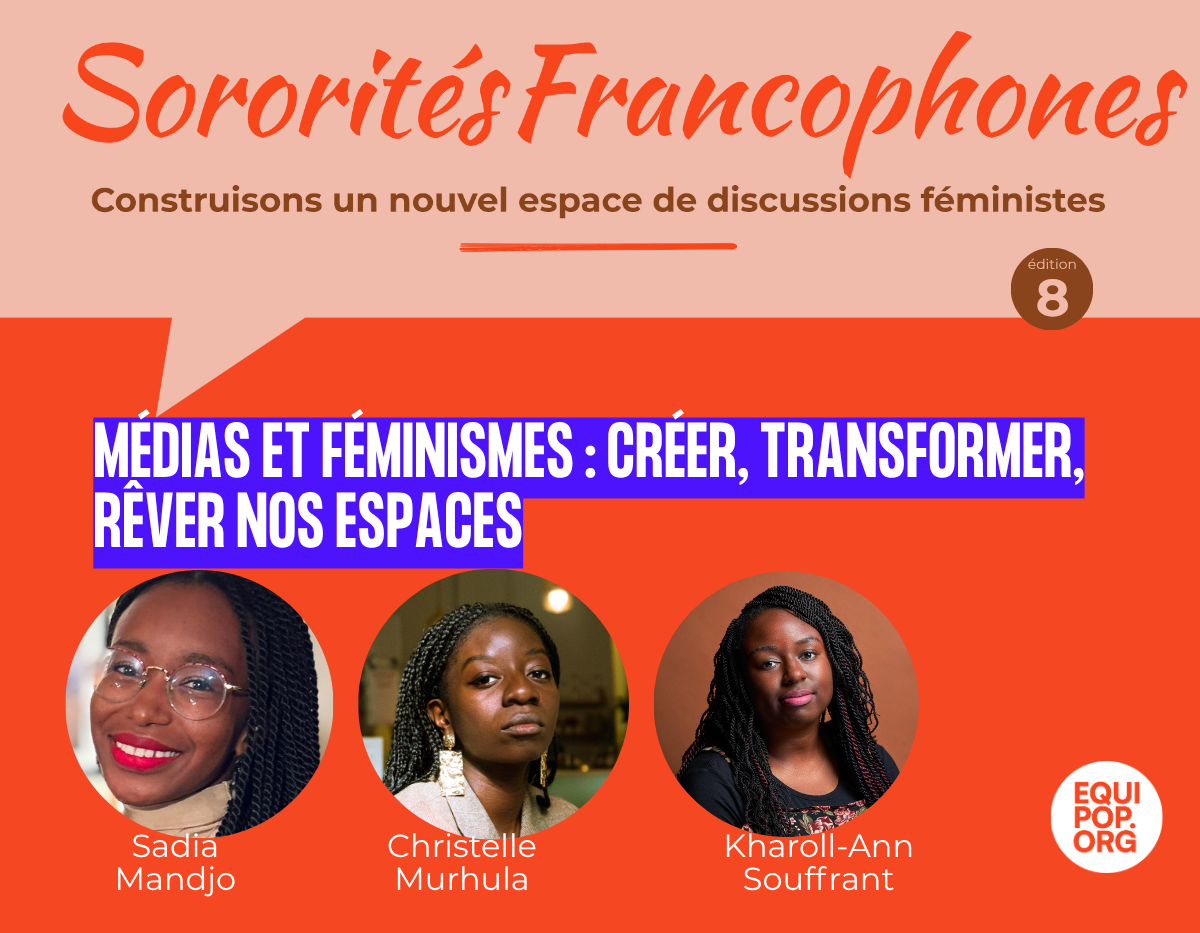
At the 8th Sororités francophones meeting, three media and feminism professionals gathered to discuss the theme "Media and Feminism: creating, transforming, dreaming our spaces." Christelle Murhula, freelance journalist and author, Sadia Mandjo, founder of Tour d'Afrique des droits des femmes, and Kharoll-Ann Souffrant, social work researcher, shared their experiences. This meeting explored how the media can be powerful tools for advancing feminist struggles while promoting equality, social justice, and inclusion.
By sharing their thoughts, the speakers highlighted three key areas: the transformative power of the media, the importance of diversifying strategies, and the challenges of feminist engagement in an environment largely dominated by patriarchal power relations.
The transformative power of media
The media play a central role in changing attitudes, but for many journalists and feminists, they remain a space where sexist and racist power relations continue to manifest themselves.
Christelle Murhula emphasized how much the media can influence major debates, as was the case with the #MeToo movement, by amplifying the voices of victims and pushing authorities to respond. However, she notes that traditional media often suffer from a lack of diversity in their perspectives, which limits the reach of feminist narratives. "The media can spark essential social debates, but they remain limited when it comes to more complex issues or minority voices," she explains, lamenting coverage that sometimes neglects the realities of marginalized women.
Sadia Mandjo highlighted the impact of the media in raising awareness of women's rights issues. Founder of the activist media outlet Tour d'Afrique des droits des femmes (Tour of Africa for Women's Rights), she pointed out that while journalists can amplify the reach of feminist messages, they sometimes come up against editorial policies that downplay these issues. This observation prompted her to create her own media outlet in order to ensure consistent coverage of African women's rights. She insists that this type of media is vital for covering topics that are often perceived as "secondary" by traditional newsrooms.
Kharoll-Ann Souffrant, author and social work researcher, emphasized the media's responsibility to convey nuanced and inclusive narratives. According to her, "the feminist perspective allows the realities of marginalized communities, which are invisible in mainstream media narratives, to be heard." The media must not only inform, but also be proactive in transforming attitudes by including feminist and intersectional perspectives.
Invest in mainstream media and multiply strategies
On the question of integrating mainstream media or creating autonomous spaces, the three speakers share complementary points of view. Kharoll-Ann Souffrant believes that it is essential to multiply approaches: "We need dedicated feminist media, but we also need to infiltrate the mainstream media to reach a wider audience and bring a feminist perspective to topics that are not covered. " For her, the goal is to build a transformative discourse that adapts to different media channels in order to reach both those who are already convinced and those who do not feel directly concerned by these issues.
Christelle Murhula, as a freelance journalist, sees this strategy as a way to circumvent the limitations of each media outlet. She is delighted to be able to collaborate with feminist media outlets, but also to bring a feminist perspective to the mainstream publications she writes for. However, she emphasizes the precarious situation of freelance journalists, who are often vulnerable to editorial and financial pressures. "To avoid self-censorship and be able to propose feminist topics, it is essential to diversify your collaborations, but this requires resilience and sacrifice," she notes.
For her part, Sadia Mandjo concludes this reflection by evoking the need to adapt the discourse to different audiences in order to avoid creating barriers. In her project, she uses social media to disseminate simplified information aimed at young African women. "I try to make complex, verified, and contextualized information accessible so that young people are aware of their rights," she explains. This approach is essential in a context where feminist issues can be misunderstood or perceived as a luxury of Western society.
Challenges and resilience: daily commitment
The three speakers also discuss the many challenges they face in their daily professional lives. Precariousness, self-censorship, and the quest for legitimacy are all challenges for those who wish to make feminist voices heard. Sadia Mandjo, for example, regrets the lack of interest in African women's rights among editorial staff, which sometimes forces her to document and self-finance her projects alone.
Kharoll-Ann Souffrant, for her part, points out that feminist engagement in the media should not be a label, but an ethic: "As a journalist, I advocate a methodology that allows me to offer in-depth stories that don't just skim the surface of issues."
Despite these challenges, all three assert that feminist media is an indispensable lever toward a more inclusive society. Whether by adopting novel angles, creating autonomous spaces, or investing in mainstream media, these women are building a new way of telling stories. The common goal is clear: to build a more inclusive society and enable women, young people, and activists to participate in public debates on human rights and social justice.
Transforming journalism: alternative spaces and narratives
Christelle Murhula emphasizes the need to offer economic guarantees to journalists so that they can work without having to moderate their comments for fear of losing their jobs. The lack of economic security remains an obstacle to the growth of these independent voices, who are often forced to adapt their topics to the editorial lines of the media in order to preserve their jobs.
Sadia Mandjo emphasizes the role of African youth as a target audience. She wants to raise awareness among this generation about the importance of women's rights through accessible media that is rooted in their realities. Her project, Tour d'Afrique des droits des femmes (Tour of Africa on Women's Rights), offers local resources and content tailored to the specific contexts of each country. Sadia Mandjo sees social media as an ideal tool for dissemination, enabling rapid education and awareness-raising among young people, who are the actors of tomorrow.
Deconstructing and rethinking the media of tomorrow
The media can be a lever for social transformation, but this requires a deliberately inclusive and critical approach. The future of the media will depend on diversifying voices, creating autonomous spaces, and journalistic practices that respect and value the stories of all women, across borders and cultures.
Building a feminist media outlet also means daring to redefine the rules of the game by taking a committed stance. "Feminist media are not niche tools; they are platforms for rethinking social norms, transforming perceptions, and amplifying the voices of women in all their diversity," says Kharoll-Ann Souffrant.
All agree on the need to develop a feminist and intersectional vision in the media in order to rethink dominant narratives and enrich them with a diversity of voices.
The common goal is clear: to make the media not only tools for information, but drivers of social change, by fully integrating the plurality of female and feminist voices, across borders and cultures.
This meeting highlighted a shared vision: that of feminist media that does not merely reflect reality, but seeks to transform it.