– SF #10 – Abortion rights: feminist and intersectional approaches

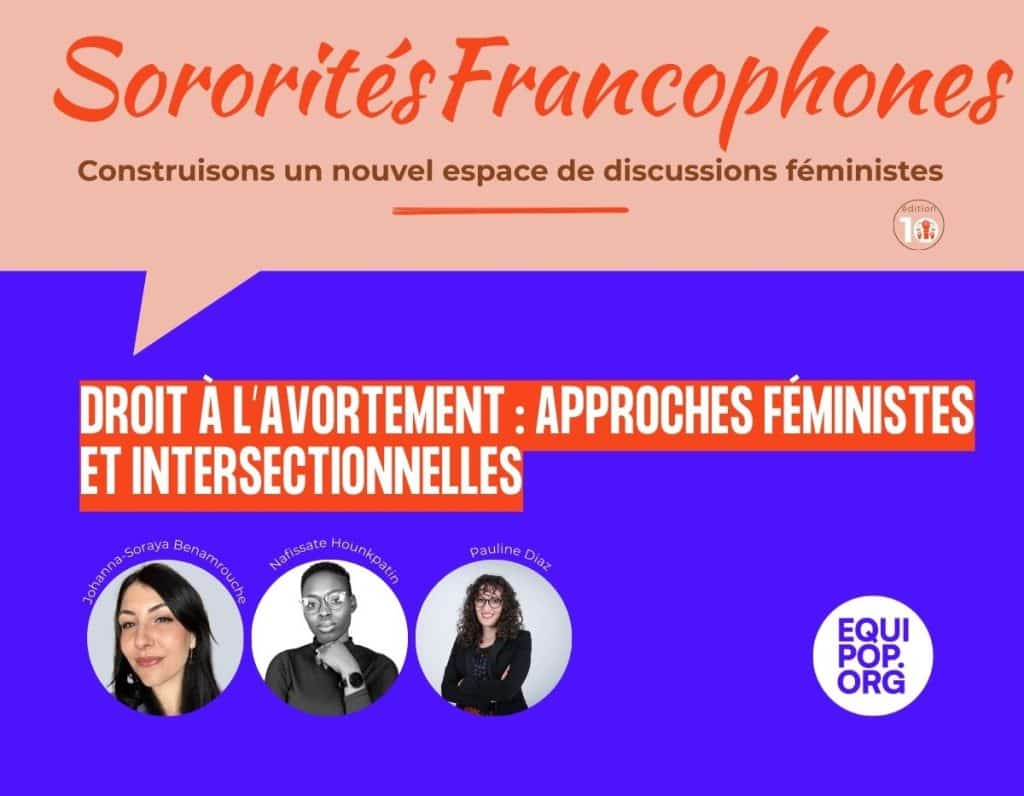
The Sororités Francophones reflection cycle recently held its tenth edition on the theme of abortion rights: feminist and intersectional approaches. 

This webinar, co-hosted by Elise Fouillet from Equipop and Salematou Baldé, an Ivorian feminist activist, brought together three committed speakers: – Johanna-Soraya Benamrouche, postcolonial feminist activist and co-founder of the association Feminists Against Cyberbullying – Nafissate Hounkpatin, feminist midwife and founder of Iléwa in Benin – Pauline Diaz, sexual and reproductive rights specialist at Women First Digital.    Coming from different regions, these speakers enriched the discussion and shared their perspectives and experiences on this fundamental issue. Each bringing a unique perspective, their exchanges highlighted the challenges and advances in issues related to access to abortion.  
A briefing note on the situation in Africa

Salimatou Balde began by highlighting the urgency of the situation: "In Côte d'Ivoire, 18% of maternal deaths are linked to unsafe abortions, according to a study conducted between 2018 and 2020." She believes that reducing the number of unsafe abortions would significantly lower maternal mortality in the country.  

A necessary feminist approach

The webinar began with a powerful statement: "We are here today because we collectively recognize that we are living under a system of domination that seeks to control our bodies against our will."  This statement was supported by Nafissate, who emphasized the importance of a feminist approach to the systems of domination that control women's bodies. She stated: "Conventional approaches are often exploited by a system of oppression that leaves no room for women's power over their own bodies. " In contrast, a feminist approach aims to give this power back to women by recognizing the different layers of oppression they face, including those based on social class, race, or geographic location. Pauline agreed with this point of view and added that the feminist approach "recognizes the specificities of women's experiences, particularly those from marginalized backgrounds." She emphasized that "access to safe abortion should not be seen solely as a public health issue, but as a matter of autonomy and human rights." This underscores the importance of a holistic view that includes the social and political dimensions of abortion rights. She also mentioned that social stigma surrounding abortion remains a major challenge, making education and information essential to changing attitudes. Johanna also emphasized the importance of intersectionality. She stated that "every human being is defined by multiple identities that interact to produce specific forms of oppression." This approach allows for the diverse realities of women to be taken into account, particularly those from minority backgrounds or living in difficult socioeconomic contexts.  

Intersectional struggles 

Johanna added another dimension by linking abortion rights to the broader struggle for human rights. She stated, "The right to control one's own body is a fundamental human right that must be respected for all people, regardless of their gender identity." " As a postcolonial feminist activist, Johanna emphasized the need to view abortion struggles within the broader context of social justice and equality. She spoke to the dangers of anti-rights movements that seek to restrict these freedoms, stating that "controlling bodies and sexualities is an early symptom of authoritarianism." This perspective highlights the importance of solidarity between feminist struggles and those of other social movements.  

The realities on the ground

Pauline Diaz shared poignant testimonies about the realities faced by women seeking abortions. She highlighted concrete obstacles, such as "social stigma and lack of access to reliable information." According to her, even in countries where abortion is legal, women face challenges such as the cost of procedures and opposition from conservative groups. "It is crucial to raise awareness and educate so that every woman can exercise her right to abortion without fear," she insisted.  

The importance of access to information

Pauline then broadened the discussion by addressing the essential role of information in accessing safe abortion. She stated, "Access to accurate information about abortion is fundamental to enabling women to make informed choices." " As Head of Partnerships at Women First Digital, she explained how digital platforms can serve as vital resources for women seeking information about abortion methods. Pauline also emphasized that "stigma and lack of sex education are major barriers preventing women from accessing their reproductive rights." This spotlight on barriers to information reinforces the idea that education is a powerful tool in the fight for women's rights.  

A collective struggle

The speakers agreed that the right to abortion is a collective struggle that requires solidarity among feminist movements around the world. This meeting provided an opportunity to exchange ideas and experiences, illustrating the need for a feminist and intersectional approach to addressing abortion rights. The voices of activists must be amplified to ensure that all people have control over their own bodies and can make informed decisions about their sexual and reproductive health. This committed sisterhood is essential to advancing women's rights and ensuring their bodily autonomy.

Further information

April 22, 2026

At a time when gender equality and international solidarity are under direct attack around the world, Equipop has set out to strengthen its alliances in order to take strong

April 2, 2026

Open Letter to Public Authorities, Academic Institutions, and Stakeholders Committed to the “One Health” Approach, Ahead of the One Health Summit in Lyon

March 31, 2026

Equipop has been involved in the development and monitoring of French feminist diplomacy for several years. In particular, in October 2025, we published a report on

Looking for something?