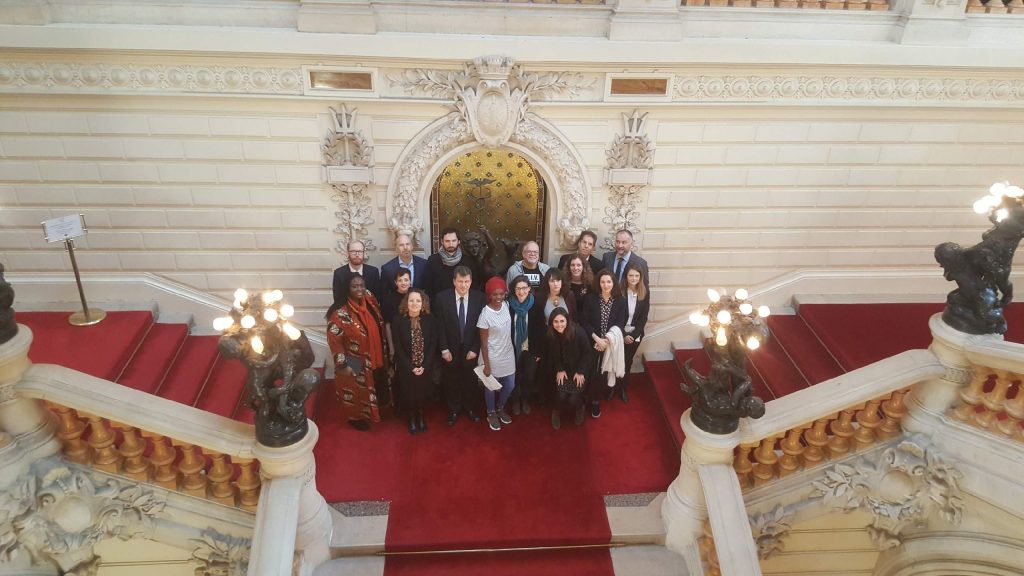
As the Advisory Council on Gender Equality meets for the first time in Paris on February 19, Equipop continues to lead the mobilization of associations to ensure that the G7 adopts a feminist position. A look back at the first step in this commitment: the meeting with the sherpas of the G7 countries in Lyon on February 5.
For several months, Equipop has been advocating for the French presidency of the G7 to place gender equality at the heart of the decision-making process, both before and during the summit. The first step has been successful, as gender equality has been defined as one of the five stated priorities. The goal now is to ensure that these discussions lead to concrete financial and political commitments in favor of women's and girls' rights.
Equipop and CARE France have launched a coalition that now brings together more than fifty French associations. This coalition is taking two courses of action: participating in the official G7 processes (advocacy) and conducting a communication campaign starting in April. The Women 7 Summit (W7), organized on May 9-10 in Paris, will be the highlight of this mobilization. It will bring together feminist activists from G7 countries, French-speaking West Africa, and around the world.
The meeting with the sherpas, a successful first step in advocacy
On February 5, as facilitator of the "W7" engagement group, Equipop participated in the first meeting with the sherpas of the G7 states, the high-level diplomats who are negotiating the content of the G7 summit in Biarritz in August. As gender equality is one of the priorities of the 2019 G7, it was raised in most of the discussions, particularly by our Civil 7 (C7) partners, who addressed issues such as health, education, and the environment. It was also specifically addressed by the director of Equipop, Aurélie Gal-Régniez(1), and our Guinean partner Hadja Idrissa Bah(2), founder and president of the Club des jeunes filles leaders de Guinée (Guinea Young Women Leaders Club), who spoke on behalf of a group of young feminists from West Africa.
Our argument was based on the principle that the 2019 G7, which made the fight against inequality its priority, will only be able to achieve its goal if it adopts a feminist position. Gender equality is a universal issue for G7 countries, developed countries, and developing countries alike. Many political promises have been made. Citizens' expectations are high, and this G7 summit will be a turning point. In this context, we emphasized two priority recommendations.
Clear feminist demands
The significant increase in funding for feminist movements
While passing laws is essential to implementing gender equality, funding all feminist movements at the local, national, regional, and international levels is also indispensable. These movements, which are too often underfunded, propose alternative solutions, influence, and contribute to changing the system toward greater equality and well-being.
The systematic integration of feminist activists into decision-making processes
The French government's desire to continue the momentum initiated at the 2018 G7 summit in Canada and to form a Gender Equality Advisory Council is an excellent first step that we must reinforce. Real change will come when all policies, including those related to trade, economic growth, and security, and not just those considered social, are truly designed and implemented in a participatory manner that is sensitive to gender inequalities. With this in mind, it is essential that, starting with this G7 summit, delegations from the W7 engagement group participate in all ministerial meetings and be able to contribute to the final documents.
Furthermore, civil society's work on gender equality must be carried out in close collaboration with the Advisory Council in order to produce truly inclusive recommendations.
Making the G7 a feminist G7 requires a real paradigm shift, and there is still a long way to go. We will therefore be presenting our recommendations to the G7 presidency throughout the year and we hope that, as in Lyon, they will be heard and that, like Hadja Idrissa Bah, many activists will take part in the G7 to become the "voice of the voiceless.".
Watch theinterview with Hadja Idrissa Bah on the G7 France Twitter account.
(1) Contribution by Aurélie Gal-Régniez
(2) Contribution by Hadja Idrissa Bah