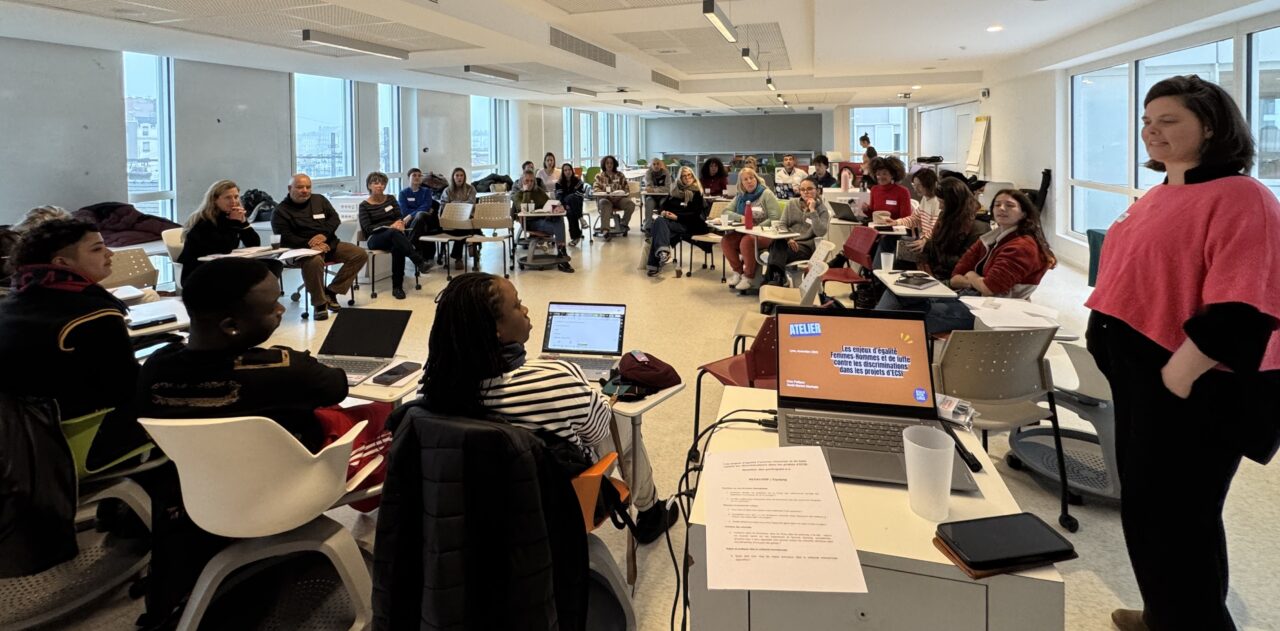
Since September 2023, Equipop and RESACOOP have been working together to build a long-term training partnership aimed at professionals in the fields of international solidarity and youth work, as well as individuals involved in projectsfocused on Education for Citizenship and International Solidarity (ECSI).
The global context reveals a constant challenge to social rights (e.g., the right to health and access to healthcare, the right to social protection, etc.), particularly due to the growing visibility of movements critical of these rights and more conservative rhetoric. In this context, this collaboration is based on a shared understanding: the ECSI cannot limit itself to a role of raising awareness. It also aims to foster an understanding of social dynamics, encourage reflection on practices, and support the collective capacity to act in favorof a more equitable society.
Through hybrid training programs, spaces for dialogue, and tools drawn from popular education, Equipop and RESACOOP are committed to a transformative ECSI focused on driving individual and collective action.
Two years of collaboration to decentralize knowledge and equip the ECSI
RESACOOP, as a key regional network in Auvergne-Rhône-Alpes, has for several years been supporting associations, local authorities, and community leaders committed to international solidarity and global citizenship education. The partnership with Equipop is part of this effort, driven by a shared commitment: to address gender equality not as just another topic, but as a cross-cutting issue for all ECSI projects.
Over the past three years, the teams have collaborated to develop support initiatives, particularly within the frameworks of the European programs Connect for Global Change and Mindchangers. Several formats have been tested: in-person training sessions, webinars, roundtables, and dialogues with feminist activists who came to share their experiences from Côte d’Ivoire, Morocco, Benin, Guinea Conakry, and Togo. These exchanges have helped to challenge the notion of a single or universal feminism, and to remind us that rights are always the result of political mobilizations rooted in local histories.
A Different Approach to Training: A Non-Prescriptive Approach at the Heart of Teaching Practices
At the heart of the Equipop–RESACOOP partnership lies a deliberate pedagogical choice: to train in a different way, drawing on the principles ofpopular education. The training programs utilize tools such as field surveys, photo-language, the privilege wheel, and stories inspired by real-life situations encountered in ECSI projects.
These tools are never used as ends in themselves, but as levers for examining practices, attitudes, and power dynamics. The core of the approach is non-prescriptive, recognizing experiential knowledge and creating spaces that are as safe as possible, where participants can voice their doubts, resistance, and limitations without fear of being judged or having their words dismissed.
The training sessions also help participants jointly develop a shared framework around key concepts such as gender equality, intersectionality, privilege, and backlash. They directly address the tensions currently facing the ECSI, particularly when gender becomes a sensitive or contentious issue in certain institutional or regional contexts.
The complementary nature of Equipop and RESACOOP is key here: Equipop’s activist and feminist roots combine with RESACOOP’s ability to build networks, share knowledge, and provide long-term support to organizations . This partnership allows us to move beyond a strictly technical approach to gender and frame it as a societal and collective issue.
Feedback from participants speaks volumes about this experience, as this project manager from the Lyon region explains:
“Thank you for these enriching and informative training sessions, which were filled with such positive energy. They fostered discussion, the sharing of experiences, and created a safe space to talk about our limitations (…) Thank you for these tools that encourage us to reflect on our attitudes, far beyond our projects (…) and inspire us to revolutionize the world…or at least our practices.”
What the training programs actually change
Participants report a better understanding of issues related to equality and the fight against discrimination. The training sessions thus help participants build new skills: conceptual clarification, mastery of new tools, strengthening of political legitimacy, and the ability to engage in dialogue with diverse audiences. They also foster a shift in professional attitudes by encouraging participants to question individual and organizational practices and by moving beyond a purely integrative or technical approach to gender. In practical terms, this can lead to several changes in practice: rethinking how ECSI projects are designed to avoid reproducing gender stereotypes; examining the composition and operating methods of teams and decision-making bodies; incorporating spaces for discussion on discrimination or privilege into collective dynamics; or adapting educational tools to better account for the diversity of experiences and backgrounds of the target audiences.
The responses also highlight a genuine momentum: renewed motivation, a desire to act collectively, and the creation or strengthening of internal dynamics within organizations. This momentum translates into changes in practices and attitudes: questioning one’s own privileges, moving toward greater equality without coercion, within a framework of continuous progress and learning. The training sessions are also seen as resource spaces, allowing participants to name tensions, share experiences with peers, and validate their questions. These are safe spaces for collective reflection.
The training sessions conducted by Equipop in partnership with RESACOOP have also received very high satisfaction ratings: nearly 85% of participants report being satisfied or very satisfied, with feedback highlighting the relevance of the content and the quality of the facilitation.
“I’m leaving with a sense of positive, unifying energy and a desire to continue exploring these topics as a team, such as by establishing a think tank within my organization”
, Community Support Coordinator
The few concerns raised primarily focus on sustaining these efforts over the long term and on the ability to keep these issues alive within organizations that are sometimes constrained. They point directly to the collective capacity to make progress in constrained contexts and to the importance of relying on the collective. These factors confirm the value of continuing support efforts, particularly by strengthening exchanges and solidarity among associations, local governments, and activists, as well as by broadening alliances.
At a time when rights could be under threat, the partnership between Equipop and RESACOOP highlights the need to provide training, but above all to sustain efforts over time, build alliances , and support initiatives. Ensuring that ECSI remains a vibrant and transformative space is now more than ever a central challenge in building lasting and equitable solidarity.
Check out Equipop’s training catalog
And feel free to contact us: formation@equipop.org