For more than twenty years, the Women, Peace, and Security agenda, embodied in particular by Resolution 1325, has shaped international discourse on peace and security. However, behind these grand declarations, the reality on the ground often reveals a disconnect. How can we conceive of peace if we do not view it through a feminist lens, rooted in the specific realities of African women and young women?
What conflicts are we talking about? Which actresses are we starting with?
In West Africa and the Sahel, women and girls face a variety of interrelated crises: armed conflict, inter-community and/or inter-ethnic violence, terrorism, coups d'état, forced displacement, and the militarization of societies. Countries such as Burkina Faso, Niger, Chad, and Mali are among the most illustrative examples of these dynamics. Added to this are more silent but equally powerful forms of structural violence, exacerbated by the crises: gender inequality, poverty, repression of civil liberties, and institutionalized patriarchy.
In this context, the Women, Peace, and Security (WPS) agenda, promoted by Resolution 1325, has led to significant but debatable progress. To date, at least 12 countries in the region have adopted National Action Plans (NAPs) for its implementation, with some even in their third generation (for example, Côte d'Ivoire and Niger are in their second generation, Mali is in its third). There are also signs of openness and even acceleration in the promotion of women's leadership: with the growing institutionalization of the agenda, including at the supranational level (with the creation of the ECOWAS Regional Action Plan on Women, Peace, and Security, and the creation of the Women, Peace, and Security Section of UNOWAS , which monitors and implements Resolutions 1325 and 2250) and the persistent commitment of civil society (creation of the Women, Peace, and Security Network in West Africa). Peace and Security Section of UNOWAS, which monitors and implements Resolutions 1325 and 2250) and the persistent commitment of civil society (creation of the FemWise-Africa network, the African Women Leaders Network (AWLN) and the West African Network for Peacebuilding (WANEP)).
However, these encouraging developments are being slowed down or even diluted at both the state and development partner levels by chronic underfunding, a lack of coordination and follow-up/capitalization of interventions, and, above all, the persistence of gender stereotypes and the weight of patriarchal and socio-cultural norms. The combination of all these factors weakens the scope of NAPs, rendering their implementation purely symbolic. In contexts of rapidly spreading multifaceted crises, particularly in the Sahel, women and girls are exposed to increasingly vulnerable situations, making it more difficult for them to participate meaningfully in decision-making spaces and peace processes.
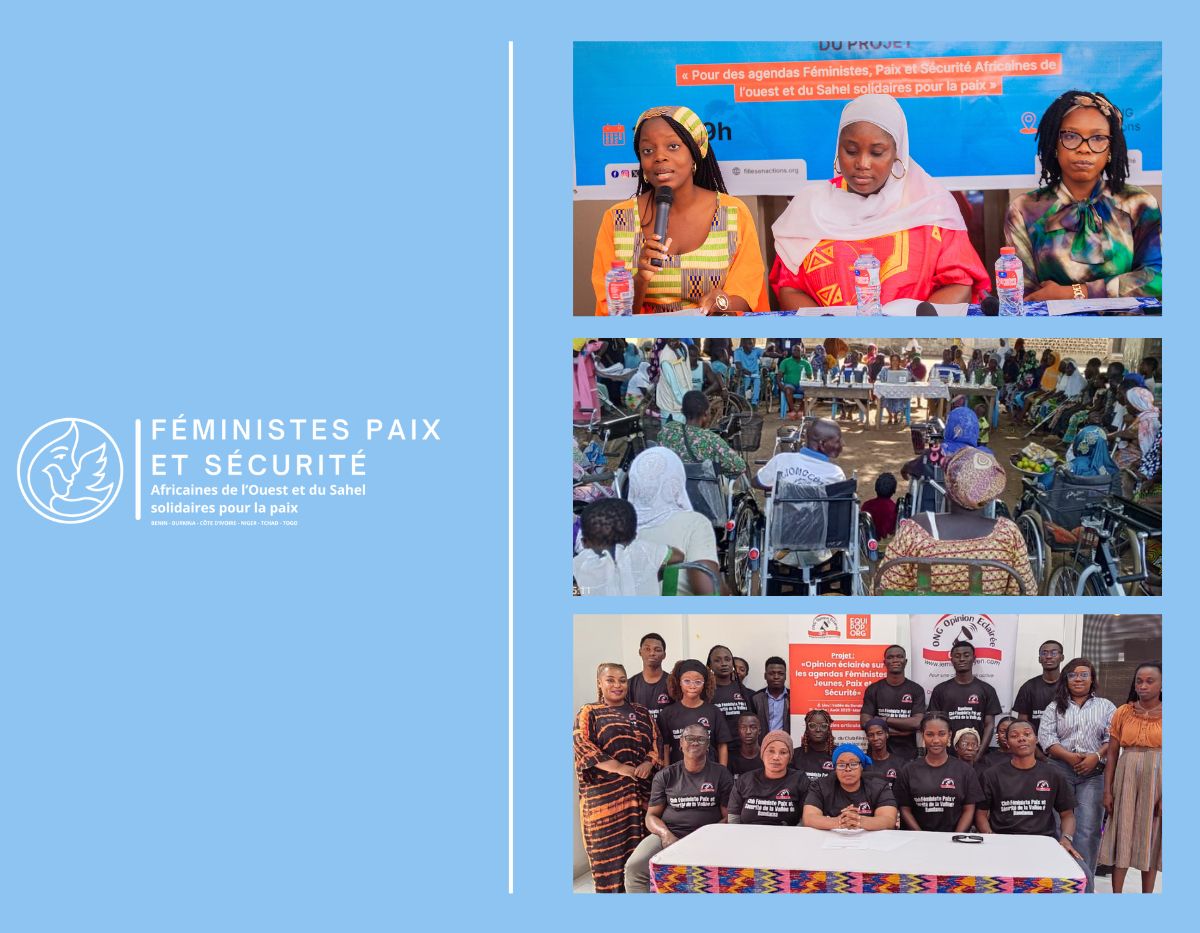
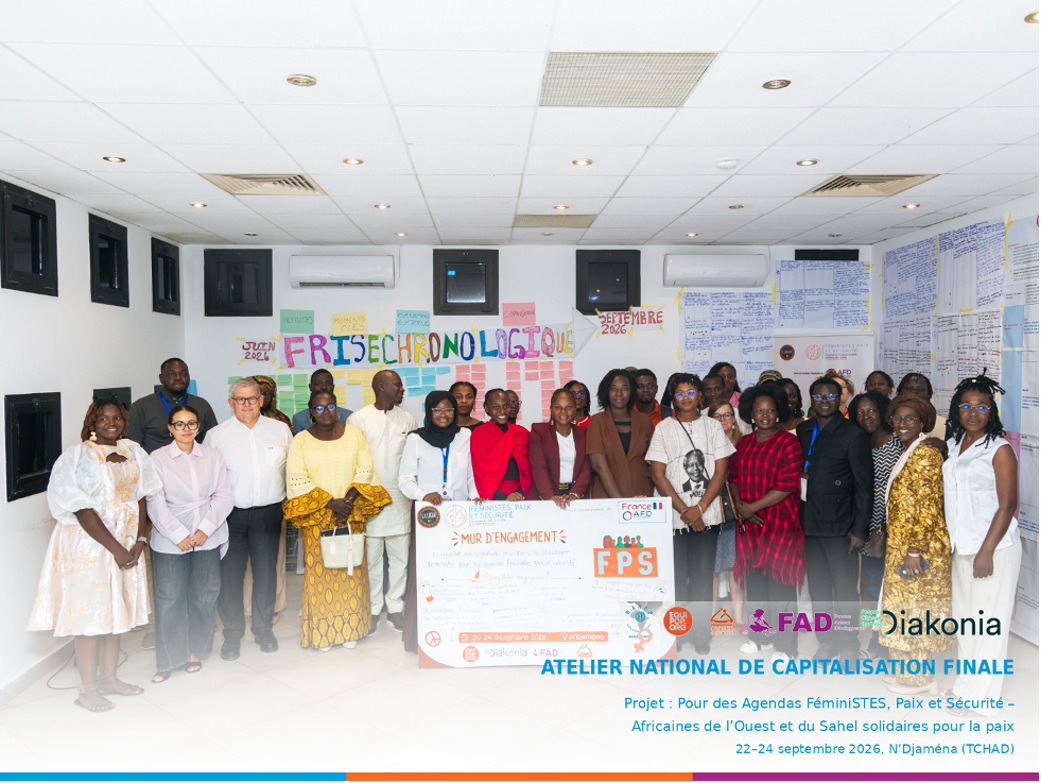
It is within this ecosystem that Equipop operates as an intermediary fund and feminist organization. Through the project "For feminist agendas, peace, and security," funded by the French Development Agency's Feminist Organizations Support Fund (FSOF), we are working in several countries in the region: Benin, Burkina Faso, Côte d'Ivoire, Chad, and Togo. Our goal is to support initiatives and amplify the voices of marginalized women and young women, particularly those who are rural, displaced, disabled, migrant, or living in areas with significant security challenges. Rather than simply inserting a few women into existing mechanisms, our approach is to go beyond traditional and non-transformative logic. We support partners in the field so that they can design, pilot, and evaluate their own actions in the areas of peace, security, social justice, and norm transformation, including through alliances.
The agency of the actors involved is not intended as a concept in this case, but rather as a practice. The organizations we support translate, reinvent, and reappropriate Resolution 1325 based on their own experiences, while valuing their endogenous knowledge.
Changing the way things are done: a feminist and community-based implementation of Resolution 1325
For more than twenty years, Resolution 1325 has been referenced and invoked in international, regional, and national policies. But its implementation remains too often technical, top-down, elitist, and far removed from the realities on the ground. It sometimes gives rise to disconnected institutional processes, where women are invited at the last minute, in an advisory or symbolic capacity, without any real decision-making power. Our stance is resolutely feminist, community-based, and decolonial. We reject extractive approaches, diagnoses made without the involvement of the women concerned, and programs designed remotely with a view to compliance.
Conversely, our approach values localized knowledge. Rather than speaking on behalf of others, we choose to redistribute resources and spaces to those who transform norms on a daily basis. Partners such as the Barika association in Benin, Salama Peace in Chad, the Young Women Leaders Committee in Niger, the Network of Women Peace Mediators in Côte d'Ivoire, the Association for the Promotion of Women in Gaoua in Burkina Faso, and the Women's Network for Development in Togo develop their own interpretations of conflict, security, violence, and peace based on their contexts, experiences, and struggles. As Amina Mama, one of the leading voices of African feminism, reminds us, "the greatest threat to women (and by extension to humanity) is the growth and acceptance of a militaristic, misogynistic, authoritarian, and violent culture." Peace is not the absence of war, but the presence of justice, a justice that cannot exist if the narratives, knowledge, and practices of African women remain peripheral to the very definition of what security is.
Towards a feminist, collective, and transformative peace
Violence against women and girls does not begin with war and does not end with peace. It is rooted in a patriarchal system that spans all periods and perpetuates deep gender inequalities. Several feminist analyses have highlighted the limitations of current approaches to peace and security agendas. They emphasize that the dominant frameworks remain marked by militarized and patriarchal logics, which reproduce power relations rather than transforming them. As long as these logics are not challenged, there can be no truly just and lasting peace.
We also seek to build bridges between the Women, Peace, and Security (WPS) and Youth, Peace, and Security (YPS) agendas. These two frameworks, although derived from complementary UN resolutions, still operate in silos. Young women, particularly those in rural areas or in precarious situations, are marginalized in both gender-related and youth-related spaces. By working on this WPS/YPS nexus, we are helping to open up spaces where their voices, priorities, and forms of organization can take their rightful place. This intersection also allows for a more nuanced approach to intersectional realities. Kimberlé Crenshaw, who conceptualized intersectionality, has long warned us about the consequences of political approaches that compartmentalize identities, particularly and above all those of Black women, and render certain lives invisible in public policy.
This intersection of FPS/JPS allows us to think differently: based on the realities experienced by young women in displacement camps, in areas under military control, in peripheral neighborhoods, or in contexts where social movements are criminalized. This is where a renewed vision of peace emerges: feminist, collective, transformative, seeking not to "include" women in an existing order, but to reach an agreement on a social order that is equitable at all levels.
Prospects for feminist and transformative peace
Peace is not limited to the end of armed conflict; it must be a process deeply rooted in the realities of the women and communities concerned. To this end, Resolution 1325 and the WPS agenda as a whole must be reappropriated locally, valuing the knowledge and strategies of women on the ground in truly decolonial approaches.
This undoubtedly requires appropriate financial support: funding must be flexible, accessible, and long-term to enable feminist organizations to act effectively, especially in contexts marked by crisis and instability.
Furthermore, the articulation between the Women, Peace, and Security and Youth, Peace, and Security agendas is essential to include the often marginalized experiences of young women, thereby enriching our very understanding of peace.
Ultimately, what we stand for is a clear vision: a feminist peace that is not content with the status quo, but that truly and sustainably transforms power relations. A peace built by women, including young women, with communities, and for social justice.
In the face of gender-based violence (GBV), feminist organizations are confronted daily with situations where the responses provided do not always succeed in removing the obstacles they encounter
This discussion on medical violence provided an opportunity to explore how feminist and decolonial approaches can transform healthcare practices and health policies. The challenge is to
From the increased participation of women and young people in decision-making bodies to the emergence of new spaces for feminist activism, including the strengthening of alliances to fight
To provide the best experiences, we use technologies such as cookies to store and/or access device information. Consenting to these technologies will allow us to process data such as browsing behavior or unique IDs on this site. Failure to consent or withdrawal of consent may adversely affect certain features and functions.
Functional
Always on
Storage or technical access is strictly necessary for the legitimate purpose of enabling the use of a specific service explicitly requested by the subscriber or user, or for the sole purpose of transmitting a communication over an electronic communications network.
Preferences
Storage or technical access is necessary for the legitimate purpose of storing preferences not requested by the subscriber or user.
Statistics
Storage or technical access used exclusively for statistical purposes.Storage or technical access that is used exclusively for anonymous statistical purposes. In the absence of a subpoena, voluntary compliance by your Internet service provider or additional third-party records, information stored or retrieved for this sole purpose generally cannot be used to identify you.
Marketing
Storage or technical access is necessary to create user profiles in order to send advertisements, or to track the user on a website or on several websites with similar marketing purposes.
Thanks to your support, Equipop can strengthen its efforts with grassroots organizations to defend the rights of women and minorities around the world.