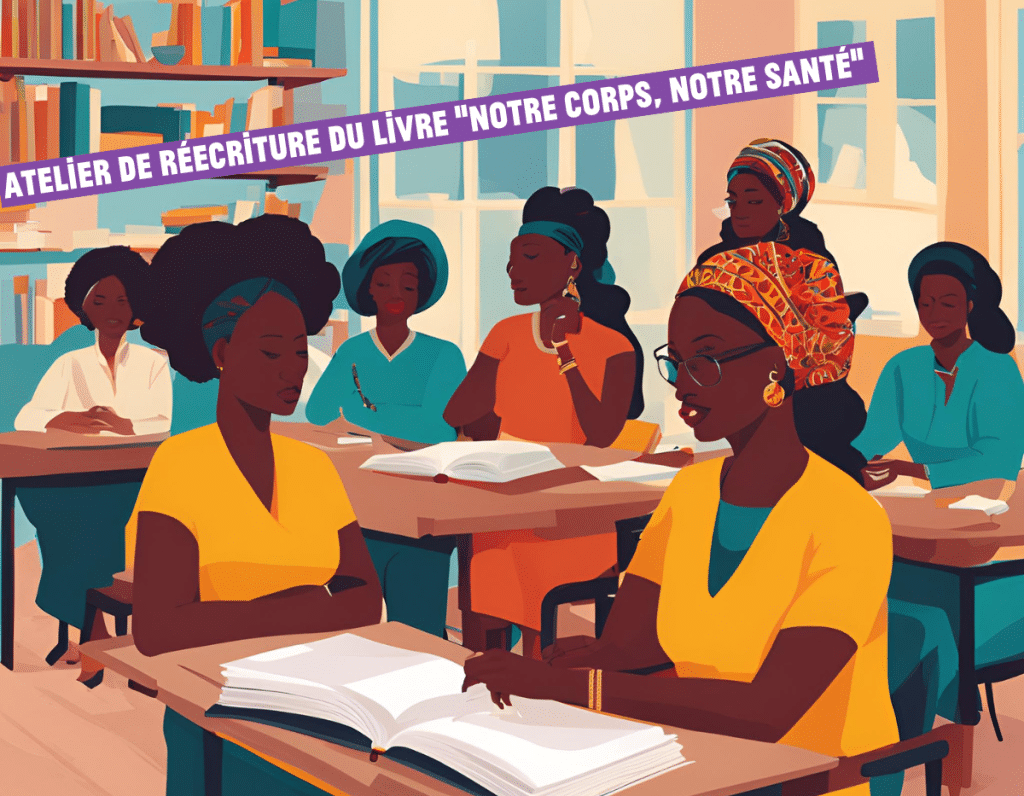
Co-published in 2004 by Fatou Sow, a Senegalese feminist sociologist and researcher on gender issues, particularly in Africa, and Codou Bop, a journalist, sociologist, researcher, feminist, and human rights activist, the book "Our Bodies, Our Health" has influenced generations of women in sub-Saharan Africa by offering a fresh perspective on their health and sexuality. Twenty years later, an intergenerational and diverse committee is rethinking this legacy to adapt it to today's challenges. Drawing on a diversity of voices and experiences, this project aims to advance knowledge and practices in women's sexual and reproductive health.
A collective project for a common cause
Born out of a desire to combat gynecological and obstetric violence, this reissue project aims to:
- Empowering women: by giving them the keys to understanding and accepting their bodies, making informed decisions, and defending their rights.
- Deconstructing norms: questioning social and cultural representations of the female body, which are often a source of taboos and violence.
- Creating a space for dialogue: promoting exchanges between women from all walks of life, for better mutual understanding and greater solidarity.
An intersectional and feminist approach
The committee's approach is resolutely intersectional and transnational, recognizing that women's experiences are shaped by the intersection of multiple social, health, economic, and cultural factors. While the body is, of course, a collection of biological elements, individuals' perceptions of it, how they use it, care for it, dress it, speak, walk, work, and think are the result of social constructs that depend on cultural, ideological, health, moral, and religious values and norms. It was therefore important to encourage women to reflect on this set of elements in order to better understand their relationship with their bodies, their sexuality, and their fertility. The committee members, who come from different African countries, draw inspiration from international feminist struggles while echoing messages from their own contexts. This approach helps to break down stereotypes and taboos related to sexual and reproductive health, while promoting local knowledge. Drawing on a diversity of voices and experiences, the committee aims to create a work that is both universal and deeply rooted in the realities of African women.
A book for everyone
This new edition of "Our Bodies, Ourselves" is intended for anyone who wants to better understand issues related to women's health and sexuality. It will be widely distributed in French-speaking Africa and beyond, with the aim of sparking debate and inspiring new action. This reissue follows in the footsteps of the historic feminist work "Our Bodies, Ourselves," published in 1973 in Boston. By adapting this concept to the African context, the co-editors have paved the way for women to gain a better understanding of themselves. Today, this collective of women is continuing this approach by offering a renewed and inclusive vision of women's health.