May 28 is World Menstrual Hygiene Day. An important occasion... but it's time to go further. Talking about "hygiene" means getting stuck in a sanitary, biomedical approach that often makes people feel guilty. What we are promoting through the Blood for Blood: United for Dignity*in nine countries in Africa, Asia, and the Caribbean is a change in narrative: putting dignity and human rights back at the heart of menstrual policies.
The challenge is clear: to enable all menstruating people to experience their periods without shame or violence, with the information, products, services, and spaces necessary to fully exercise their rights. Let's restore dignity to menstruation!
RULES UNDER CONTROL: HOW HYGIENISM PERPETUATES DOMINATION
The term "menstrual hygiene," widely used in public policy, awareness campaigns, and educational programs, has become the dominant framework for discussing menstruation. What does it say about the control that patriarchy exercises over the bodies, desires, and existence of women and marginalized people? How does it shape our representations of menstruation? And above all, how can we break free from it in order to overturn these logics of domination and escape a framework that perpetuates the taboo and stigmatization of menstruation? The framing of menstruation, inherited from a biomedical approach, reduces periods to a question of "cleanliness" and a health issue to be managed, obscuring their social, cultural, and political significance. It has fueled a socialization marked by shame and disgust for the body, particularly among adolescent girls. The link with patriarchy is very clear in this case: this control, often invisible but deeply rooted, manifests itself through norms, laws, silences, and violence that dictate what bodies can do, feel, or claim, without questioning the power relations that perpetuate stigmatization. In all geographical areas, the word "impurity," in its cultural translations and nuances, comes up strongly when it comes to menstruation. This idea cuts across contexts, language, symbols, and expected behaviors, revealing one constant: menstruation is marginalized, and those who experience it are often silenced or made invisible.
BETWEEN SILENCE, TABOOS, AND DISCRIMINATION
One statistic: 93% of menstruating people in the countries covered by the project reported having experienced at least one form of discrimination related to their periods. This figure is a wake-up call, a strong signal of the intensity and scope of the stigma to which menstruating people are subjected. It reveals the extent of the stigma and the glaring lack of control these people have over their own bodies and health. In some countries, restrictions go as far as prohibiting them from cooking, touching objects, or frequenting certain spaces. The lack of safe menstrual products and adequate infrastructure reinforces this exclusion and deprives them of control over their own well-being. In many contexts, menstruation is seen as dirty or shameful. This shame is internalized, but also imposed. What is natural becomes taboo, deemed undesirable, even forbidden. Thus, a biological and natural reality becomes a source of systemic discrimination. Activities such as going to school, participating in social events, or even interacting with men become forbidden acts. Restrictive social and religious norms further amplify this reality. As long as institutional responses remain focused solely on products, without addressing the root causes of stigma, nothing will change in any meaningful way. Yes, access to menstrual products is necessary, but it alone is not enough to erase the stigma surrounding menstruation. This failure of public policies and programs to adapt to the lived reality of menstruating people further exacerbates inequalities. And behind these figures and stories are lives marked by isolation, shame, and exclusion. It's time to talk about dignity. And for that, it all starts with words. Shall we talk about it?
OUT OF SHAME AND INTO DIGNITY
Restoring the perspective of human rights and dignity in the treatment of menstruation is the key alternative. Talking about "dignity" means recognizing the right of menstruating people to information, safety, health, freedom of speech, and respect for their bodies. It means saying loud and clear that menstruation is not a problem to be managed, but a human reality to be welcomed, understood, and integrated into public policy, social norms, and all areas of life. And we do not use the word "dignity" lightly. We view menstrual dignity as a state in which all people can menstruate without shame, fear, judgment, pain, discomfort, isolation, exclusion, discrimination, or violence; where they have access to information, resources, services, and support tailored to their needs so that they can live their lives without disruption or difficulty, whether or not they are menstruating; where they have control over their bodies; and where these conditions are respected for what they are, namely human rights. This demanding framework must guide public and activist action for menstrual justice. Because words are never neutral: they reflect and reinforce systems of domination. The dominant lexicon ("menstrual hygiene," "hygiene product," "sanitary napkin") perpetuates a view of menstruation as an embarrassment, a secret. Conversely, talking about menstrual dignity means shifting the focus, changing the narrative. It means politicizing an intimate experience that is too often reduced to a question of cleanliness. It means recognizing legitimate needs and responding to them without judgment. Changing vocabulary means changing perspectives. We no longer say "hygiene products" but "menstrual products." No longer "sanitary napkin" but "menstrual pad." No longer "hygiene management," but "dignified menstrual care." This semantic adjustment is not insignificant: it is a paradigm shift, one step closer to a society that respects people who menstruate.
It doesn't say menstrual hygiene products, but menstrual products!
Sanitary napkin? Let's say menstrual pad instead.
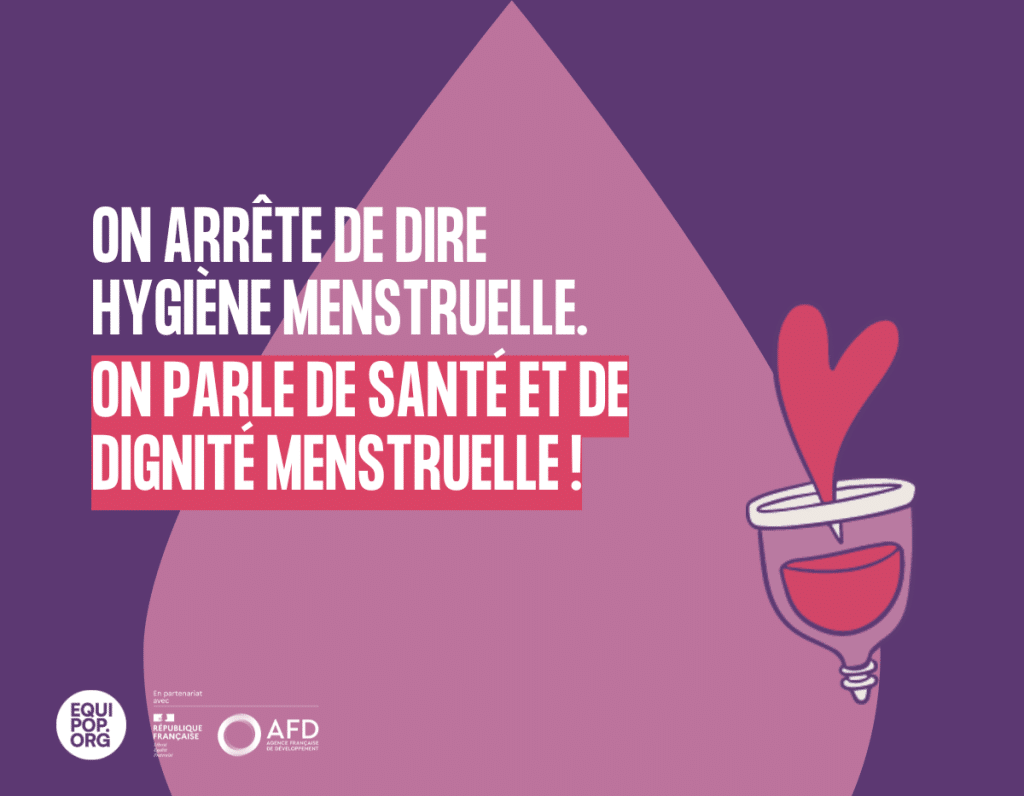
Menstrual hygiene... We're talking about menstrual health and dignity!
Menstrual health, yes, but menstrual health and dignity is better.
Menstrual hygiene management—no, we would rather talk about taking menstrual needs into account with dignity.
* The Blood for Blood: United for Dignity project is implemented by a consortium comprising Equipop, Fòs Feminista, Global South Coalition for Dignified Menstruation, and PSI-Europe. It is funded by AFD through an FSOF (Fund to Support Feminist Organizations). ** Blood Magic The Anthropology of Menstruation · by Thomas Buckley, Alma Gottlieb · June 1988 · First Edition · Paperback