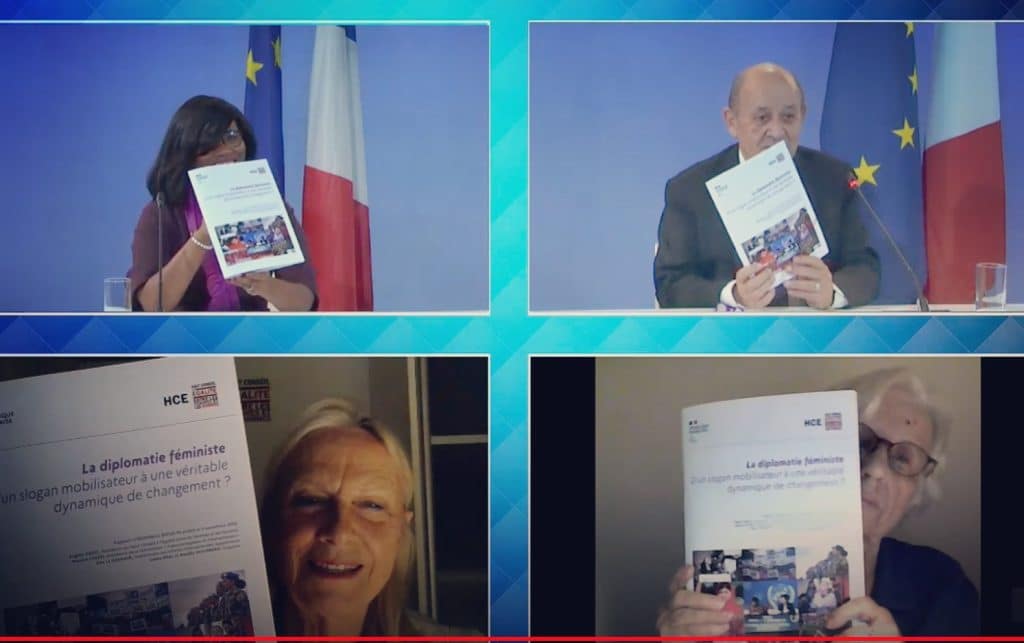
On November 18, the High Council for Equality submitted its report on "feminist diplomacy" to Jean-Yves Le Drian and Elisabeth Moreno. Equipop contributed to this document, which proposes courses of action for a truly transformative French foreign policy.
For the past fifteen years, Equipop has been monitoring France's international action on gender equality and contributing to the development of related policies and programs. The French government's first two strategies covered only development policy (the 2007 and 2013 "gender and development" strategies). The scope was then broadened in 2018 with the adoption of France's international strategy for gender equality. Although this document remains valid until 2022, the joint statement published on March 8, 2019, by the Minister for Europe and Foreign Affairs, Jean-Yves Le Drian, and Marlène Schiappa, Secretary of State for Gender Equality, changed the game. Through the voices of these two ministers, France proclaimed that it was pursuing a "feminist diplomacy" approach, in a prescriptive manner, since the strategic framework and corresponding analytical tools did not exist.
Building a shared vision of feminist foreign policies
A year and a half later, the High Council for Equality published a 60-page report entitled "Feminist diplomacy: from a rallying slogan to a real force for change?" The report assesses the extent to which, over this relatively short period in terms of public policy, French foreign policy has been driven by a feminist approach. Equipop participated as a member of the "European and international issues" commission, which over the course of several months defined the focus of this work and conducted numerous hearings with representatives from the various institutions concerned.
To contribute to the analysis underlying this report, and to all future work on this issue, Equipop relies on a positioning that aims to connect different actors and institutions. For example, it is interesting to consider the concrete impact of French foreign policy through the eyes of young feminists in West Africa, or American or Swedish associations interested in UN or international processes such as the G7. The feminist approach to foreign policy is a very new field. Sweden theorized it only a few years ago, followed by Canada and France. While we have undoubtedly moved beyond the stage of clearing the ground in this area, there is still work to be done, both at the national level and in terms of building a common international understanding of the issues at stake.
Four levers to activate simultaneously
For this reason, at the French level, the HCE goes beyond simply assessing progress made and limitations observed, and proposes four major areas of focus to embed the feminist approach in French foreign policy.
Firstly, foreign policy must adopt a "transformative" approach, embedded in all its dimensions (political, but also defense, trade, etc.), and embraced by the representatives of the institutions concerned.
Secondly, the feminist approach must be central to the establishment of foreign policy. The HCE proposes, in very concrete terms, the establishment of an interministerial roadmap, a coordinating body under the authority of the President of the Republic or the Prime Minister, and an accountability mechanism.
Thirdly, a feminist foreign policy cannot be achieved without significant, sustainable, and transparent financial resources. Finally, this feminist approach can only be envisaged if parity is achieved in decision-making positions and if French support for feminist associations and the actions of activists increases.
Political support and implementation at all levels
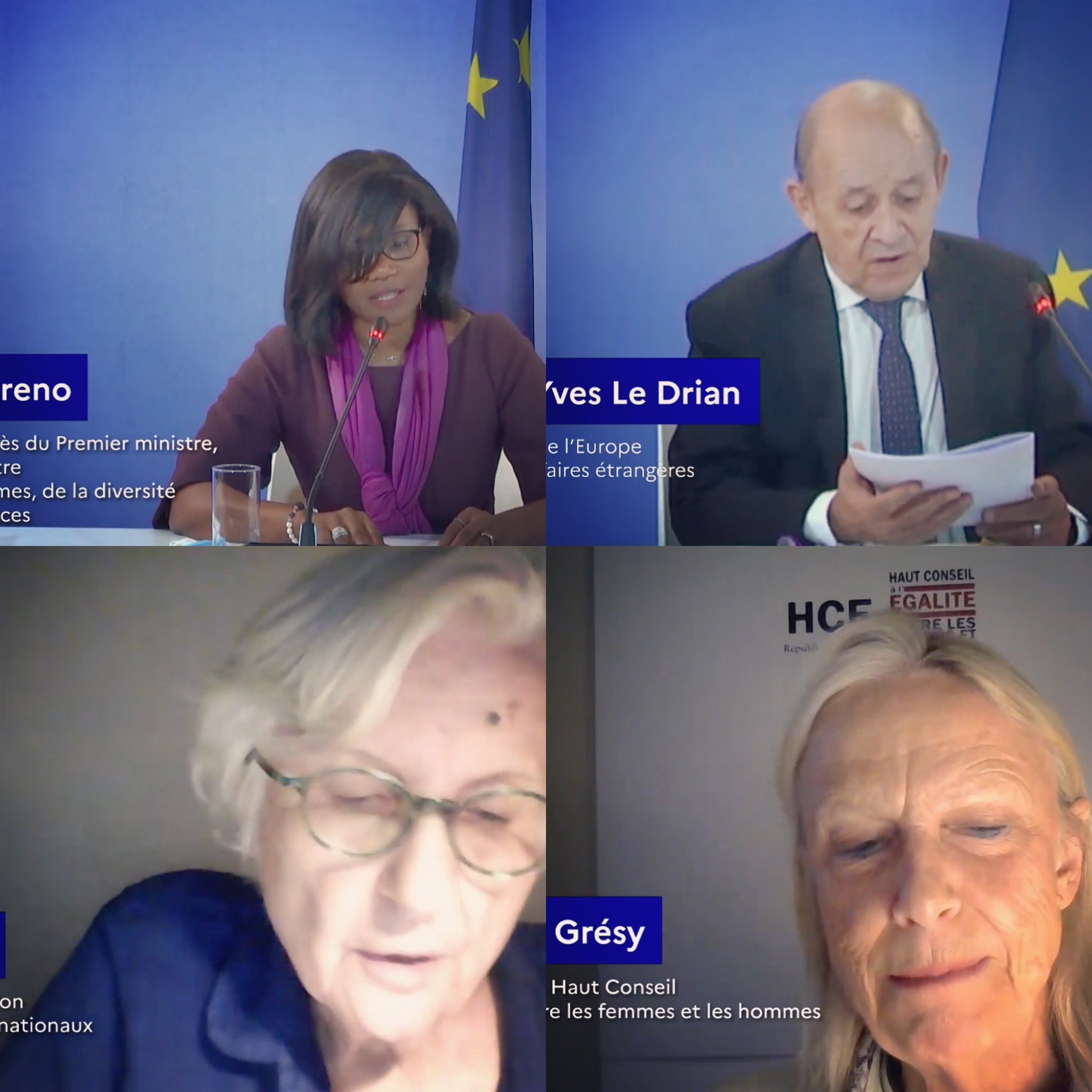
On November 18, the report was presented by Brigitte Grésy, President of the HCE, and Martine Storti, Chair of the European and International Issues Committee, to Jean-Yves Le Drian and Elisabeth Moreno, Minister Delegate to the Prime Minister responsible for Gender Equality, Diversity, and Equal Opportunities.
It was important for this report to be received at the ministerial level. Without strong political backing, the suggested guidelines, which involve a real challenge to mechanisms deeply rooted in practice, will not be able to be implemented. However, Jean-Yves Le Drian has set out a very clear line: feminist diplomacy is a "powerful factor for change" and even, in a way, "the future of our diplomacy." He thanked the HCE for recognizing the progress made and assured that the 19 recommendations would be "examined very carefully in order to implement them."
While it was probably too early to discuss the possible creation of a coordinating body under the authority of the President of the Republic or the Prime Minister, the minister emphasized three points: first, the bilateral aspect of feminist diplomacy, i.e., raising the issue of women's rights in all exchanges with foreign states, "would benefit from being systematized," an issue that "the posts take very seriously." Second, the increase in gender-related ODA (Official Development Assistance) must continue. Finally, and most importantly, all ministries and public operators involved in international activities must "ensure that they integrate" this approach. This is indeed the key to moving forward and ensuring that "feminist diplomacy" soon becomes more than just a rallying slogan. In the coming months, Equipop will continue to monitor the commitments made at the political level and propose ways of operationalizing them to technical officials, through the promotion of this HCE report, but also more broadly in the context of the Generation Equality Forum, which will be held in Paris in June 2021.