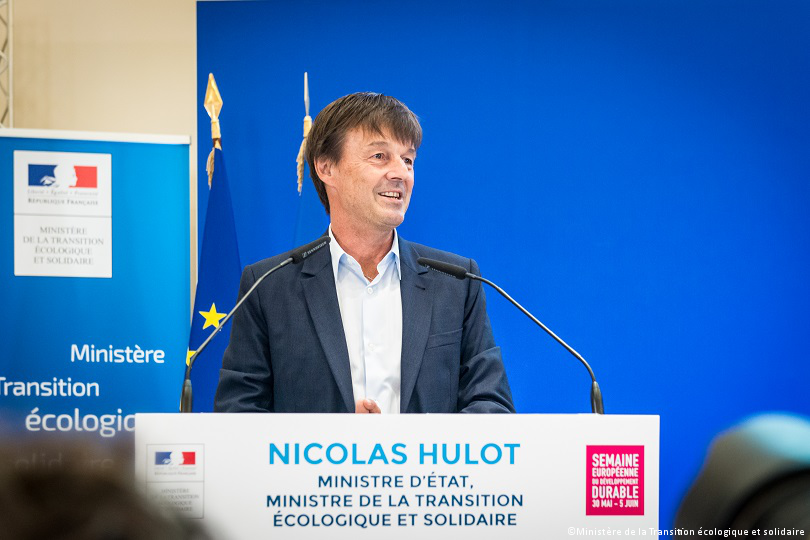
Appointed on May 17, Nicolas Hulot presented a broad roadmap for his ministry during European Sustainable Development Week (ESDW). Present at this event, Equipop noted that the level of commitment varied greatly depending on the topic. The new minister must not limit himself to acting on environmental issues, which certainly correspond to his background. The vision of sustainable development must be broadened to include its social dimension.
On May 29, 2017, the launch event for European Sustainable Development Week was held at the new Ministry for Ecological and Solidarity Transition. Every year, the ministry issues a call for projects and receives thousands of applications and initiatives related to sustainable development. In France, the event has been running for fifteen years and last year enabled 1,500 projects to see the light of day, with the support of the European Union.
Sustainable development, presented solely through its ecological dimension
For the 2017 edition, the UN's 2030 Agenda and, more specifically, the 17 Sustainable Development Goals (SDGs) are in the spotlight. In his first speech since taking office, Nicolas Hulot expressed his desire for his government and his ministry to play a leading role in bringing the country into the era of sustainable development. He mentioned the necessary solidarity that "man" would have to show towards future generations. This vocabulary, perhaps simply clumsy, is nevertheless revealing of the rather restrictive vision of development that shines through in the minister's speech as a whole. Firstly, the contribution of women to sustainable development, including the fight against climate change, and the leverage effect of the gender approach, were not mentioned by the minister. In the subsequent speeches by actors from the public and private sectors, these fundamental factors were only mentioned very discreetly, with the notable exception of the Director of Sustainable Development at Suez.
High expectations regarding the social dimension of development
Gender equality and the "gender and development" approach were not the only issues overlooked in these speeches. More broadly, the SDGs on health, education, inequality, and decent work were either ignored or barely mentioned.
This erosion of the social dimension of development is not solely due to the division of responsibilities between Nicolas Hulot's ministry and, for example, the Ministry of Europe and Foreign Affairs (a division that has yet to be officially clarified). It has deeper causes, rooted in collective perceptions. Admittedly, the younger generations have never known a time when the term "sustainable development" did not exist. It is now taught in schools, the field of Corporate Social Responsibility (CSR) is present in most large groups and companies, and the César award given to the film Demain proves that the subject is of interest to the general public. But for many, "sustainable development" is still synonymous with electric cars, compost, and energy-saving light bulbs.
Beyond this initial event, Equipop will therefore work to promote social development issues so that they are integrated into the actions of Edouard Philippe's government. In the longer term, we will continue to raise awareness of the "gender and development" approach, which is both a matter of respect for fundamental rights and a tremendous opportunity to accelerate development.