A vast body of research now shows that high-quality sex education has a very positive long-term impact on the lives of young girls and boys.
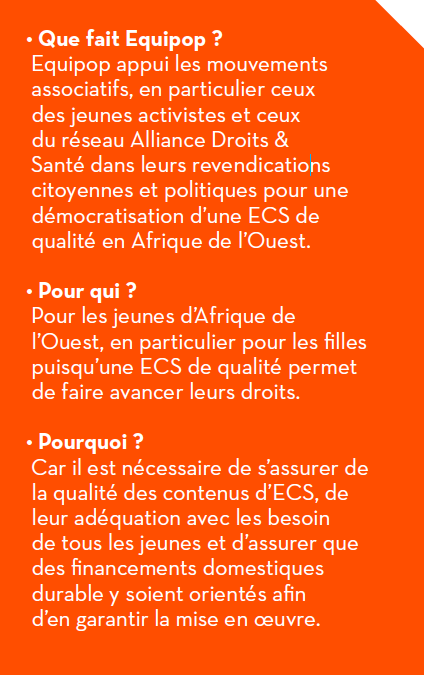
Equipop has been working for several years alongside numerous partners in West Africa to promote comprehensive sexuality education (CSE) and, in particular, its systematic integration into school curricula. In 2019, Equipop provided specific support to the 21 associations in the Alliance Droits et Santé network in their political and civic advocacy efforts.
ECS: AN APPROACH WITH MANY BENEFITS THAT IS DIFFICULT TO IMPLEMENT
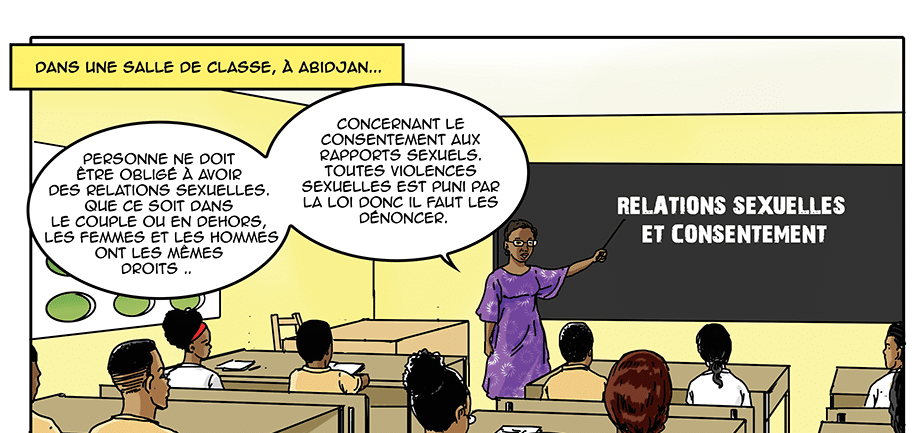
Too many young people lack reliable information about romantic relationships and sexuality. Many are aware of this gap and are calling on political and educational leaders to commit to providing them with structured learning about sexuality and interpersonal relationships in a positive, clear, and interest-focused manner. These demands are supported by research findings that show that sexuality education has many positive effects on young people's health and well-being, including delaying the age of first sexual intercourse, reducing the number of partners, reducing risky behaviors, and promoting condom and contraceptive use. Other studies also provide evidence that sexuality education contributes to reducing gender-based violence, intimate partner violence, and discrimination, and to strengthening gender equality, self-confidence, and quality interpersonal relationships.
Despite this evidence, few countries in West Africa have truly implemented the International Guidelines on Sexuality Education, which were first published in 2009. Some countries have initiated interesting developments, such as Benin, where since 2019, ECS has been officially integrated at all school levels (from kindergarten to university) and in initial teacher training schools. This rapid integration has been facilitated by strong political will, marked by the state's rapid institutional appropriation of the process through the National Institute for Training and Capacity Building of Trainers (INIFRCF). In Burkina Faso, too, after a trial phase in 2013, ECS content is being gradually integrated (between 2015 and 2020) into all preschool, primary, post-primary, and initial teacher training school curricula. However, for meaningful change to take place, it is essential that coalitions of actors continue to push this issue with governments and ensure that they fully integrate the voices of young people and research findings, so that policies and programs are of high quality and achieve their objectives.
THE OBJECTIVE OF THE RIGHTS AND HEALTH ALLIANCE: TO MOBILIZE YOUTH AND COMMUNITIES AND SECURE SUSTAINABLE POLITICAL COMMITMENTS
In 2019, with technical support from Equipop, the 21 associations of Alliance Droits et Santé joined forces to call on governments and mobilize young people and communities in the six countries of the network (Benin, Burkina Faso, Côte d'Ivoire, Mali, Niger, and Senegal). The Alliance is calling for a strong commitment from the health and education authorities of the member countries of the Ouagadougou Partnership and is part of the regional campaign initiated by UNESCO and UNFPA. It is focusing its dialogue with decision-makers on three demands:
Mobilize
• Ensure a quality approach by ensuring continuity between the demand created by ECS and the sexual and reproductive health and rights services provided by the government.
• Take into account the needs of all adolescents and young people, especially young girls, in terms of SRH and sexual and reproductive health and rights services, regardless of their age, gender, location, or whether they are in school or not.
• Ensure sustainable domestic funding for SRH programs and services, and maintain them even in times of crisis.
At the same time, to support the network's advocacy efforts, members have developed a multi-channel communication campaign called #JeVeuxSavoir (I Want to Know). This campaign aims to create the conditions for civic and political dialogue on the need for young people to know their rights and have access to quality sexual and reproductive health education and services. It seeks to relay the voices of young people and deconstruct misconceptions through social media, the media, and meetings and events in each of the Alliance's member countries. The various content created with Alliance partners aims to highlight the positive impact that comprehensive sexuality education programs have on the lives of young people and adolescents. Even more so after the Covid-19 health crisis, it is clear that these programs need to be strengthened in each country in terms of content, pedagogical approach, and accessibility.
#IWANTTOKNOW: ART TO BREAK TABOOS
Art conveys messages, proposes ideas, and encourages reflection. When propriety or modesty are dangerous—because they deprive young people, girls and boys, of crucial information about their sexual rights and health—art makes it possible to address topics that are otherwise silenced. As part of the #JeVeuxSavoir campaign, around 20 volunteer artists were trained to deconstruct preconceived ideas and break down taboos surrounding comprehensive sexuality education. Sensitive and often already committed to human rights, they took up the challenge of creating works aimed at educating, denouncing, opening debate, sharing, and encouraging young people, their parents, and more broadly every member of society to reflect. Many topics are addressed—from contraception to early pregnancy, sexual consent, menstruation, and puberty—through music, graphic arts, humor, and poetry. With #JeVeuxSavoir, the fight for young people's right to know is taking place at all levels of society!